A Stellar Breakthrough in Visual Creativity: 🌌 Alibaba’s Qwen team launched Qwen-Image-Edit on August 18, 2025, a 20B parameter open-source model revolutionizing the $10B digital imaging market. With pixel-perfect edits, style transformations, and bilingual text capabilities, it outshines rivals like Seedream and FLUX.1, per Alibaba’s benchmarks. Let’s blast off into this cosmic innovation and its orbit-shifting potential!
Dual-Track Editing Power
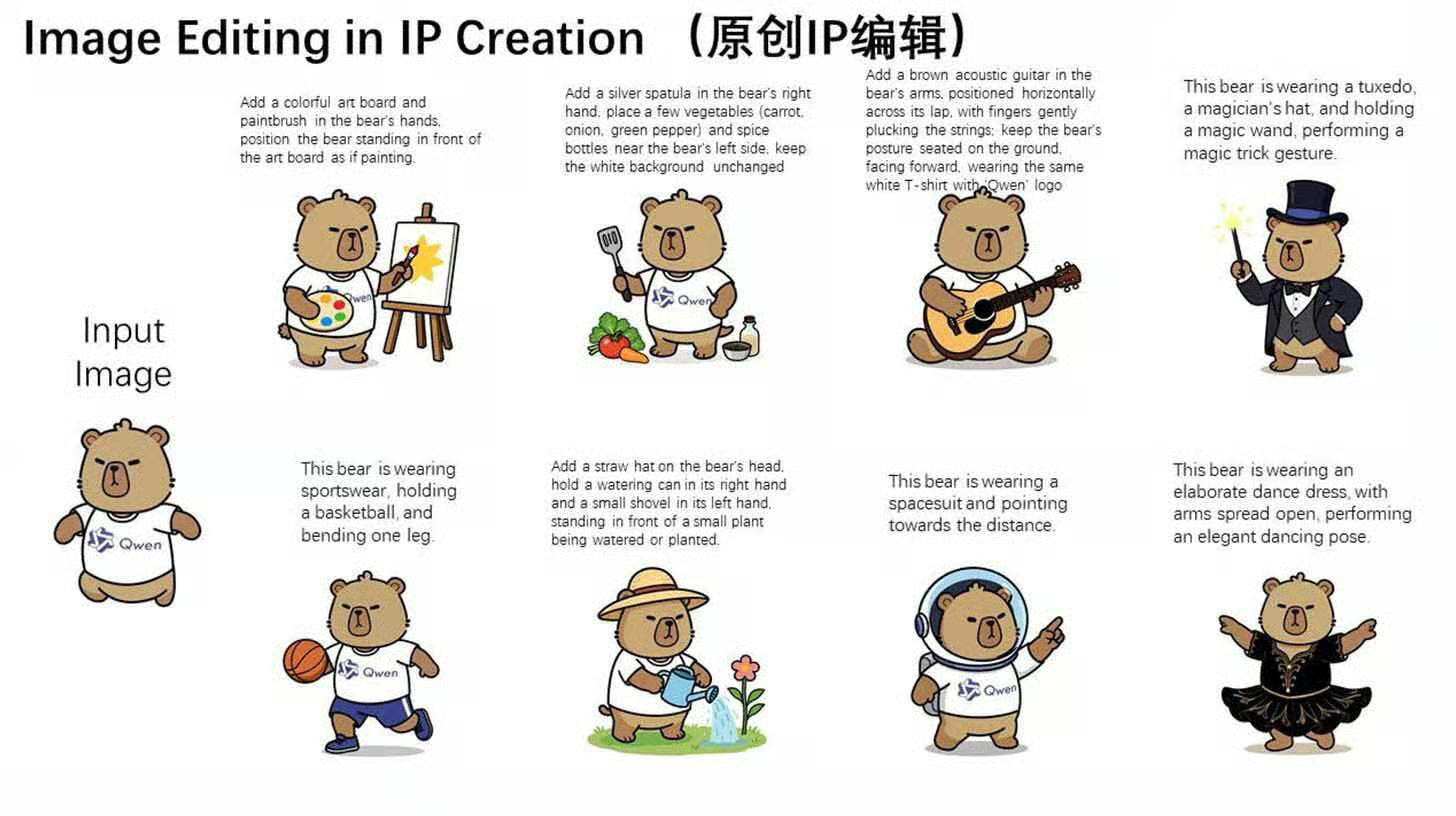
Qwen-Image-Edit splits tasks into semantic edits (e.g., object rotation, Studio Ghibli-style transfers) and appearance edits (e.g., adding signs or removing elements while preserving the rest), per Metaverse Post. Its dual-path system uses Qwen2.5-VL for semantic control and a VAE Encoder for visual fidelity, enabling precise, multi-step edits without restarting, per Qwenimageedit.pics. For instance, it can rotate a capybara mascot 180° or generate MBTI-themed emoji packs while maintaining character consistency, per Alibaba’s demos.
Bilingual Text Mastery
The model excels at editing Chinese and English text within images, preserving font, size, and style, per The Decoder. Unlike overlay-based systems, it integrates text seamlessly, achieving >90% OCR accuracy across languages like Korean and Japanese, per QWQ AI. This makes it ideal for multilingual posters or UI mockups. Available via Qwen Chat, Hugging Face, and ModelScope under Apache 2.0, it’s commercially friendly, per DEV Community.
Why This Matters in the AI Cosmos
Qwen-Image-Edit’s state-of-the-art performance on GenEval, GEdit, and LongText-Bench, surpassing GPT Image and FLUX.1, signals a shift toward granular AI editing, per Alibaba’s Qwen X post. The $2B image editing software market could see disruption, with applications in marketing, e-commerce, and IP creation, per PixelDojo. However, its 40GB VRAM requirement for bf16 limits local deployment, per GitHub. X users like @MohamedTrfhgx celebrate its open-source power, but @SciSkeptic notes scaling to complex edits needs testing.
The Next Frontier
Will Qwen-Image-Edit redefine creative workflows, or will hardware demands and competition slow its orbit? UrviumAI tracks this starry voyage.
🌠 Join the Cosmic Journey! Subscribe to our newsletter for the latest AI updates.
Read more about “HTC’s Vive Eagle AI Glasses: A Cosmic Shot at Meta’s Throne“

Jigar Chaudhary is the Editor-in-Chief at UrviumAI, where he oversees coverage of artificial intelligence news, tools, and in-depth studies. With over 5 years of experience analyzing AI and robotics, he focuses on maintaining high editorial standards, accurate reporting, and clear explanations to help readers understand how AI is shaping the future.