
Anthropic Takes the U.S. Government to Court ⚖️

Silicon Valley is taking the Pentagon to court. In an unprecedented escalation, Anthropic has fired back against the Trump administration and the Department of Defense, filing two federal lawsuits to block the government’s aggressive crackdown on its Claude AI model.
Here is the breakdown of the historic legal battle:
- The Lawsuits: Anthropic is asking federal judges to throw out the Pentagon’s “supply chain risk” label and block a White House directive that forces all federal agencies and defense contractors to cut ties with the company.
- The Argument: Anthropic claims the government is illegally weaponizing the ‘supply chain risk’ designation—a tool designed to counter foreign adversaries like China—to punish a domestic American company over policy disagreements.
- First Amendment: The core of the lawsuit argues that the Pentagon violated Anthropic’s free speech rights by retaliating against the company for publicly advocating for AI safety limits, specifically its refusal to allow AI for mass surveillance and autonomous weapons.
- Industry Backing: Proving that the broader tech industry sees this as a dangerous precedent, over 30 staffers from rivals like OpenAI and Google signed a legal brief supporting Anthropic, warning that government blacklisting threatens US AI leadership.
Why it matters: This is the most consequential legal battle in the history of artificial intelligence. It will definitely answer whether the US government has the legal authority to force private AI labs to build weapons against their will, or if corporations have the constitutional right to set ethical boundaries on the technologies they invent.
UrviumAI Take: This is a defining moment for corporate sovereignty. Watch the stock prices of major defense contractors like Palantir and Lockheed Martin. If Anthropic wins an injunction, the military supply chain gets to keep using Claude. If Anthropic loses, defense contractors will be forced to undergo massive, expensive software migrations to replace Claude with unrestricted models like Grok.
Anthropic Rolls Out Code Review for Claude Code 💻
Your next code review is being handled by a team of AI agents. Anthropic has officially rolled out Code Review for Claude Code, introducing a rigorous, multi-agent system designed to catch the subtle software bugs that exhausted human reviewers routinely miss.
Here is how Anthropic is fixing the PR bottleneck:
- The Problem: AI tools have dramatically increased how fast developers write code (output per Anthropic engineer is up 200%), but human reviewers can’t keep up. PRs are getting “skimmed” instead of deeply analyzed, leading to production bugs.
- The Solution: When a developer opens a Pull Request, Code Review dispatches a team of autonomous AI agents. These agents work in parallel to read the code, verify potential bugs to filter out false positives, and rank the issues by severity.
- Depth over Speed: Unlike lightweight linters, this system is built for depth. It leaves a high-signal overview comment and specific in-line critiques. In testing, it caught a one-line change that would have silently broken authentication—something a human easily read past.
- Cost & Control: Available now in research preview for Team and Enterprise accounts, the reviews cost around $15–$25 per PR. Admins can set monthly spend caps and restrict the tool to specific repositories.
Why it matters: We are entering the era of “AI checking AI.” If an AI coding assistant writes the initial code, a human doesn’t have the time or context window to review it properly. By deploying a specialized team of AI reviewers to audit the work, Anthropic is building the automated QA layer required for the future of self-driving codebases.
Microsoft Launches Claude-Powered Copilot Cowork 🤝
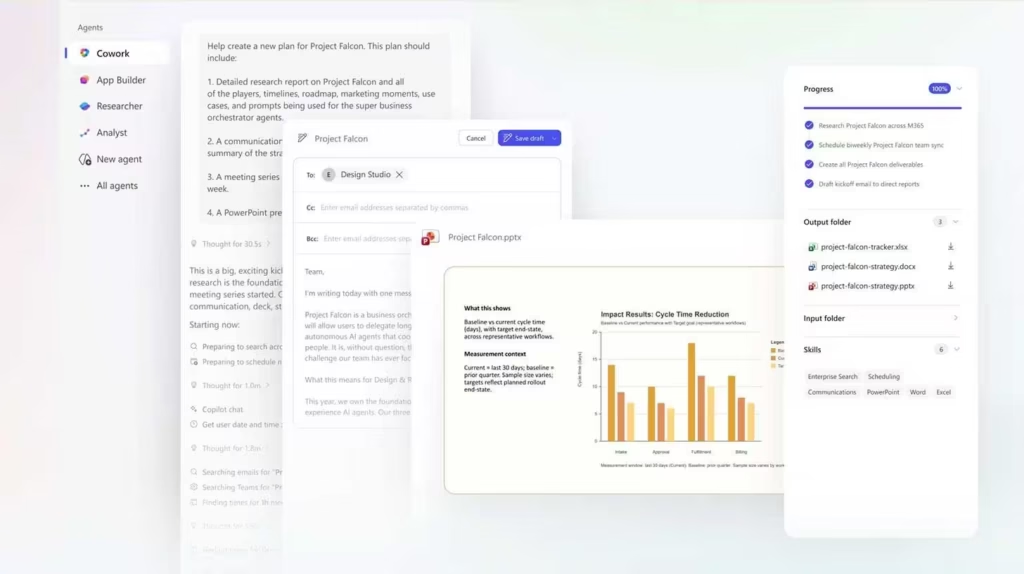
If you can’t beat them, integrate them. In a massive plot twist in the enterprise agent wars, Microsoft has introduced Copilot Cowork, a powerful new feature for Microsoft 365 that is built entirely on the back of Anthropic’s Claude system.
Here is the breakdown of the blockbuster partnership:
- The Integration: Copilot Cowork operates directly in the Microsoft cloud, allowing users to describe an outcome (e.g., “Prepare me for the Q3 board meeting”). The AI breaks the task into steps, pulls context from emails, Teams chats, and OneDrive files, and autonomously builds deliverables like pitch decks and workbooks.
- The Anthropic Engine: Microsoft built Cowork with Anthropic. It utilizes the exact same agentic technology that spooked SaaS investors when Anthropic launched its own desktop-only “Claude Cowork” preview weeks ago.
- The Enterprise Wrapper: While Claude Cowork operates locally, Copilot Cowork wraps Anthropic’s intelligence tightly inside Microsoft 365’s rigorous enterprise security, compliance, and data-governance boundaries.
- The Price: This high-end automation isn’t cheap. Copilot Cowork is launching as part of a new $99/user per month E7 tier, which bundles the agent with advanced management and security tools.
Why it matters: This is a masterstroke by Microsoft. Anthropic’s Claude is widely considered the best reasoning agent on the market, but large enterprises hesitate to give a desktop app access to secure files. By absorbing Anthropic’s tech into the trusted M365 ecosystem, Microsoft neutralizes a major competitor while offering its 450 million users the absolute state-of-the-art in workflow automation.
Last AI News: Google’s Nano Banana 2, OpenAI Poaches Meta Exec, & Anthropic Defies Pentagon
Other AI News Today:
- The sixth edition of the a16z Consumer AI Top 100 report reveals ChatGPT’s continued dominance with 900M users, alongside massive growth from rivals Claude and Gemini.
- OpenAI acquired AI security and red-teaming platform Promptfoo, integrating its technology into the Frontier enterprise platform to provide native testing for autonomous agents.
- AI pioneer Andrew Ng released Context Hub (chub), a free tool that feeds current, curated API documentation directly to coding agents to prevent hallucinations and broken code.
- Anthropic launched the Claude Marketplace, allowing enterprise customers to use their existing financial commitments to purchase third-party Claude-powered tools like GitLab and Harvey.
- The open-source AI agent framework OpenClaw has sparked a massive, mainstream craze in China, drawing crowds of retirees and developers to public installation events in Shenzhen.

Jigar Chaudhary is the Editor-in-Chief at UrviumAI, where he oversees coverage of artificial intelligence news, tools, and in-depth studies. With over 5 years of experience analyzing AI and robotics, he focuses on maintaining high editorial standards, accurate reporting, and clear explanations to help readers understand how AI is shaping the future.
Pingback: Meta Acquires Moltbook, Nvidia's NemoClaw, & Thinking Machines' 1GW Deal