
Figma Opens Design Canvas to AI Coding Agents 🎨
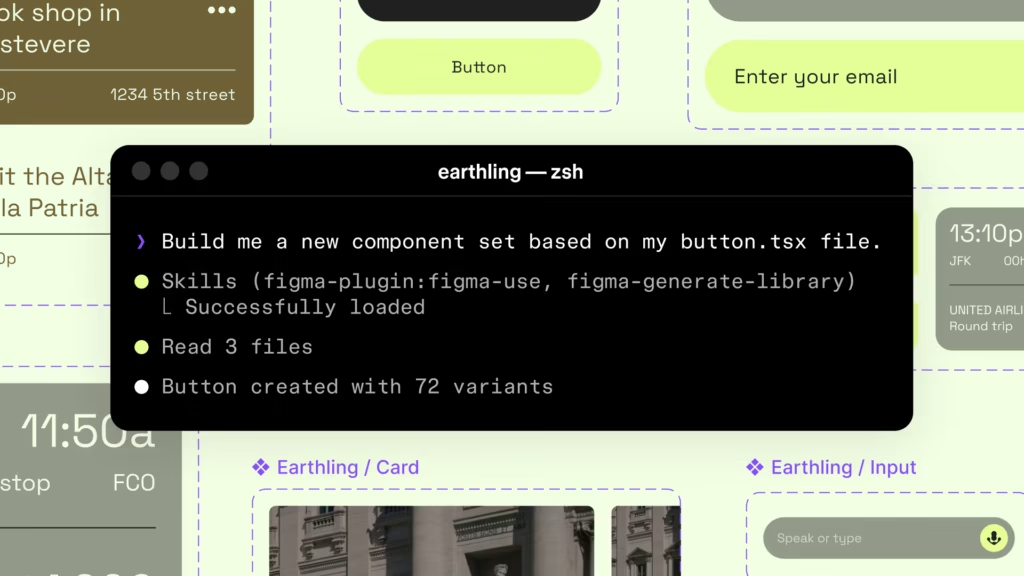
The boundary between design and development is rapidly disappearing. Figma has officially opened its design canvas to AI coding agents, allowing tools like Claude Code and Codex to read and write designs natively using the Model Context Protocol (MCP).
Here is how the new agentic integration works:
- Direct Canvas Access: Agents can now generate and modify design assets directly on the Figma canvas, utilizing a team’s established design systems, components, and variables.
- The Integration: Powered by Figma’s MCP server and the new
use_figmatool, developers can guide agents with markdown-based “skills” to follow specific brand standards and intentions. - Fluid Workflows: If a coded UI falls out of sync, developers can use the
generate_figma_designtool to pull the live app back into Figma as editable layers, refine it with AI, and push the code back out. - The Beta: The feature is currently available for free during its beta period and works seamlessly across major MCP clients, turning Figma into a central hub for agentic development.
Why it matters: AI-generated UI used to feel generic because it lacked brand context. By granting coding agents direct access to Figma’s rich design systems, companies can now auto-generate production-ready code and interfaces that perfectly match their proprietary brand standards, bridging the eternal gap between designers and developers.
UrviumAI Take: The era of manual design handoffs is over. If you manage a product team, mandate that your designers perfectly structure their Figma variables and component libraries. AI agents are only as good as the context they are given; a messy Figma file will lead to messy AI code, but a well-structured design system will let your developers build perfectly branded features in seconds.
Roche Launches Massive AI Factory with 3,500 Nvidia GPUs 💊

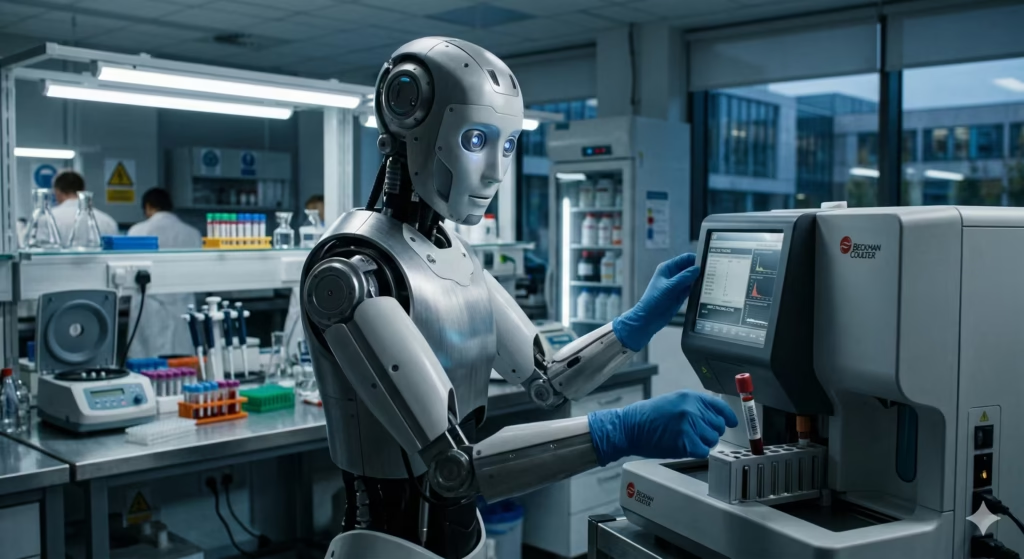
Artificial intelligence is fundamentally accelerating the timeline for life-saving medicine. Pharmaceutical giant Roche has launched a massive new “AI factory” designed to speed up drug discovery and manufacturing.
Here is how Roche is supercharging its computing power:
- Massive Infrastructure: Roche has expanded its computing capacity by purchasing 2,176 cutting-edge Nvidia Blackwell GPUs, bringing its total footprint to over 3,500 GPUs.
- Industry Leader: The company claims this $65+ million investment represents the largest announced GPU footprint available to any pharmaceutical company in the world.
- The Implementation: The AI factory is being embedded across Roche’s entire value chain, supporting Genentech’s “Lab-in-the-Loop” strategy to design specialized oncology molecules up to 25% faster.
- Digital Twins: Beyond drug discovery, Roche is using Nvidia Omniverse to build digital twins of its production facilities, optimizing manufacturing processes for treatments like GLP-1s before construction.
Why it matters: Developing a new drug traditionally costs $1 billion and takes a decade. By aggressively scaling its in-house compute with thousands of Nvidia Blackwell chips, Roche is proving that the pharmaceutical industry views AI not as a side project, but as the foundational engine required to survive the next generation of precision medicine.
UrviumAI Take: Compute power is the new competitive moat in healthcare. Do not view AI as just software; view it as heavy industrial infrastructure. Roche isn’t just renting cloud space; they are building massive physical GPU factories to secure their competitive advantage. If your enterprise is serious about AI, you must treat compute acquisition as a core capital expenditure, not just an IT subscription.
OpenAI Foundation Pledges $1B for Global AI Initiatives 💰
The company behind ChatGPT is deploying its massive capital to shape the global impact of artificial intelligence. The OpenAI Foundation, the nonprofit arm of the AI giant, has officially pledged to invest $1 billion over the next year across several critical humanitarian sectors.
Here is how the Foundation plans to distribute the massive funding:
- Life Sciences: A major pillar is “Life Sciences & Curing Diseases,” focusing on using AI to map Alzheimer’s pathways, unlock public health data, and accelerate treatments for high-mortality diseases.
- Economic Impact: The fund will deploy resources to address job displacement and economic disruption caused by rapid AI automation.
- AI Resilience: A newly announced division focusing on AI model safety, biosecurity, and protecting children and youth from negative AI impacts.
- New Leadership: OpenAI co-founder Wojciech Zaremba has been tapped to lead the AI Resilience division, joining other new hires tasked with scaling the Foundation’s philanthropic operations.
Why it matters: As OpenAI transitions into a highly valued, for-profit enterprise software giant, it is facing intense public and regulatory scrutiny regarding the societal damage its tools might cause. By deploying $1 billion into healthcare and job resilience through its nonprofit arm, OpenAI is attempting to prove that its ultimate mission remains benefiting “all of humanity,” while simultaneously funding the safety research necessary to prevent regulatory crackdowns.
UrviumAI Take: Philanthropy is the new public relations for frontier AI labs. Pay attention to where OpenAI is putting its non-profit money, specifically “AI Resilience” and “Biosecurity.” These investments act as a massive signal to the market indicating exactly which existential risks the creators of the technology are actually worried about behind closed doors. If they are spending hundreds of millions on biosecurity research, enterprises need to start taking those specific threat vectors seriously.
Last AI News: Zuckerberg’s CEO Agent, Claude Desktop Control & OpenAI’s PE Pitch
Other AI News Today:
- Apple is reportedly testing a standalone Siri application and a new “Ask Siri” chatbot experience that will debut in iOS 27 at the WWDC 2026 event.
- OpenAI has reportedly decided to wind down its Sora AI video generator to free up compute resources for an upcoming major model codenamed “Spud.”
- Microsoft hired former Ai2 CEO Ali Farhadi and top researchers Hanna Hajishirzi and Sophie Lebrecht to join Mustafa Suleyman’s Superintelligence team.
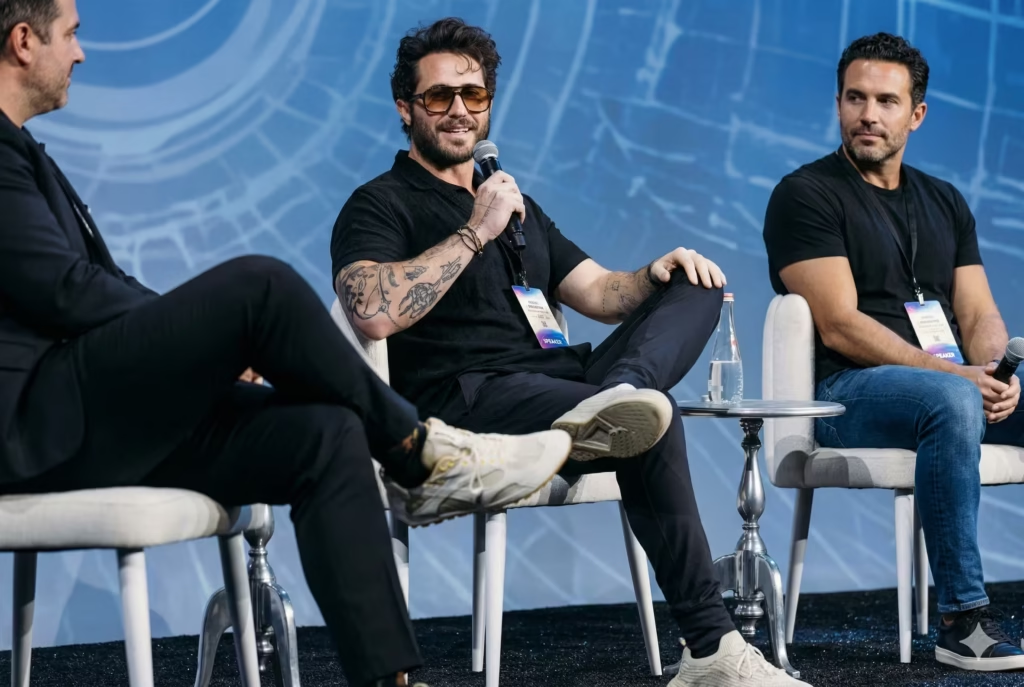
- Figure AI founder Brett Adcock launched Hark, a stealth AI startup backed by his own $100M, aiming to build personalized AI hardware and devices for the home.
- Tencent has launched “ClawBot,” integrating the OpenClaw AI agent directly into WeChat, bringing autonomous AI task execution to over a billion users in China.

Jigar Chaudhary is the Editor-in-Chief at UrviumAI, where he oversees coverage of artificial intelligence news, tools, and in-depth studies. With over 5 years of experience analyzing AI and robotics, he focuses on maintaining high editorial standards, accurate reporting, and clear explanations to help readers understand how AI is shaping the future.
Pingback: Reddit's Bot Rules, ARC-AGI-3 Stumps Models & Google's TurboQuant