Google’s Nano Banana 2 Claims No. 1 Spot 🍌

The ultimate image generation model just got a massive discount. Google has officially rolled out Nano Banana 2 (the official branding for Gemini 3.1 Flash Image), completely replacing the previous base and Pro models in the Gemini app.
Here is what makes the new model a game-changer for digital creatives:
- SOTA Quality: The model immediately claimed the #1 spot for text-to-image generation on leaderboards like Artificial Analysis, beating out OpenAI’s GPT Image 1.5.
- Hyper-Consistency: It fixes the “morphing” problem. Nano Banana 2 can maintain perfect visual consistency for up to five characters and 14 distinct objects within a single generated scene.
- Precision Text: The model has mastered text rendering and in-image localization, allowing it to generate crisp, accurately spelled typography for posters, infographics, and UI mockups in multiple languages.
- The Economics: Operating at the speed of Google’s Flash architecture, the model undercuts the pricing of Nano Banana Pro and OpenAI’s equivalents by nearly 2x, costing roughly 7 cents per image.
Why it matters: Historically, AI image generation forced users to choose between high quality (expensive and slow) or low quality (cheap and fast). Nano Banana 2 collapses that tradeoff entirely. By delivering frontier-level imagery at “Flash” speeds and prices, Google is making studio-quality synthetic media cheap enough to run at massive enterprise scale.
UrviumAI Take: The precision text rendering is the killer feature here. If you run a marketing agency or e-commerce store, Nano Banana 2 is now your default graphic designer. You can generate entire ad creatives, complete with perfectly localized, translated text inside the actual imagein seconds, drastically cutting your design overhead.
OpenAI Poaches Meta’s $200M Infrastructure Lead 🏃♂️

The mercenary era of Silicon Valley is in full swing. In a stunning victory in the ongoing AI talent wars, OpenAI has successfully poached top infrastructure engineer Ruoming Pang from Meta’s Superintelligence Labs.
Here is why this specific hire is making headlines across the tech industry:
- The Staggering Price Tag: Pang is not an average engineer. Last summer, Meta aggressively poached him from his role as Apple’s head of foundation models, reportedly luring him to Mark Zuckerberg’s team with an astronomical, multi-year compensation package valued at over $200 million.
- The Quick Exit: Despite the massive payday, Pang left Meta after barely seven months. According to The Information, OpenAI executives spent months aggressively courting him before he finally made the jump in late February.
- The Value: Pang has nearly two decades of experience building the plumbing for AI. At Google, he helped create massively scalable training frameworks. At Meta, he was in charge of the crucial AI infrastructure required to build the next generation of Llama models.
- The Trend: OpenAI isn’t stopping there. They also recently scooped up viral engineer Riley Walz to prototype new AI interfaces, signaling a massive push to secure top-tier talent.
Why it matters: The infrastructure required to train frontier models is so complex that there are only a few dozen humans on Earth who truly know how to scale it perfectly. Pang’s rapid departure proves that in the absolute top tier of AI talent, culture, compute access, and company momentum can ultimately trump even a $200 million paycheck.
UrviumAI Take: This is a massive blow to Meta’s “open-source” momentum. Watch the infrastructure space. The smartest engineers in the world aren’t just building the models; they are building the systems that build the models. OpenAI securing Pang means they are doubling down on ensuring their backend training pipelines remain vastly superior to the competition.
Anthropic CEO Defies Pentagon Ultimatum 🛑
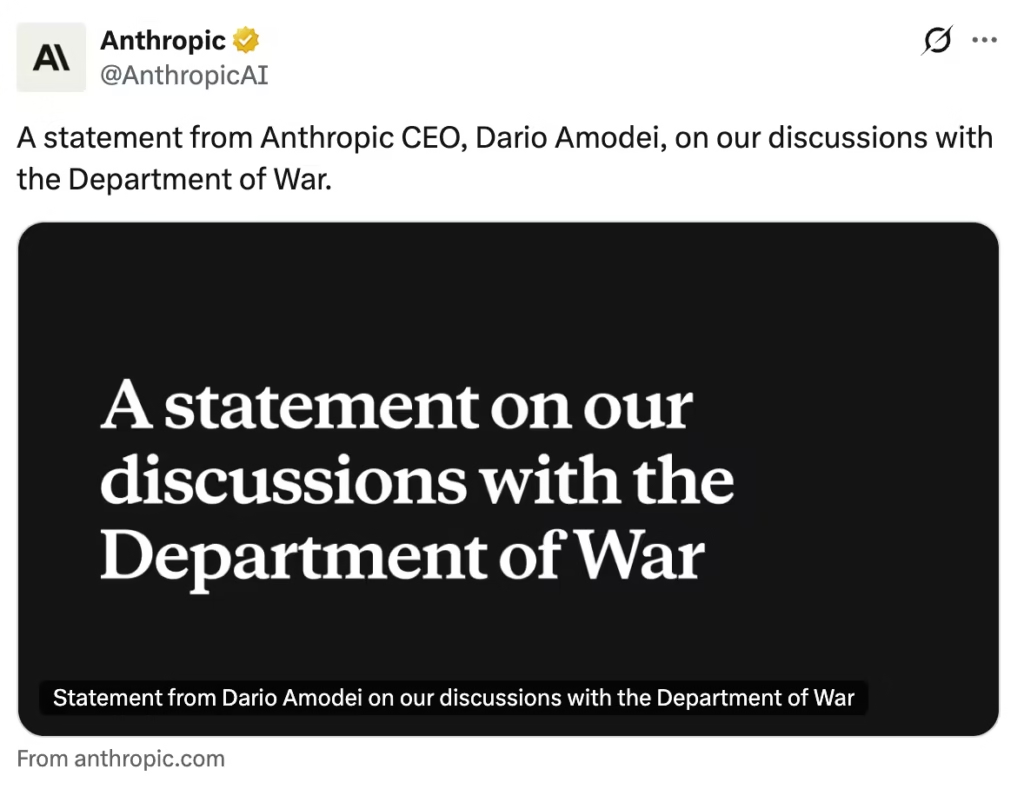
Silicon Valley just called the Pentagon’s bluff. In a bold public statement, Anthropic CEO Dario Amodei has firmly rejected the “final offer” from the US Department of Defense, refusing to strip critical ethical guardrails from the Claude AI model.
Here is the breakdown of the high-stakes national security standoff:
- The Red Lines: Anthropic’s Terms of Service strictly forbid the military from using its AI for two purposes: mass domestic surveillance and the deployment of fully autonomous weapons that fire without human oversight.
- The Government Threat: The Pentagon recently issued an ultimatum, demanding Anthropic allow Claude to be used for “any lawful use.” Defense officials threatened to terminate Anthropic’s $200M contract, label the company a “supply chain risk,” and even invoke the Defense Production Act to force compliance.
- The Refusal: In an 800-word manifesto, Amodei called out the contradictions of the Pentagon’s threats, writing: “These threats do not change our position: we cannot in good conscience accede to their request.”
- The Reality Check: Amodei stated that current frontier AI is “simply not reliable enough” to handle lethal targeting autonomously without putting civilians and troops at risk.
Why it matters: This is the most significant clash between tech ethics and military authority in the modern AI era. While competitors like xAI have eagerly signed unrestricted defense contracts, Anthropic is proving that its “Responsible Scaling Policy” isn’t just a marketing gimmick. They are willing to walk away from hundreds of millions of dollars in federal revenue to ensure their technology isn’t weaponized against democratic values.
UrviumAI Take: This is true corporate bravery. Anthropic’s refusal is a massive trust-builder for enterprise clients. If a company is willing to tell the US military “No” to protect its core safety principles, enterprise customers can trust that their data and security policies won’t be compromised for a quick buck.
Last AI News: Perplexity’s 19-Model Agent, Anthropic Buys Vercept & Claude’s Blog
Other AI News Today:
- A new Pew Research Center study shows that a majority of US teens rely on AI for schoolwork, with nearly 60% reporting that AI-assisted cheating is a regular occurrence at their schools.
- OpenAI announced a massive $110 billion funding round at a $730 billion valuation, backed by Amazon, SoftBank, and NVIDIA to secure gigawatts of dedicated AI infrastructure.
- Burger King is rolling out an OpenAI-powered chatbot named “Patty” inside employee headsets to track if workers are saying “please” and “thank you” to customers.
- Cursor upgraded its cloud agents, giving them isolated Virtual Machines where they can autonomously build, test, and use desktop apps before shipping merge-ready code.
- Nous Research launched Hermes Agent, a fully open-source, model-agnostic AI agent that lives on your terminal and messaging apps, learning and building reusable skills over time.

Jigar Chaudhary is the Editor-in-Chief at UrviumAI, where he oversees coverage of artificial intelligence news, tools, and in-depth studies. With over 5 years of experience analyzing AI and robotics, he focuses on maintaining high editorial standards, accurate reporting, and clear explanations to help readers understand how AI is shaping the future.