Nvidia Releases Nemotron 3 Open Models for Agentic AI 🤖

Nvidia is no longer just the world’s chipmaker—it’s now a major player in frontier models! The company just unveiled Nemotron 3, a family of open models built specifically for the next wave of AI: autonomous agents.
Here is why Nemotron 3 is a strategic masterstroke:
- The Lineup: The family includes three sizes: Nano (30B), available now, and the massive Super (100B) and Ultra (500B) variants coming in early 2026.
- Speed Demon: Nano uses a unique hybrid Mamba-Transformer architecture, allowing it to generate responses 3x faster than rivals like Qwen3-30B while using fewer active parameters.
- True Openness: While many U.S. labs are closing their doors, Nvidia is releasing the training data, fine-tuning tools, and RL environments alongside the models. This transparency is a massive gift to the open-source community.
- Immediate Adoption: Heavyweights like Cursor, Perplexity, and CrowdStrike are already integrating Nemotron 3 to power their coding, search, and security agents.
Why it matters: As Chinese labs like DeepSeek dominate the open-source market and U.S. labs like OpenAI remain closed, Nvidia is providing a “third way.” By offering elite, open models, Nvidia ensures that developers stay within its software ecosystem while continuing to buy its high-end GPUs.
UrviumAI Take: Nvidia’s focus on “Agentic AI” rather than just “Chat AI” is the right move. If you are building an automated workflow, test the Nemotron 3 Nano. Its ability to activate only 3 billion parameters per token makes it incredibly cost-efficient for “always-on” agents compared to larger, slower models.
Perplexity Study: Users Want Cognitive Work, Not Concierges 📊
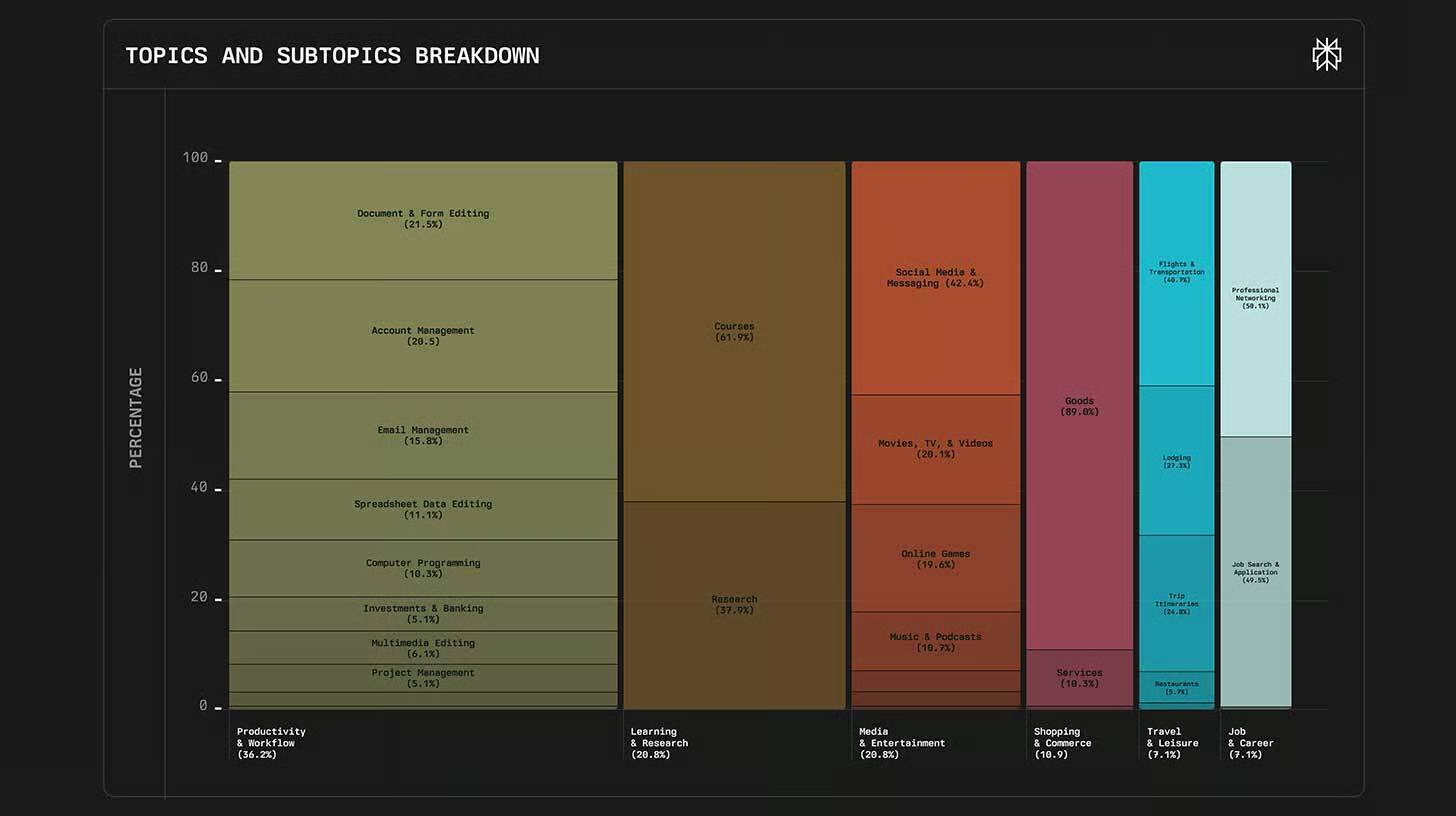
Forget booking flights—we’re using AI to think! A massive new study by Perplexity and Harvard analyzed hundreds of millions of queries to see how people actually use AI agents. The results debunk the popular idea that AI is just a “digital butler” for boring chores.
Here are the surprising findings:
- Brain Power over Chores: Over 57% of all agent activity focused on deep cognitive work. This includes summarization, document editing, and research assistance.
- Casual to Professional: Users often start with casual queries like travel planning, but quickly “graduate” to heavy-duty knowledge work like debugging code or analyzing financial reports.
- The Power Users: Tech workers, academics, and finance professionals drive the most activity. Finance pros specifically use AI for efficiency (47% of their queries), while students focus on learning (43%).
- Retention Secret: Users who use AI for research and learning early on are far more likely to become long-term, daily active users.
Why it matters: While tech companies often market AI agents as tools to order groceries or book hotels, users are actually using them as “cognitive partners.” This shift suggests that the real value of the AI economy isn’t in saving us 5 minutes on a chore—it’s in scaling human intelligence and problem-solving.
UrviumAI Take: The “stickiness” of research tasks is the most important data point for developers. If you are building an AI tool, don’t just focus on “doing the task” (concierge). Focus on “explaining the logic” (cognitive partner). Users who feel they are learning alongside the AI are the ones who stay.
US Gov Launches ‘Tech Force’ & Blocks State AI Rules 🧪

The U.S. government is clearing the path for AI dominance! The Trump administration just made two major moves: launching a high-paying hiring surge for AI talent and signing an executive order to stop individual states from regulating AI on their own.
Here is the breakdown of the “US Tech Force” and the new rules:
- The Talent Surge: The “US Tech Force” aims to hire 1,000 early-career software engineers, data scientists, and AI experts.
- The Pay: To compete with Silicon Valley, salaries will range from $130,000 to $195,000. Partners like Microsoft, Meta, and OpenAI will provide mentorship.
- The Projects: Tech Force members will work on high-stakes tasks, including advanced AI for drones/weapons at the DoD and intelligence improvements at the State Department.
- One Rule for All: Simultaneously, President Trump signed an Executive Order blocking states from enforcing their own AI regulations (like the Colorado AI Act). The goal is a “One Rule” system to prevent a “patchwork” of 50 different state laws that could slow down innovation.
Why it matters: These moves show a “Build, Baby, Build” approach to AI. By aggressively hiring talent and stripping away state-level red tape, the U.S. government is treating AI as a national security priority that must be scaled as fast as possible to win the global race for dominance.
UrviumAI Take: “One Rule” executive order is a major win for AI startups but a point of conflict for state privacy advocates. If you are an AI developer, look for the upcoming US Tech Force postings on USA Jobs. The ezxcability to work on national-scale problems with a private-sector salary and a “leave of absence” path back to big tech is a rare career opportunity.
last AI News: Google AI Translates Live Audio to Any Headphones, Zoom Claims New Reasoning SOTA, and Google Labs Launches GenTabs Browser

Jigar Chaudhary is the Editor-in-Chief at UrviumAI, where he oversees coverage of artificial intelligence news, tools, and in-depth studies. With over 5 years of experience analyzing AI and robotics, he focuses on maintaining high editorial standards, accurate reporting, and clear explanations to help readers understand how AI is shaping the future.