
You know that awkward moment when you realize you’re spending way too much money at one store? Well, OpenAI just had that realization – except the “store” is Nvidia, and they’ve been dropping billions on GPUs like they’re Pokemon cards. So what did they do? They decided to build their own chip factory, and they’re bringing Broadcom as their wingman with a cool $10 billion commitment.
What Actually Happened
OpenAI just pulled the ultimate “fine, I’ll do it myself” move by announcing they’re going into mass production of custom AI chips next year through Broadcom. The Financial Times spilled the tea that Broadcom’s CEO was bragging about a mystery customer with a $10 billion chip order – and surprise! It’s OpenAI planning to keep all these fancy chips for themselves, not sell them to competitors.
What Makes This Chip Drama Special
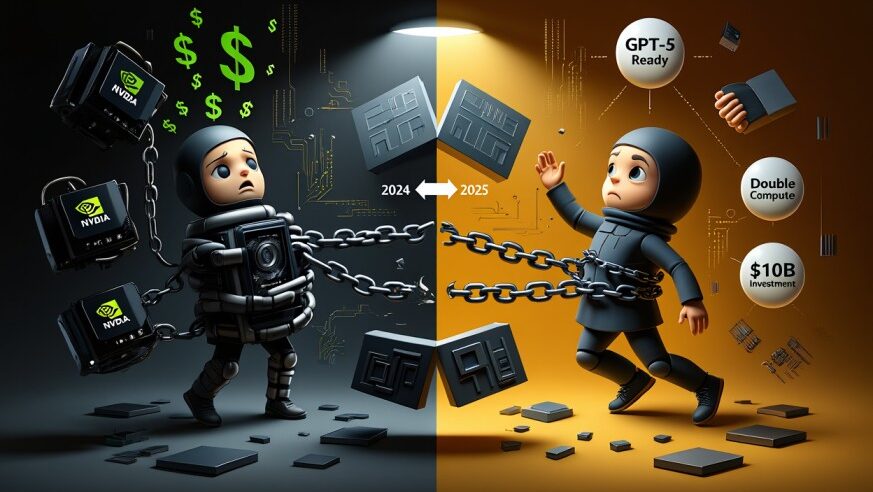
- $10 Billion Commitment: OpenAI isn’t playing around – this is serious “we’re done being Nvidia’s ATM” money
- Double Compute in 5 Months: Custom chips designed to handle GPT-5’s massive computational appetite and solve ongoing GPU shortage headaches
- Internal Use Only: Unlike other companies, OpenAI plans to hoard these chips for their own AI models – no sharing allowed
- Big Tech Trend: Joining Google, Amazon, and Meta in the “let’s ditch Nvidia” club with custom hardware solutions
- Full Stack Control: Moving toward owning their entire AI pipeline from chips to chatbots, reducing external dependencies
Why This Silicon Valley Divorce Actually Matters
This isn’t just about saving money (though OpenAI’s compute bills are probably scarier than your credit card statement). It’s about control, independence, and not having to wait in line behind everyone else for the latest GPU drops. When you’re building the future of AI, you don’t want to be at the mercy of someone else’s supply chain or pricing decisions.
The Future Impact We’re Looking At
Next 6 Months: OpenAI will finalize chip designs and begin small-scale testing, while other AI companies rush to announce their own custom silicon partnerships.
1 Year: Mass production begins, giving OpenAI a significant competitive advantage in training speed and cost efficiency. GPT-5 launches powered by their own hardware.
2-3 Years: The custom chip arms race intensifies. Every major AI company will have their own silicon, fracturing the market and reducing Nvidia’s dominance from “monopoly” to “major player.”
5 Years: AI hardware becomes as specialized as smartphone chips. Each AI company will have processors optimized for their specific model architectures and training methods.
Long-term Vision: We’re heading toward a world where AI companies are also semiconductor companies. The line between software and hardware completely blurs, with each major AI lab designing chips specifically for their next-generation models.
The Bottom Line
OpenAI just fired the first shot in the great AI hardware independence war. With $10 billion on the table and GPT-5 on the horizon, they’re betting that owning their chip destiny is worth more than any Nvidia partnership. Expect every other AI company to follow suit – the age of GPU dependency is ending.
Read more about “Scientists Just Cracked the Code to Mind-Controlled Robots (No Brain Surgery Required!)“

Jigar Chaudhary is the Editor-in-Chief at UrviumAI, where he oversees coverage of artificial intelligence news, tools, and in-depth studies. With over 5 years of experience analyzing AI and robotics, he focuses on maintaining high editorial standards, accurate reporting, and clear explanations to help readers understand how AI is shaping the future.


Pingback: OpenAI Just Bet $30 Million That AI Can Make Better Movies