OpenAI Counters Nano Banana Pro with New Images Upgrade 🚀

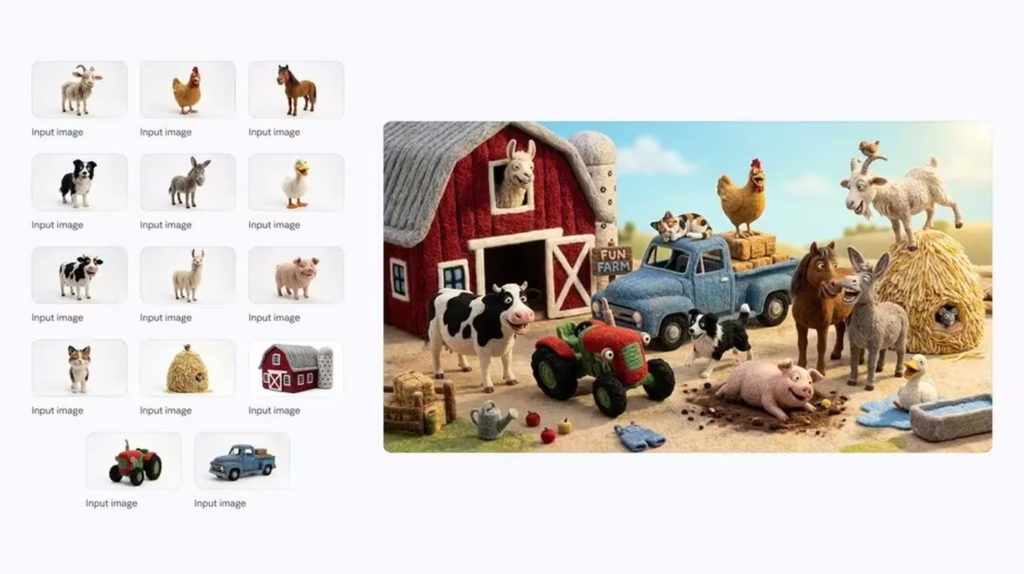
OpenAI just reclaimed the creative crown! After falling behind Google’s Nano Banana Pro, OpenAI has released GPT Image 1.5. This isn’t just a minor patch; it’s a total overhaul that makes image generation faster, smarter, and much more useful for real-world design work.
Here is what’s new in the 1.5 upgrade:
- Insane Speed: The model creates visuals up to 4x faster than the previous version, allowing for near-instant iteration.
- Text Mastery: One of the biggest complaints about AI art is “gibberish” text. 1.5 handles dense text, infographics, and even newspaper-style layouts with shocking accuracy.
- Consistency is King: The model can now preserve faces, specific lighting, and overall composition across multiple edits. You can change a character’s shirt or the weather in a scene without the entire image “morphing” into something new.
- New Creative Panel: OpenAI also launched a dedicated sidebar workspace in ChatGPT with templates and style presets, moving beyond a simple “chat-only” interface.
- Leaderboard Leader: GPT Image 1.5 has already vaulted to the #1 spot on the Artificial Analysis and LM Arena leaderboards, narrowly beating Google’s best.
Why it matters: For a long time, AI image editing was like a “gacha game”—you hoped for a good result but had little control. 1.5 changes that, offering the precision needed for professional-grade assets. With the competition between OpenAI and Google reaching a fever pitch, users are finally getting the reliable, fast tools they’ve been waiting for.
UrviumAI Take: The “compositional consistency” is the real game-changer for creators. Try the new “Creative Panel” to build a consistent brand kit. Upload one reference image of a character or logo, and use the new presets to see how well GPT Image 1.5 maintains that specific likeness across five completely different styles (e.g., “3D Render” to “Oil Painting”).
Google, MIT Study Finds Pitfalls in Multi-Agent Systems 😵

Is your “AI swarm” actually making things worse? While the tech industry is rushing to build complex “multi-agent” systems (where multiple AIs talk to each other), a new study from Google and MIT offers a sobering reality check. It turns out that for many tasks, a single smart agent is actually superior to a team.
The researchers ran 180 experiments, and the results were eye-opening:
- The “Sequential Trap”: In tasks requiring a step-by-step chain of logic (like planning in Minecraft), adding more agents caused performance to drop by as much as 70%. Splitting the logic across agents actually “broke the chain.”
- The 45% Threshold: The study discovered the “45% Trap”—if a single AI agent can already solve a task with more than 45% accuracy, adding more agents usually makes the results worse. The coordination “tax” outweighs the benefit.
- The Parallel Win: Multi-agent systems only truly shine in parallel tasks where work can be cleanly split (like financial analysis), where they saw an 81% improvement.
- Token Debt: Multiple agents eat through token budgets and “cognitive space” much faster, leading to error amplification that can be 17x higher than a single agent if not managed by a central “manager” node.
Why it matters: We are currently in an “agentic hype” phase where everyone assumes “more is better.” This research proves that complexity is a cost. For enterprise leaders, the lesson is clear: don’t build a complex swarm when a well-prompted single agent can do the job faster, cheaper, and more accurately.
UrviumAI Take: This study moves us from “agent hype” to “agent engineering.” Evaluate your current AI workflows. If your task is “sequential” (where Step B depends entirely on the specific outcome of Step A), stick to a single, high-context agent like GPT-5.2 or Claude Opus 4.5. Only use multi-agent systems for “independent” parallel tasks, like researching five different competitors simultaneously.
AI Chip Crunch May Spike Phone Prices 📱

Your next phone upgrade is about to get a lot more expensive, and you can blame AI! A new forecast from Counterpoint Research warns that the AI boom is creating a massive “memory chip crunch” that will force smartphone prices up by an average of 6.9% in 2026.
Here’s why the AI boom is hitting your wallet:
- Memory War: AI data centers (which run models like GPT-5 and Gemini) have a voracious appetite for DRAM memory chips. They are outbidding smartphone makers for the same critical components.
- Price Spike: This shortage is expected to drive component costs up by 15%, nearly doubling the previous price hike estimates.
- Budget Phones Hit Hardest: Low-end phones (under $200) have already seen material costs surge by 20% to 30% since early 2025. Mid- and high-end devices are up about 15%.
- Shipping Slump: Counterpoint now expects global smartphone shipments to fall by 2.1% in 2026 as manufacturers struggle with costs.
- Spec Downgrades: To keep prices “stable,” some brands may be forced to downgrade features like camera quality or display specs, or reuse older parts.
Why it matters: AI is no longer just a software trend; it is now directly competing with consumer electronics for physical resources. This “dual bind” means manufacturers must either shrink their profit margins or pass the costs to you. The result? A widening gap between premium flagships from giants like Apple and Samsung and a struggling mid-to-low-tier market.
UrviumAI Take: The memory shortage is a classic supply chain bottleneck. If you were planning to buy a mid-range or budget Android phone, consider doing it before mid-2026. Counterpoint predicts memory prices could climb another 40% through the first half of 2026, meaning the best “spec-for-dollar” value is likely available right now before the next manufacturing cycle hits.
Last AI News: Nvidia Nemotron 3 Launch, Perplexity’s AI Usage Study, and U.S. Tech Force Hiring

Jigar Chaudhary is the Editor-in-Chief at UrviumAI, where he oversees coverage of artificial intelligence news, tools, and in-depth studies. With over 5 years of experience analyzing AI and robotics, he focuses on maintaining high editorial standards, accurate reporting, and clear explanations to help readers understand how AI is shaping the future.