
Zuckerberg Builds Personal ‘CEO Agent’ at Meta 👔

The top executive of one of the world’s most powerful tech companies is actively trying to replace his own corporate bureaucracy with artificial intelligence. According to a Wall Street Journal report, Meta CEO Mark Zuckerberg is building a personal “CEO agent” to help him run the company.
Here is how the agentic shift is altering the internal culture at Meta:
- The CEO Agent: The tool, currently in development, is designed to retrieve answers and data for Zuckerberg instantly, shortcutting the traditional process of passing requests down through multiple layers of management.
- Employee Adoption: Meta staffers have already built custom agent tools for daily workflows, including “My Claw,” which reads work files and negotiates directly with the AI agents of other coworkers.
- The “Second Brain”: Another internal tool, built on top of Anthropic’s Claude, functions as an “AI chief of staff,” indexing and querying documents across massive internal projects.
- The Mandate: This shift is not optional; Meta has formally tied AI tool adoption to employee performance reviews, pushing the massive organization to operate as fast and lean as newer, AI-native startups.
Why it matters: When the CEO of a trillion-dollar company builds an AI to bypass his own middle management, it is a massive signal for the rest of the corporate world. Zuckerberg is proving that AI isn’t just a tool for entry-level coding or customer service; it is a structural wrecking ball designed to flatten corporate hierarchies and massively accelerate executive decision-making.
UrviumAI Take: Middle management is in the crosshairs of the AI revolution. If your primary job function is acting as an information conduit between executives and individual contributors, your role is highly vulnerable to “CEO agents.” You must transition from being an information gatherer to an information synthesizer. Start using AI tools yourself to generate high-level strategic insights, rather than just passing data up the chain of command.
Anthropic Hands Claude Direct Control of Your Mac 🖥️
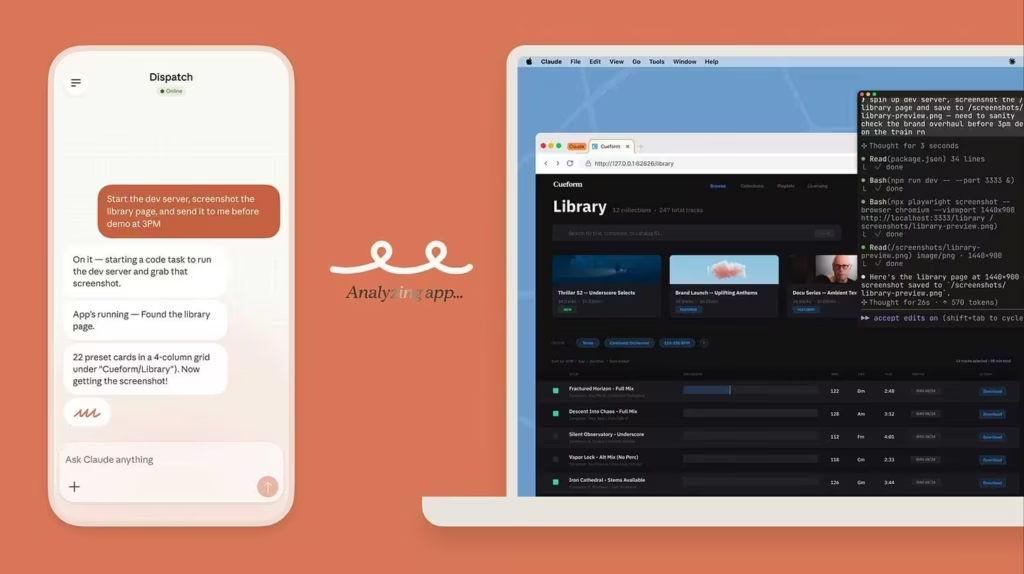
The line between a chatbot and a digital employee just vanished. Anthropic has released a groundbreaking research preview that grants its Claude assistant direct, autonomous control over your desktop environment.
Here is how the new computer-use capability, known as Dispatch, actually functions:
- Remote Control: Dispatch allows users to pair their mobile phone with their Mac. You can text a task to Claude from your phone, and the AI will take over your computer to execute it.
- Autonomous Navigation: Claude can literally click, type, scroll, and navigate across any open application on your desktop, interacting with the UI just like a human operator.
- Smart Execution: The system is designed to be efficient; it checks for direct API integrations (like Slack or Google Calendar) before resorting to physically moving the mouse and clicking on the screen.
- Security Guardrails: To mitigate severe privacy risks, the system continuously monitors for abnormal activity and requires explicit user consent on the paired phone before it opens any new applications.
Why it matters: This is the Holy Grail of agentic AI. Instead of copy-pasting code or text out of a browser window, Claude can now physically execute multi-step workflows across your local applications while you aren’t even in the room. Anthropic is proving that the future of enterprise productivity isn’t a smarter chat window; it is a persistent, localized agent that physically drives your operating system.
UrviumAI Take: Your computer is about to become an employee, not just a tool. Start preparing your local desktop environment for autonomous execution. Organize your files, standardize your folder naming conventions, and secure your local application permissions. As tools like Claude Dispatch become mainstream, a messy desktop won’t just slow you down; it will completely break the ability of your AI agent to automate your daily tasks.
OpenAI Offers Private Equity a 17.5% Guaranteed Return 💰
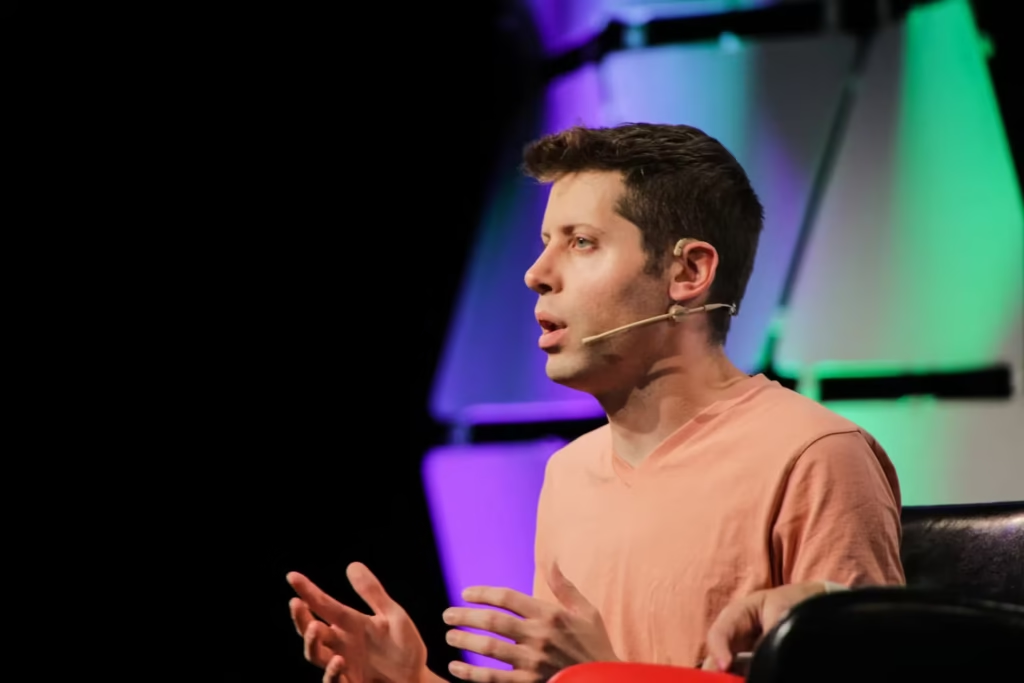
The enterprise AI turf war has escalated into a high-stakes financial bidding war. In a highly unusual move for the tech sector, OpenAI is reportedly offering private equity firms a guaranteed minimum return of 17.5% to lure them into a massive enterprise joint venture.
Here are the details behind the aggressive financial structuring:
- The Joint Venture: OpenAI is seeking to raise $4 billion at a $10 billion pre-money valuation to build a dedicated enterprise deployment arm.
- The Deal Sweetener: To outbid its rival Anthropic, which is courting the same buyout firms without offering a floor return, OpenAI is offering preferred equity stakes with a massive 17.5% guaranteed minimum return, plus early access to its newest models.
- The Strategic Goal: Private equity firms control hundreds of established portfolio companies. By partnering with these firms, OpenAI can instantly bypass the slow, deal-by-deal enterprise sales cycle and deploy its customized AI tools across massive corporate networks.
- The Financial Logic: The joint venture absorbs the massive upfront costs of deploying engineers to customize models for these clients, keeping those expenses off OpenAI’s core balance sheet as it prepares for a potential IPO later this year.
Why it matters: Offering a guaranteed 17.5% return is a desperate, highly aggressive financial maneuver that shifts massive risk directly onto OpenAI. It proves exactly how terrified OpenAI is of losing the enterprise market to Anthropic. Whoever wins this bidding war will instantly lock their AI models into the daily workflows of hundreds of the world’s largest companies, securing the recurring revenue necessary to survive the exorbitant costs of frontier AI development.
UrviumAI Take: Distribution is currently more valuable than intelligence. Stop obsessing over which AI model scores 2% higher on a coding benchmark. OpenAI is willing to guarantee massive financial returns just to secure a distribution channel through private equity portfolios. If you are building an AI product, focus 80% of your energy on securing locked-in distribution channels (like B2B partnerships) rather than fighting an endless, expensive war over slight model improvements.
Last AI News: Musk’s Terafab Chip Project, Halter’s $2B Cowgorithm & Anthropic Projects
Other AI News Today:
- An engineer built an AI voice agent named Rachel to call over 3,000 Irish pubs, successfully extracting Guinness prices to create a live analytics index.
- Luma AI launched Uni-1, an autoregressive image model that processes text and visuals through a single pipeline, allowing it to think and reason before generating pixels.
- NVIDIA CEO Jensen Huang declared on the Lex Fridman Podcast that he believes Artificial General Intelligence (AGI) has already been achieved.
- Apple announced its WWDC 2026 conference for June 8-12, teasing major AI advancements, including a generational overhaul of Siri powered by Google Gemini.
- OpenAI hired Dave Dugan, a former top advertising executive at Meta, to lead global ad solutions as the company pushes to monetize ChatGPT.

Jigar Chaudhary is the Editor-in-Chief at UrviumAI, where he oversees coverage of artificial intelligence news, tools, and in-depth studies. With over 5 years of experience analyzing AI and robotics, he focuses on maintaining high editorial standards, accurate reporting, and clear explanations to help readers understand how AI is shaping the future.


Pingback: Figma's AI Canvas, Roche's GPU Factory & OpenAI Foundation's $1B Pledge