xAI Hits $230B Valuation with Nvidia Backing 💰

Elon Musk just secured a massive war fund for AI. xAI has officially closed a colossal $20 billion Series E funding round, pushing its valuation to a reported $230 billion. This cements xAI as the third most valuable AI lab in the world, right behind OpenAI and Anthropic.
Here is the breakdown of the mega-deal:
- The Backers: The round was supported by heavyweights like Nvidia, Cisco, the Qatar Investment Authority, and Valor Equity Partners.
- Infrastructure Scale: The funds are earmarked for expanding the Colossus supercomputer in Memphis. Plans for a third data center could push xAI’s total power capacity near 2 gigawatts—enough energy to power a small country.
- Grok 5: The company confirmed that its next-generation model, Grok 5, is currently in training.
- Ecosystem Integration: xAI plans to weave Grok deeper into Musk’s empire, linking the chatbot with X (Twitter), Tesla vehicles, and the Optimus robot to create a unified AI ecosystem.
Why it matters: The “AI funding wars” are escalating. By securing direct backing from Nvidia (the chipmaker) and massive sovereign wealth, Musk has ensured xAI can compete with OpenAI’s $500B valuation. This capital guarantees that the race to AGI will remain a fierce, three-way battle for the foreseeable future.
UrviumAI Take: The $230B valuation proves that investors see xAI not just as a chatbot company, but as the underlying intelligence layer for Tesla and X. You can watch the “Colossus” expansion in Memphis. If xAI successfully brings 2 gigawatts of compute online before Microsoft or OpenAI can build their Stargate project, Musk could momentarily hold the title for the world’s most powerful training cluster.
Razer Unveils Holographic AI Gaming Companion 🎮
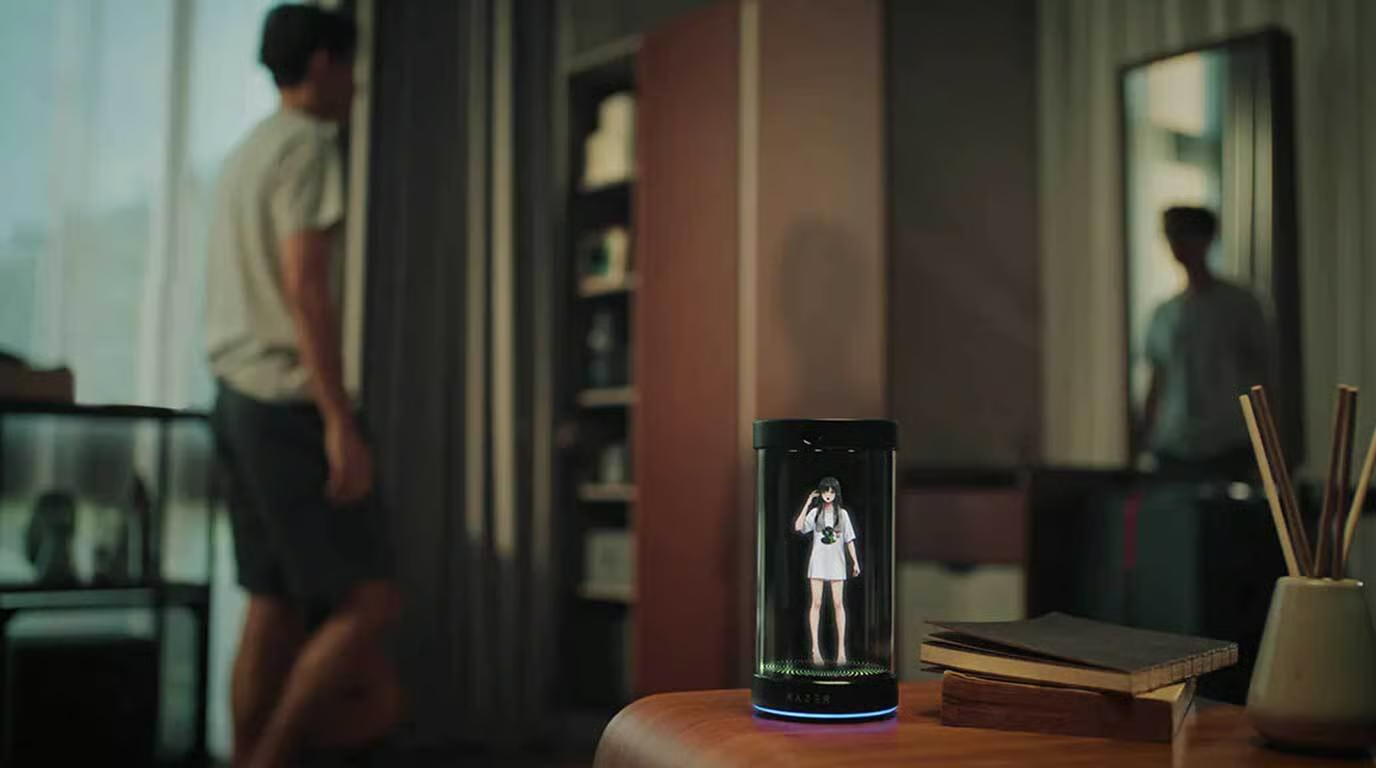
Your AI assistant just got a physical body on your desk! At CES 2026, gaming giant Razer unveiled Project AVA, a futuristic holographic device that puts an animated AI companion right next to your monitor.
Here is what makes AVA unique:
- Holographic Display: It features a 5.5-inch transparent display that projects a 3D animated avatar inside a glowing cylinder. You can choose from various personalities, including “Grok” variants, anime characters, or esports pros.
- Grok Inside: The device is powered by xAI’s Grok, giving it a witty, rebellious personality. Razer promises compatibility with other AI models in the future.
- PC Vision: With a built-in camera and “PC Vision Mode,” AVA can watch your screen in real-time. It can offer live coaching during a game (“Watch your left flank!”) or help you navigate complex spreadsheets during work.
- Availability: You can reserve one now for $20, with shipments expected in late 2026.
Why it matters: We are seeing the rise of “Embodied AI”—AI that isn’t just text on a screen but has a presence. While focused on gamers, AVA represents a new category of hardware: the “Desktop Companion.” It’s a bold bet that people want their AI to be a visible, always-on friend rather than just a hidden software tool.
UrviumAI Take: The “PC Vision Mode” is the killer feature here. Think beyond gaming. If this device can “see” your screen, it could be the ultimate pair programmer or design assistant, pointing out errors in real-time without you needing to copy-paste code into a chat window.
Stanford AI Predicts 130 Diseases from a Night’s Sleep 😴

Your sleep patterns might be revealing your future health. Researchers at Stanford Medicine just published a groundbreaking study on SleepFM, a new AI foundation model that can predict over 130 different diseases just by analyzing a single night’s sleep recording.
Here is how this medical breakthrough works:
- Massive Dataset: The model was trained on nearly 600,000 hours of sleep data from 65,000 participants, analyzing complex signals like brain waves, heart rate, breathing, and muscle movement.
- Predictive Power: SleepFM acts as an early warning system. It predicted Parkinson’s disease with 89% accuracy, dementia at 85%, and heart attacks at 81%.
- Hidden Signals: The AI detects subtle “desynchronizations”—like when your brain is in deep sleep but your heart rate remains high—that human doctors might miss but are strong indicators of future illness.
- Life Saving: It can even predict overall mortality risk with 84% accuracy, potentially giving patients a crucial heads-up to make lifestyle changes years before a diagnosis.
Why it matters: Sleep is roughly one-third of our lives, yet it has been a “black box” for data. SleepFM unlocks this data as a powerful diagnostic tool. As wearable tech (like Apple Watch or Oura Ring) improves to capture this level of fidelity, we could soon have a “doctor on our wrist” monitoring for serious diseases every night.
UrviumAI Take: The jump from “sleep tracking” to “disease prediction” is massive. If you use a sleep tracker, look for updates that integrate “biometric variability” or “heart-brain sync.” These are the consumer-friendly versions of the metrics SleepFM uses. Data is only useful if it leads to preventative action.

Jigar Chaudhary is the Editor-in-Chief at UrviumAI, where he oversees coverage of artificial intelligence news, tools, and in-depth studies. With over 5 years of experience analyzing AI and robotics, he focuses on maintaining high editorial standards, accurate reporting, and clear explanations to help readers understand how AI is shaping the future.