
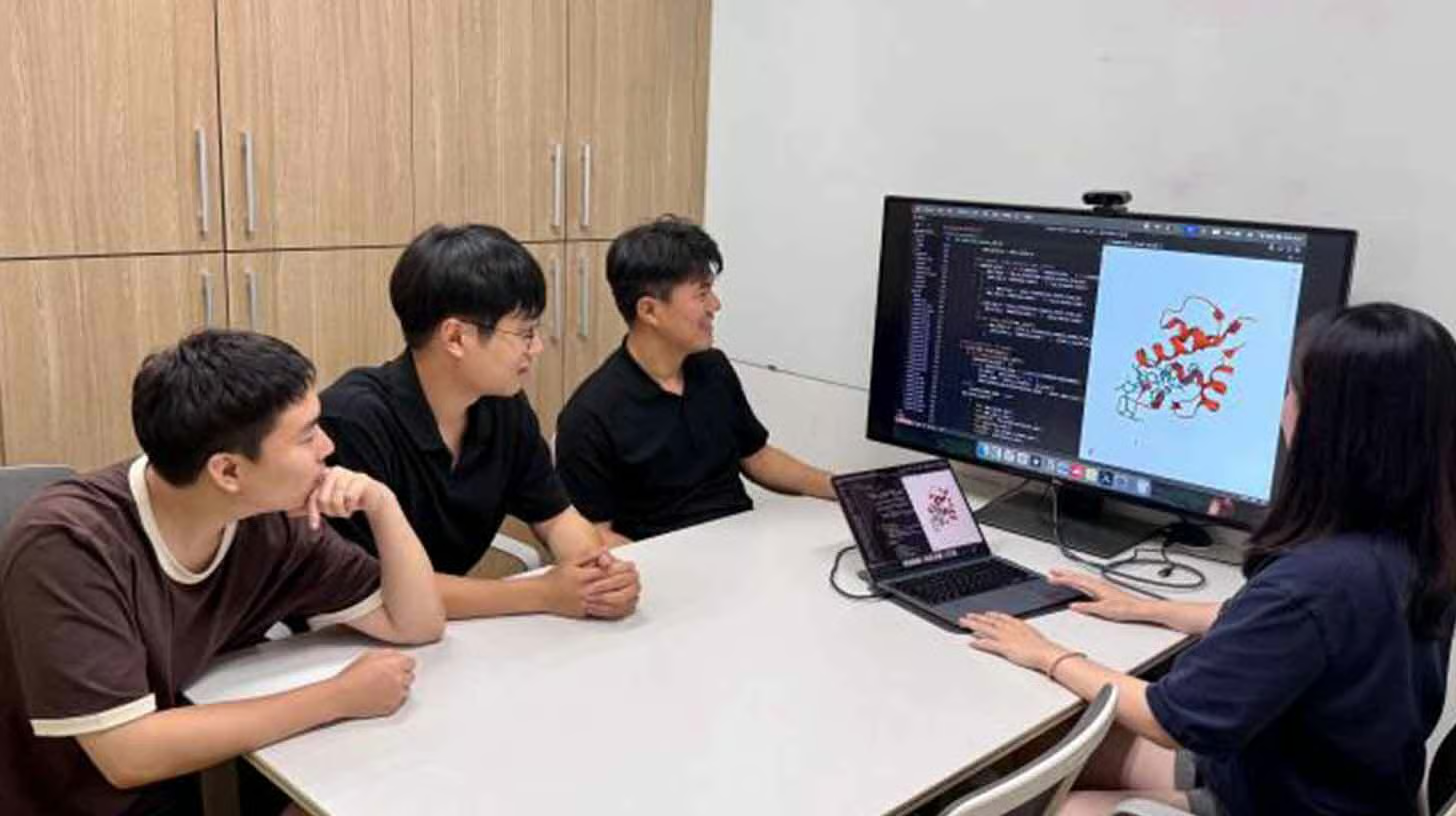
A Stellar Breakthrough in Drug Discovery: 🌌 Researchers at the Korea Advanced Institute of Science and Technology (KAIST) have unveiled BInD, a revolutionary AI diffusion model that designs cancer drugs from scratch, announced in August 2025. In the $150B global drug discovery market, BInD’s ability to craft precise, safe, and manufacturable cancer therapies without prior molecular data marks a galactic shift. Let’s dive into this cosmic innovation and its future impact on medicine!
Crafting Precision Drugs at Light Speed
Unlike traditional AI models that iterate through design and testing, BInD simultaneously designs drug molecules and their binding to cancer-causing protein mutations, per KAIST News. It targets only diseased proteins, sparing healthy ones, advancing precision medicine. For example, BInD created drugs for specific cancer mutations, showing superior specificity compared to older systems, per Advanced Science. Its one-step process slashes development time, potentially reducing the 10–15 years typically needed for drug discovery, per Forbes.
A Multifaceted AI Powerhouse
BInD stands out by optimizing multiple criteria—safety, stability, and manufacturability—simultaneously, unlike predecessors limited to single-factor optimization, per The Rundown. Its “recycling technique” learns from successful designs, reusing strategies to improve future drugs without starting over, boosting efficiency. In lab tests, BInD’s drugs showed high binding affinity and low toxicity, validated through computational simulations, per KAIST’s press release. However, scaling to human trials remains a challenge, per Nature.
Why This Matters in the AI Cosmos
BInD’s breakthrough could transform oncology, enabling tailored therapies for cancers like lung or breast cancer. By 2030, AI-driven drug discovery could save $50B annually and accelerate 30% of new drugs, per McKinsey. X posts, like @BioTechAI, praise BInD’s potential, while @SciSkeptic notes risks of overhyping pre-clinical results. KAIST’s tech, licensed to BioRevert Inc., aims for practical therapies, per news.kaist.ac.kr.
The Next Frontier
Will BInD open the floodgates for AI-designed, life-saving drugs, or will clinical hurdles slow its orbit? UrviumAI tracks this starry voyage in AI-driven medicine.
🌠 Join the Cosmic Journey! Subscribe to our newsletter for the latest AI updates.
Read more about “OpenAI’s GPT-5 Rollout Chaos: A Cosmic AMA Fix-Up“

Jigar Chaudhary is the Editor-in-Chief at UrviumAI, where he oversees coverage of artificial intelligence news, tools, and in-depth studies. With over 5 years of experience analyzing AI and robotics, he focuses on maintaining high editorial standards, accurate reporting, and clear explanations to help readers understand how AI is shaping the future.
Pingback: Perplexity’s $34.5B Chrome Bid: A Gambit in AI’s Browser War