Anthropic Lands OpenAI Co-Founder Andrej Karpathy 🧠
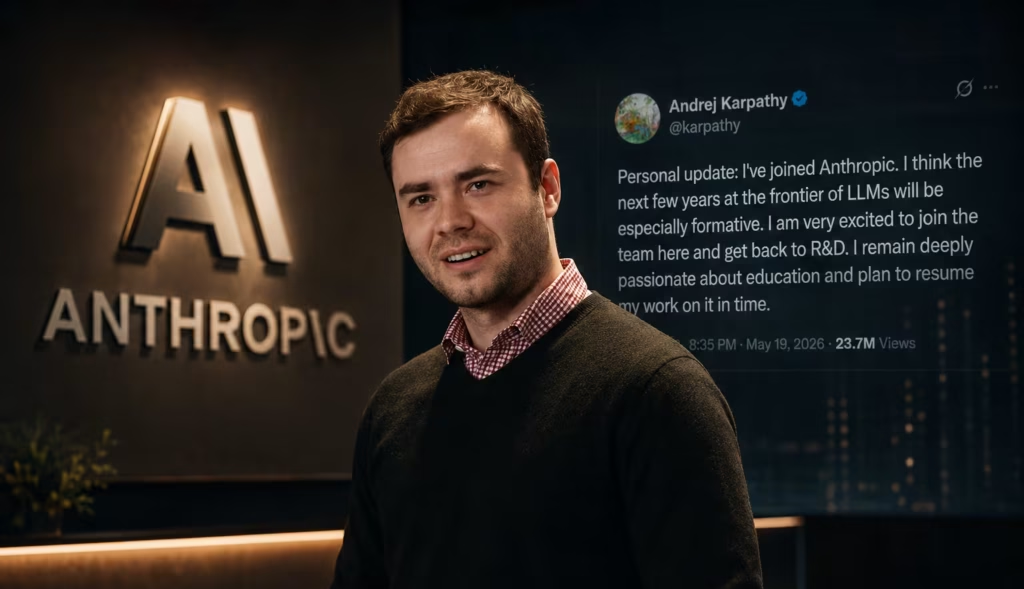
One of the most respected minds in the artificial intelligence industry has officially jumped ship to a major rival. OpenAI co-founder and former Tesla Autopilot lead Andrej Karpathy announced on X that he has joined Anthropic, dealing a massive talent acquisition blow to OpenAI.
Here is the breakdown of Karpathy’s strategic career move:
- The Journey: Karpathy co-founded OpenAI in 2015, left to run Tesla’s AI division until 2022, returned to OpenAI briefly, and left again in 2024 to launch the AI education startup Eureka Labs.
- The New Role: At Anthropic, he is joining the pre-training team under Nick Joseph. His primary mandate is to create and lead a new internal group focused entirely on applying Claude to automate Anthropic’s own training pipelines.
- The Mission: The goal is recursive self-improvement using Anthropic’s current models to accelerate the research and development of its future frontier models.
- Future Plans: While committing to the frontier of LLMs at Anthropic, Karpathy noted he still intends to resume his educational work “in time.”
Why it matters: In the hyper-competitive race for AGI, top-tier engineering talent is more valuable than compute. Karpathy is widely considered an architectural visionary. By luring him to Anthropic specifically to build a system where Claude trains the next generation of Claude, Anthropic is accelerating the timeline toward fully autonomous, self-improving AI ecosystems and doing so with one of OpenAI’s original architects leading the charge.
UrviumAI Suggestion: The focus of frontier labs has shifted from manual engineering to autonomous AI-assisted research. Pay close attention to Karpathy’s new mandate at Anthropic. If the brightest minds in the world are using AI agents to write the code that trains the next generation of AI, your enterprise engineering teams should be doing the same. You must begin aggressively integrating agentic coding tools into your CI/CD pipelines to automate your internal development, because human-only engineering is no longer fast enough to stay competitive.
Gemini’s Busy Agentic Day at Google I/O 🤖
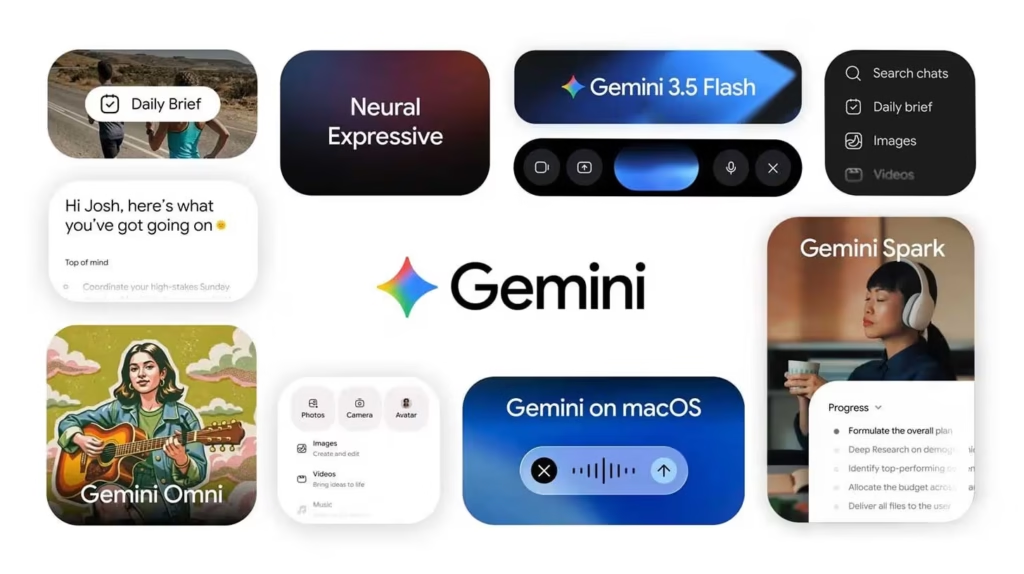
Google is completely re-architecting its software ecosystem around autonomous intelligence. At its flagship I/O 2026 event, the Mountain View tech giant unleashed a massive wave of Gemini-powered models, tools, and agentic upgrades designed to natively embed AI into the daily digital workflow of billions.
Here are the heavy-hitting announcements from Google I/O:
- Gemini Omni: A groundbreaking multimodal video generation model capable of turning text, image, audio, or video inputs into highly dynamic video outputs, internally referred to as the “Nano Banana for video.”
- Gemini 3.5 Flash: The kickoff of the 3.5 family, this highly efficient model nears the benchmark performance of rivals like Opus 4.7 and GPT-5.5, but operates at 4x the speed and half the API cost.
- Gemini Spark: A new 24/7 cloud-based personal agent that runs continuously on virtual machines, capable of taking autonomous, cross-app actions across Google Workspace, Chrome, and email, even when your device is turned off.
- Antigravity 2.0: A massive upgrade to Google’s agentic coding system, which the company claims can generate the core components of an entire operating system in half a day.
Why it matters: Google I/O 2026 was less about “chatbots” and entirely about “agents.” While Gemini 3.5 Flash is highly impressive, the true disruption is Gemini Spark. By deploying an autonomous assistant that lives permanently in the cloud and has frictionless access to your Gmail, Docs, and Calendar, Google is shifting the paradigm from an AI you “talk to” into a digital proxy that “works for you” 24 hours a day.
UrviumAI Suggestion: Frictionless ecosystem integration beats standalone AI capability. Do not just look at the raw benchmark scores of Gemini 3.5 Flash; look at its distribution. If you are building enterprise software, you must ensure your platforms integrate deeply into Google Workspace. With the launch of the Gemini Spark agent, Google users will increasingly rely on their 24/7 cloud agent to manage their daily workflows. If your SaaS tool does not offer a seamless API connection for Spark to interact with, you will be completely boxed out of the future enterprise ecosystem.
SpaceX Reportedly Acquiring Cursor for $60B 🚀
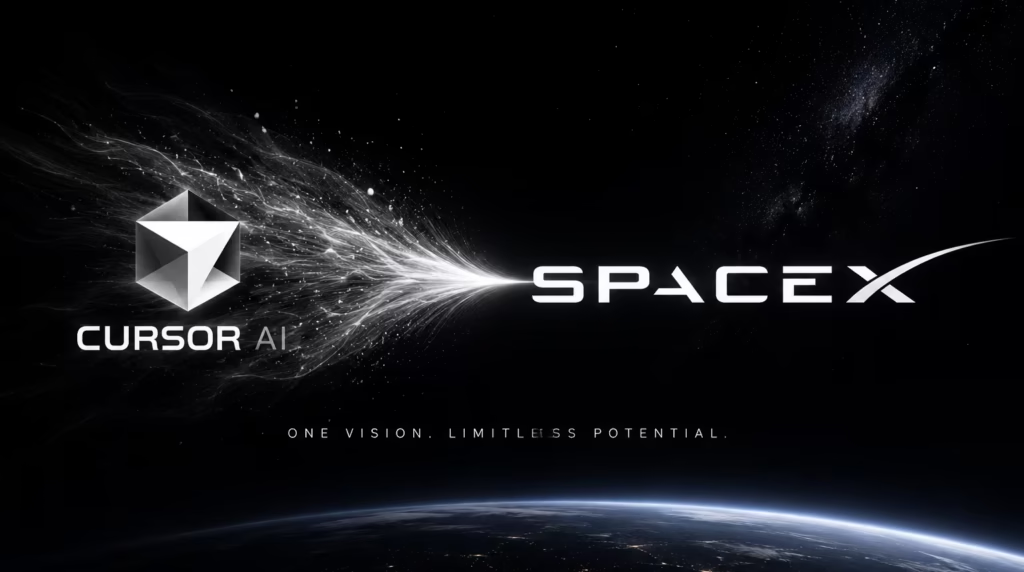
The infrastructure requirements for elite software engineering are driving unprecedented corporate consolidation. According to reports from Bloomberg, Elon Musk’s SpaceX is preparing to acquire the highly popular AI coding startup Cursor in a historic transaction valued at approximately $60 billion.
Here is the operational breakdown of the impending mega-acquisition:
- The Target: Cursor (built by Anysphere) is the fastest-growing AI code editor on the market. It boasts millions of developer users, over $1 billion in annualized revenue, and recently raised capital at a nearly $30 billion valuation.
- The Timeline: SpaceX reportedly plans to finalize the acquisition roughly 30 days after the aerospace giant begins trading publicly, tying the M&A event directly to its highly anticipated initial public offering (IPO).
- The Synergy: Cursor recently released its
Composer 2.5model, which was trained explicitly using xAI’s massiveColossus 2data center. Bringing the startup in-house deeply integrates Cursor’s front-end developer dominance with Musk’s immense back-end compute infrastructure. - The Breakup Fee: Reports indicate the proposed deal is structured with a severe $10 billion cash breakup fee if the transaction fails to close.
Why it matters: If finalized, this acquisition will radically alter the software development landscape. Cursor has successfully challenged GitHub Copilot’s dominance by providing superior, multi-file agentic coding capabilities. By placing Cursor directly under the SpaceX/xAI umbrella, Elon Musk is securing a direct pipeline to the millions of developers who rely on the tool daily, seamlessly funneling them into his proprietary compute ecosystem and creating an absolute powerhouse in automated software engineering.
UrviumAI Suggestion: Proprietary compute combined with superior developer UX is the ultimate competitive moat. If you manage a software engineering team, the potential integration of Cursor into the xAI/SpaceX ecosystem guarantees that the tool will have priority access to some of the largest supercomputers on Earth. If you have not yet migrated your developers to agentic IDEs like Cursor, you are actively burning capital. The speed at which these tools can refactor codebases and automate boilerplate development is about to exponentially increase with Musk’s hardware backing them.
Last AI News: Musk Loses OpenAI Lawsuit, Alexa Podcasts & Anthropic Acquires Stainless
Other AI News Today:
- OpenAI is offering $2 million in AI token credits to every startup in the current Y Combinator batch in exchange for equity, encouraging “tokenmaxxing.”
- Google DeepMind CEO Demis Hassabis was revealed as a personal angel investor in Anthropic, highlighting the deeply intertwined financial web of frontier AI labs.
- Anthropic rolled out self-hosted sandboxes and MCP tunnels for Claude Managed Agents, enabling enterprises to run AI securely on their own infrastructure.
- OpenAI has integrated Google’s SynthID watermarking into ChatGPT images and launched a public verification tool to combat deepfakes and ensure content provenance.
- Google and Blackstone formed a massive joint venture, fueled by a $5 billion investment, to build a new AI cloud company renting out Google’s TPU chips.

Jigar Chaudhary is the Editor-in-Chief at UrviumAI, where he oversees coverage of artificial intelligence news, tools, and in-depth studies. With over 5 years of experience analyzing AI and robotics, he focuses on maintaining high editorial standards, accurate reporting, and clear explanations to help readers understand how AI is shaping the future.