California Moves to Protect Workers Impacted by AI
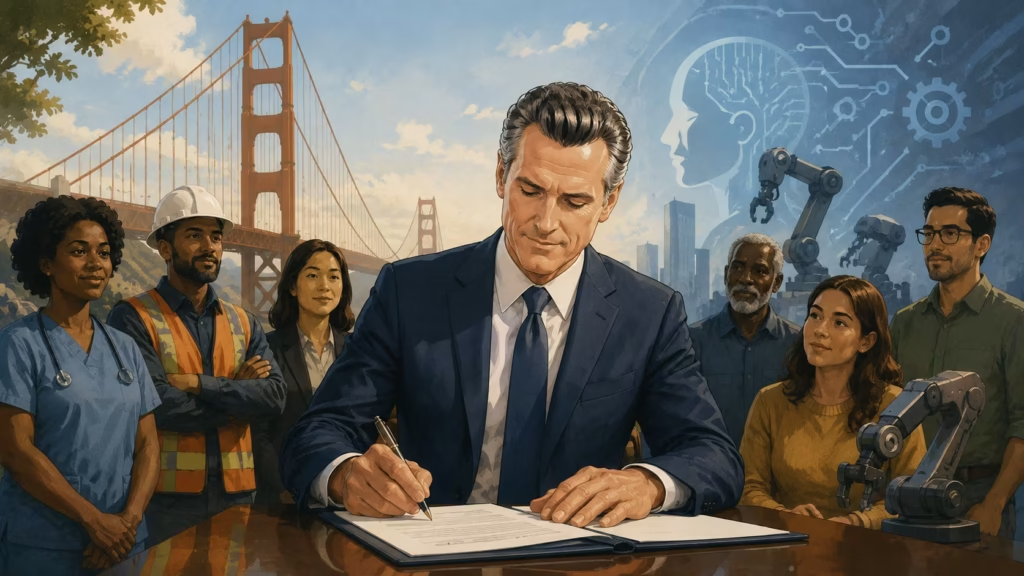
The legislative response to the artificial intelligence labor crisis has officially begun in Silicon Valley’s home state. California Governor Gavin Newsom has signed an executive order directing state agencies to rapidly develop policies to protect workers from AI-driven job losses.
Here is the breakdown of California’s aggressive new labor protection initiative:
- Policy Exploration: State agencies are directed to explore progressive labor safety nets, including severance standards, stock compensation, worker cooperative ownership models, and universal basic capital.
- Rapid Timelines: Within 90 days, the state will launch a public dashboard tracking the exact impact of AI on jobs. Within 180 days, agencies must propose updates to the WARN Act to ensure workers receive faster alerts before mass layoffs.
- Workforce Adaptation: By October 15, the state will review how labor unions are negotiating AI adoption and explore mechanisms to channel AI-generated corporate revenue toward public benefits.
- The Catalyst: The order was notably signed just one day after Meta initiated 8,000 layoffs explicitly designed to offset a massive $145 billion increase in AI infrastructure spending.
Why it matters: With over 70,000 tech jobs already vanishing in 2026, the transition to AI is no longer a theoretical labor threat. Because California houses the vast majority of the world’s top AI companies, this executive order serves as the absolute bleeding edge of global tech regulation. If California successfully implements policies like universal basic capital or AI-revenue sharing, it will set the legislative blueprint for how governments worldwide manage the economic fallout of the agentic era.
UrviumAI Suggestion: Corporate efficiency cannot continuously outpace public stability without triggering heavy regulation. If you are an enterprise leader aggressively replacing human head count with AI agents, you must prepare for imminent financial penalties at the state level. California’s move to explore “severance standards” and “AI revenue sharing” signals that the government intends to heavily tax the productivity gains of automation. Start budgeting for compliance and transition-support taxes now, because the era of consequence-free, AI-driven mass layoffs is ending.
Manus Explores $1B Raise to Unwind Meta Acquisition
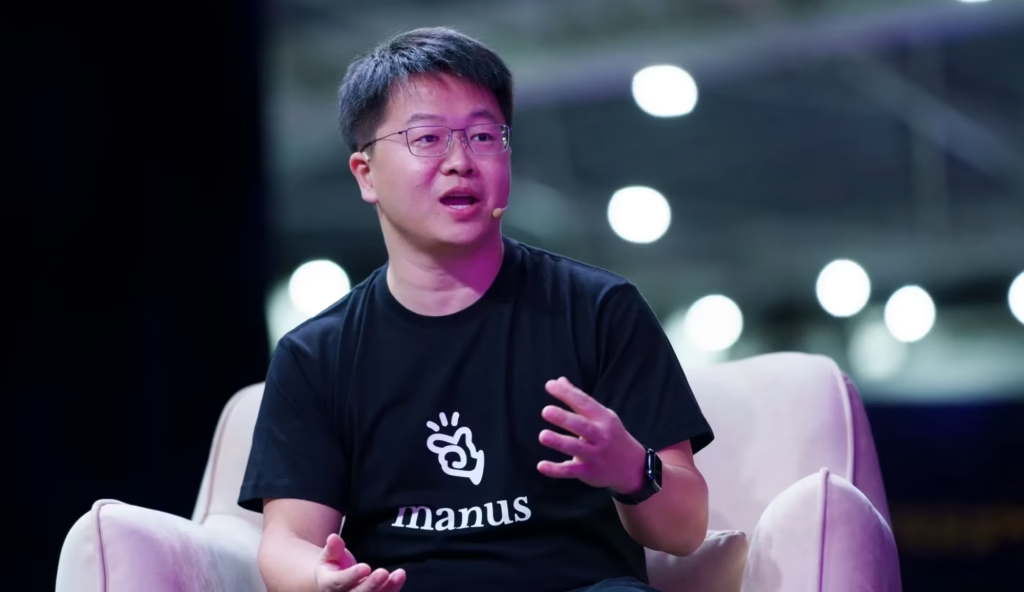
The geopolitical battle over artificial intelligence technology is forcing one of the most complex corporate uncouplings in Silicon Valley history. Agentic AI startup Manus is frantically attempting to raise $1 billion to reverse its recent acquisition by Meta.
Here is the breakdown of the high-stakes international corporate drama:
- The Mandate: Earlier this year, China’s National Development and Reform Commission (NDRC) ordered Meta to completely unwind its $2 billion+ December acquisition of Singapore-based Manus, citing national security concerns over Chinese-origin AI technology.
- The Buyback Strategy: To comply with the mandate, Manus co-founders Xiao Hong, Ji Yichao, and Zhang Tao are exploring a massive $1 billion funding round from external investors to physically buy their company back from Mark Zuckerberg’s tech empire.
- The Valuation Gap: The founders are attempting to secure a valuation that matches the premium Meta originally paid, with reports indicating the founders may inject their own capital to bridge any financial shortfalls.
- The Future Structure: If successful, the massive recapitalization could transform Manus into a China-based joint venture with its new backers, setting the stage for an initial public offering (IPO) in Hong Kong.
Why it matters: This situation proves that the borderless era of global tech venture capital is dead. Even though Manus had relocated its headquarters to Singapore and fired most of its Chinese workforce prior to the Meta deal, Beijing successfully asserted that the underlying technology and the founders’ origins gave China the ultimate regulatory authority over the sale. This effectively kills the ability for American hyperscalers to freely acquire any AI startup that has historical roots or foundational engineering tied to mainland China.
UrviumAI Suggestion: Geopolitical risk is now the highest hurdle in AI mergers and acquisitions. If you are an enterprise scouting for AI acquisitions or investing in early-stage startups, you must conduct extreme geopolitical due diligence. You cannot simply look at where a company is currently incorporated. As Beijing proved with Manus, the origin of the underlying technology and the citizenship of the founding team are enough to trigger massive, retroactive regulatory blocks. Restrict your strategic M&A targets to companies with absolute, undisputed Western IP origins to avoid having your multi-billion-dollar deals unwound months after closing.
OpenAI’s Latest Wave of Codex Upgrades

OpenAI is aggressively evolving Codex from a helpful coding assistant into a persistent, autonomous digital employee. The company has released a massive wave of upgrades for the Codex platform, fundamentally changing how developers interact with the agentic system.
Here are the major workflow enhancements introduced by OpenAI:
- Appshots: Developers on macOS can now instantly attach any open application window including screenshots and hidden off-screen text to a Codex thread using a simple Command-Command shortcut, entirely bypassing the friction of manual copy-pasting.
- Goal Mode: Now widely available across the Codex app, CLI, and IDE extension, this mode allows developers to assign a high-level objective and let Codex work continuously in the background for hours or even days to achieve it.
- Locked Computer Use: Codex can now operate processes behind the scenes and utilize desktop apps even when a Mac is locked and the screen is off, securely triggered and monitored via a secondary device like Codex Mobile.
- Advanced Annotation: A significantly upgraded in-app browser allows users to explicitly highlight and describe what they want changed directly on a live web page, instantly generating code to match the visual request.
Why it matters: These updates completely shift the paradigm of software engineering. By combining “Goal mode” with “Locked computer use,” a developer can instruct Codex to completely refactor a legacy database on a Friday afternoon, close their laptop, go home for the weekend, and track the AI’s autonomous progress from their smartphone. OpenAI is betting that these deep, seamless OS integrations will give Codex a decisive advantage over Anthropic and Google in the battle for enterprise developer dominance.
UrviumAI Suggestion: Context friction is the enemy of automation. If you manage developers, the introduction of “Appshots” is a massive productivity multiplier. Engineers waste hours manually explaining visual bugs or copying terminal errors into chat windows. By allowing the AI to instantly “see” the exact state of the local machine and work continuously toward long-term goals in the background, you are effectively doubling your engineering output. Mandate that your teams leverage these continuous, agentic background workflows immediately to drastically accelerate your software deployment cycles.
Last AI News: OpenAI Solves Erdős Math Problem, Anthropic Q2 Profit & OpenAI’s YC Offer
Other AI News Today:
- Anthropic is in early talks to rent servers powered by Microsoft’s custom-designed Maia AI chips, signalling a major shift in the cloud infrastructure race.
- Brett Adcock’s stealth AI startup, Hark, announced a massive $700 million Series A funding round at a $6 billion valuation to build an AI-native personal assistant and hardware.
- SpaceX’s IPO prospectus revealed that Anthropic is paying the company a staggering $1.25 billion per month for exclusive AI compute capacity through May 2029.
- Microsoft and EY announced a massive $1 billion partnership to scale agentic AI across enterprise clients by pairing Microsoft engineers with 400,000 consultants.

Jigar Chaudhary is the Editor-in-Chief at UrviumAI, where he oversees coverage of artificial intelligence news, tools, and in-depth studies. With over 5 years of experience analyzing AI and robotics, he focuses on maintaining high editorial standards, accurate reporting, and clear explanations to help readers understand how AI is shaping the future.