
Remember when Microsoft was basically OpenAI’s biggest fan, throwing billions at them like a tech sugar daddy? Well, plot twist! Microsoft just announced they’ve been secretly building their own AI models in the basement, and they’re ready to show the world they don’t need anyone else’s homework to copy.
What Actually Happened
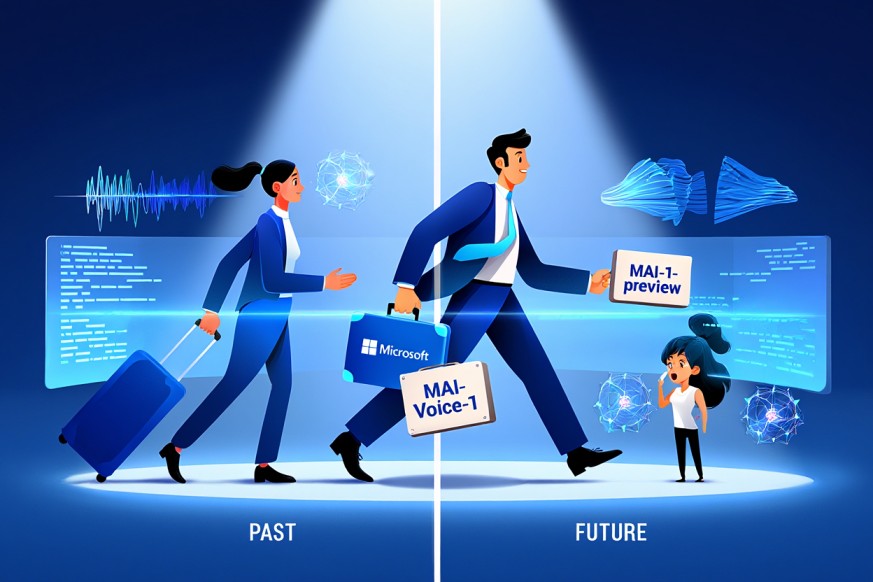
Microsoft dropped two bombshells with fancy names that sound like robot passwords: MAI-Voice-1 and MAI-1-preview. This marks the first time Microsoft said “we got this” and built AI models completely from scratch, without borrowing OpenAI’s brain. It’s like finally learning to cook instead of ordering takeout every night – except the kitchen is worth billions of dollars.
What Makes These AI Models Special
- MAI-Voice-1 Speed Demon: Generates a full minute of speech in under a second – basically the Usain Bolt of AI voices, already powering Copilot Daily and Podcasts
- Resource-Smart Training: MAI-1-preview was trained using way fewer GPUs than competitors, proving Microsoft’s “work smarter, not harder” philosophy
- Everyday Query Specialist: Designed specifically for instruction following and regular human questions – no more “I’m sorry, I can’t help with that”
- CEO Confidence Level: Mustafa Suleyman claims MAI-1 is “up there with some of the best models in the world” (benchmarks coming soon, we promise!)
- Real-World Integration: Already being tested on LM Arena and available via API for developers to play with
Why This Silicon Valley Drama Actually Matters
This isn’t just corporate flexing – it’s Microsoft saying “we’re done being the sidekick in this buddy cop movie.” For years, Microsoft was seen as OpenAI’s wealthy enabler, but now they’re positioning themselves as the main character in their own AI story. Think of it as the tech equivalent of moving out of your parents’ house and actually doing your own laundry.
The Future Impact We’re Looking At
Next 3 Months: Microsoft will quietly integrate these models across Office 365 and Windows, making millions of people interact with Microsoft-built AI without even knowing it.
6-12 Months: The OpenAI partnership will evolve from “total dependency” to “strategic collaboration” – expect some awkward corporate dinners ahead.
1-2 Years: Other Big Tech companies will follow Microsoft’s lead, building their own models instead of licensing everything. The AI supply chain is about to get very interesting.
Long-term Vision: We’re heading toward a world where every major tech company has its own AI personality. Microsoft’s AI will have a different “vibe” than Google’s, which will feel different from Apple’s. Consumer choice is about to get a lot more interesting.
The Bottom Line
Microsoft just proved that being in a relationship with OpenAI doesn’t mean they can’t also work on themselves. The tech giant is growing up, becoming independent, and ready to compete with everyone – including their former AI supplier. Expect some serious AI family drama in 2025.
Want the Technical Details?
Models Released: MAI-Voice-1 (speech generation) and MAI-1-preview (text model)
Performance Claims: Sub-second speech generation, competitive text performance
Training Efficiency: Used fewer GPUs than competitor models
Current Integration: Copilot Daily, Podcasts, LM Arena testing
Availability: API access available, broader rollout in “certain text use cases” coming
Benchmarks: Public benchmarks pending, CEO claims world-class performance
Strategic Impact: First fully in-house Microsoft AI models, reducing OpenAI dependency
Getting Access: Developers can access MAI-1-preview via Microsoft’s API platform and LM Arena testing.
Read more about “A16z Just Dropped Their GenAI Rankings and the Results Will Surprise You“

Jigar Chaudhary is the Editor-in-Chief at UrviumAI, where he oversees coverage of artificial intelligence news, tools, and in-depth studies. With over 5 years of experience analyzing AI and robotics, he focuses on maintaining high editorial standards, accurate reporting, and clear explanations to help readers understand how AI is shaping the future.

Pingback: Scientists Just Cracked the Code to Mind Controlled Robots