Coca-Cola Doubles Down on AI Holiday Ads

Coca-Cola launched its 2025 holiday campaign featuring AI-generated versions of its iconic “Holidays Are Coming” commercials. One year after its first AI attempt sparked backlash from creatives over the tech’s impact on artists.
The details:
- Coca-Cola partnered with AI studios Silverside and Secret Level to produce new spots that swap last year’s unsettling human characters for animals
- The beverage giant cut production from roughly 12 months to 30 days, with one studio needing just five specialists to generate and refine 70,000+ clips
- Coca-Cola’s latest ad comes despite social media backlash for its 2024 Christmas ad spot, with the company also using AI for a separate ad in 2023
- Global VP Pratik Thakar said AI is at the centre of Coca-Cola’s marketing transformation, and that the “genie is out of the bottle” with the use of the tech
Why it matters: Given AI video’s acceleration, this is likely the last Christmas where AI use in ads is even noticeable. Coca-Cola pushing through backlash signals big brands are willing to experiment despite criticism, potentially setting adoption precedent across advertising.
Spider-Like Microbots Target Cancer Detection

Swallowable, spider-inspired soft robots. developed by China’s University of Macau and steered by external magnets, could cartwheel through the GI tract to enable early, less-invasive cancer screening.
The details:
- 3D-printed soft capsules, guided by external magnetic fields, aim to replace invasive scopes, delivering patient-friendly screening for intestinal cancers
- Bot movement simulates Namibia’s golden wheel spider, rolling and cartwheeling to slip through the digestive system without scraping tissue
- In animal tests across the stomach, colon, and small intestine, it navigated complex terrain under real-time magnetic guidance and ultrasound tracking
- The magnetic control system lets doctors steer the capsule wirelessly from outside the body, avoiding anaesthesia
Why it matters: Intestinal cancers are climbing, and traditional endoscopies require sedation, recovery time, and carry perforation risks. If the research team hits its five-year clinical timeline, swallowable spider bots could enable early diagnosis without invasive procedures.
Toyota Unveils Four-Legged Robotic Wheelchair
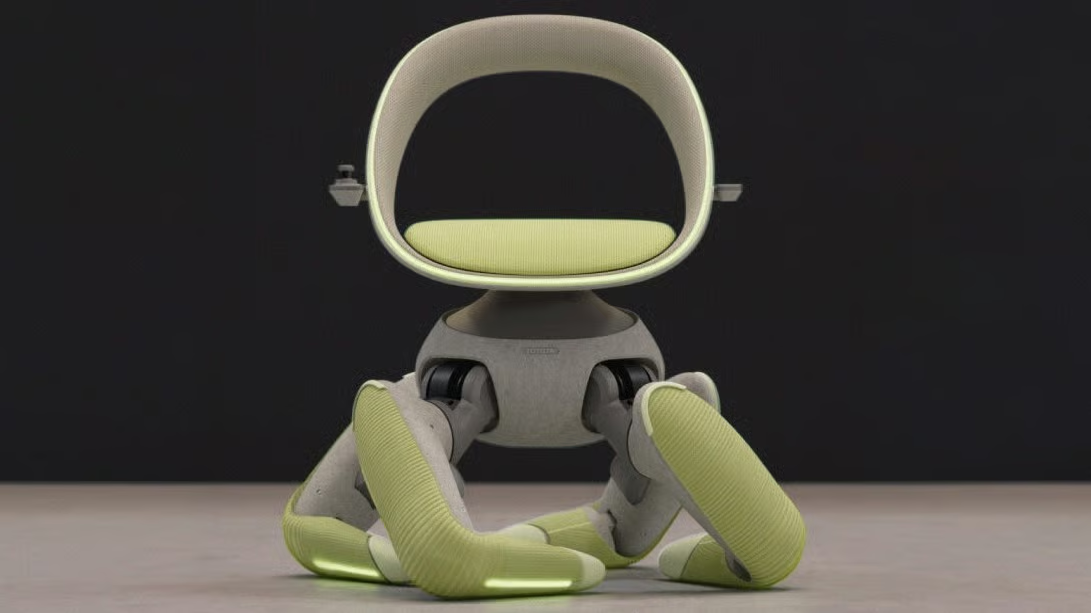
At the Japan Mobility Show, Toyota unveiled “Walk Me,”. A concept autonomous wheelchair that swaps wheels for four foldable robotic legs, letting users climb stairs, cross rough ground, and even kneel to floor level.
The details:
- A supportive frame and curved backrest stabilize posture. While side handles and simple buttons let users command motion with minimal hand strength
- Built for homes and public interiors, the legs retract into a compact package for car loading or storage, then auto-extend and stabilize on command
- The legs move like animal limbs, lifting and bending independently to feel their way over steps and obstacles with precision
- The chair can lift users to vehicle or table height, simplifying transfers and reducing dependence on caregivers
Why it matters: Millions with reduced mobility face barriers like stairs, curbs, and uneven terrain, limiting access to public spaces. Toyota’s Walk Me aims to eliminate these barriers, though it remains a concept with no launch date.
Read more about: Universal Settles with Udio, Canva’s new design model, OpenAI mind read

Jigar Chaudhary is the Editor-in-Chief at UrviumAI, where he oversees coverage of artificial intelligence news, tools, and in-depth studies. With over 5 years of experience analyzing AI and robotics, he focuses on maintaining high editorial standards, accurate reporting, and clear explanations to help readers understand how AI is shaping the future.