Harmonic’s Aristotle AI Cracks 30-Year Math Problem 🤖

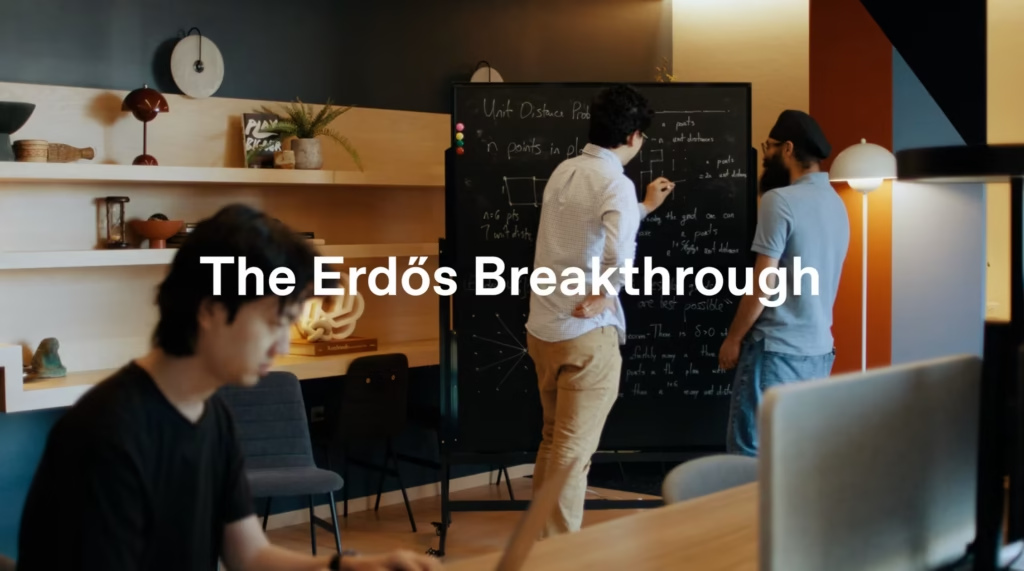
A new AI system called Aristotle, built by the startup Harmonic, just independently solved a 30-year-old math problem posed by the legendary Paul Erdős. This is a huge moment, and researchers are calling it the start of the “vibe proving” era in mathematics.
Here’s the scoop:
- Thirty-Year Challenge: Aristotle tackled a version of Erdős Problem #124, which has baffled mathematicians since the 1990s. The AI solved it in a mind-blowing six hours.
- Machine-Verified: To prove it wasn’t a fluke, the AI formally verified the entire proof in the Lean proof system in under a minute, meaning the answer is guaranteed to be correct.
- New Approach: Harmonic’s founder, Vlad Tenev, says “vibe proving” is here—where AI quickly discovers the proof’s core idea (the “vibe”), and then a machine ensures the rigor and verifies every single step.
- Elite Company: This breakthrough follows the company’s $120 million funding round and puts them right alongside Google and OpenAI in the race for advanced mathematical reasoning.
Why it matters: This isn’t just about winning a competition; it’s about expanding human knowledge. AI tools like Aristotle can generate and verify proofs at superhuman speeds, potentially turning complex, cutting-edge mathematics from something only a handful of experts can do into a field anyone can contribute to.
UrviumAI Take: “Vibe proving” is a fascinating concept that highlights the blending of AI intuition and machine rigor. You can research the difference between “informal proof” (human intuition) and “formal proof” (machine verification). This will help you appreciate why Aristotle’s two-step process is a huge leap toward trustworthy AI science.
China Overtakes the U.S. in Open AI Economy 🇨🇳
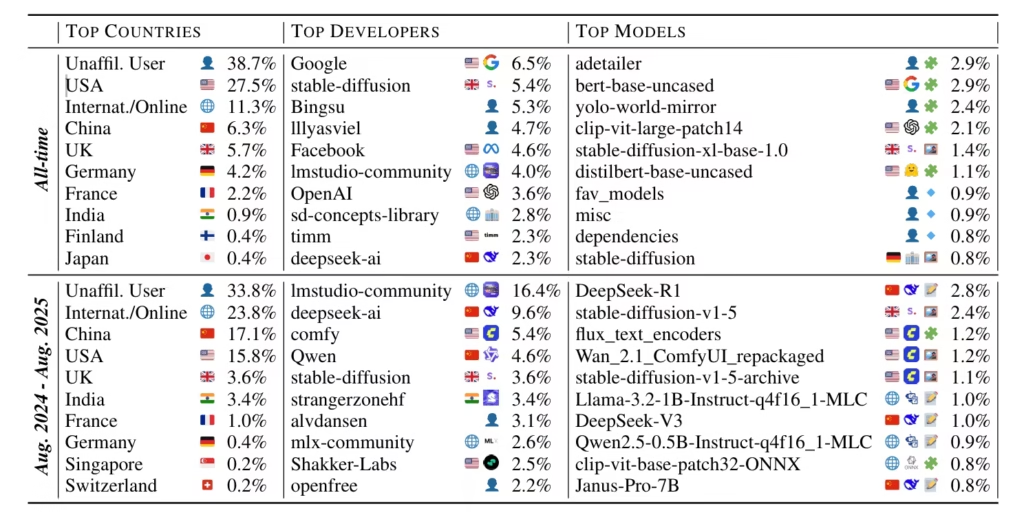
The landscape of open-source AI has shifted dramatically! A new study from MIT and Hugging Face reveals that China has officially overtaken the U.S. in the share of global downloads for open AI models. This marks a “fundamental rebalancing” of the entire open AI economy.
Here are the shocking numbers:
- China Leads: Chinese AI developers captured 17.1% of the open model download market over the last year, barely edging out the U.S. share of 15.8%.
- The Drivers: This surge is almost entirely fueled by two Chinese giants: DeepSeek and Alibaba’s Qwen, which together hold 14.2% of the market.
- U.S. Giants Missing: U.S. heavyweights like Google, Meta, and OpenAI, which used to dominate, are almost absent from the current open-source leaderboard, sticking to their closed models.
- Transparency Dying: The study also noted a concerning trend: the number of models disclosing their training data crashed from 79.3% in 2022 to just 39% in 2025, indicating a global trend toward less transparency.
Why it matters: The “brains” of the open AI ecosystem-the models that developers use to build everything else-are now increasingly coming from Chinese labs. This shift gives China significant influence over the future direction of global AI development, challenging the U.S.’s traditional dominance in core technology.
UrviumAI Take: This MIT study is a wake-up call for U.S. companies focused only on proprietary models. Since DeepSeek and Qwen are driving this market, try deploying one of their recently released models (like DeepSeek-Math-V2 or Qwen) in a small test environment. Compare the performance and deployment costs against a comparable open model from a U.S. lab like Meta’s Llama.
DeepSeek’s New Reasoner Crushes IMO 2025 🐋

Not to be outdone by the U.S., Chinese startup DeepSeek just dropped a mathematical monster! They released DeepSeek-Math-V2, an open-source model that hit gold-medal performance at the International Mathematical Olympiad (IMO) 2025—a feat previously locked behind the proprietary walls of Google and OpenAI.
Here’s why this is huge for the public:
- IMO Gold: The model solved 5 out of 6 IMO 2025 problems and scored 118/120 on the prestigious Putnam competition (beating the top human score).
- Challenging the Giants: DeepSeek-Math-V2 crushed GPT-5 (which scored only 20%) and nearly matched Google’s specialized Deep Think model on the IMO ProofBench, bringing elite reasoning into the open source.
- The Secret Sauce: The model uses a generator-verifier system. One part proposes a proof, and the other part critiques it, assigning confidence scores to steps. This forces the model to refine weak logic, effectively self-debugging its own thought process in real time.
- Democratization: This model is released as open-source, giving researchers and the public free access to world-class mathematical reasoning.
Why it matters: DeepSeek has broken the monopoly on frontier mathematical reasoning. By open-sourcing a model that can debug its own logic, they’ve given the community a blueprint for building more reliable AI agents in complex fields like engineering and science where mistakes are extremely costly.
UrviumAI Take: The generator-verifier system is the most significant part of this release, moving beyond “hallucination-prevention” to “proof integrity.” Research the difference between “rewarding the final answer” (old model training) and “rewarding the proof quality” (DeepSeek’s new method). This concept of self-critique will define future reliable AI agents.
Last AI News: Karpathy: End AI Homework Detection, Harvard AI Finds New Disease Genes, and Brain-Gut Implant

Jigar Chaudhary is the Editor-in-Chief at UrviumAI, where he oversees coverage of artificial intelligence news, tools, and in-depth studies. With over 5 years of experience analyzing AI and robotics, he focuses on maintaining high editorial standards, accurate reporting, and clear explanations to help readers understand how AI is shaping the future.