Claude Code’s Virality Rattles Software Stocks 📉
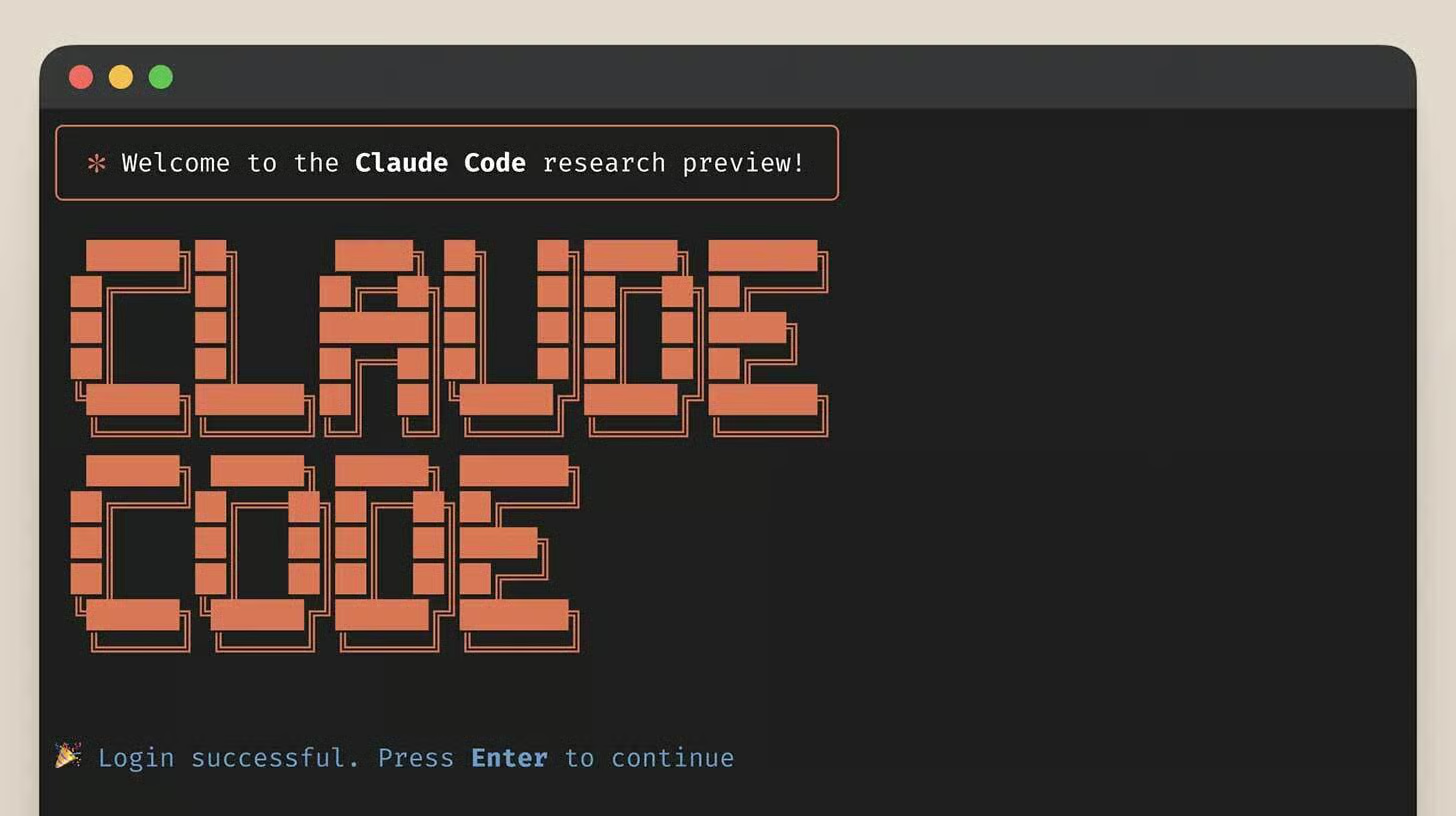
Wall Street is panicking about “Selfware.” A viral wave of developers and hobbyists using Anthropic’s Claude Code to build their own custom applications has triggered a massive selloff in traditional software stocks. The fear? If AI allows anyone to build their own tools instantly, why pay for expensive subscriptions?
Here is the market impact:
- The Crash: A Morgan Stanley SaaS index is down 15% year-to-date. Giants like Adobe, Salesforce, and Intuit have seen double-digit drops as investors question the long-term viability of the “seat-based” pricing model.
- The “Selfware” Era: Viral examples include a CEO who cancelled engineering hires after becoming “5x more productive” and a hobbyist who built a complex MRI viewer from scratch.
- Vercel’s Validation: Even top tech leaders are onboard. The CTO of Vercel reportedly used Claude Code to finish a project in one week that was scheduled to take a year.
- Investor Sentiment: Analysts note that the safety of “recurring revenue” is evaporating. If a company can simply generate a CRM or design tool on demand, the moat protecting legacy software companies disappears.
Why it matters: This is the first time AI has visibly threatened the stock prices of established tech giants not because of what they are doing, but because of what users are doing with AI. We may be witnessing the shift from “Software as a Service” (SaaS) to “Service as Software” (self-generated tools).
UrviumAI Take: The threat isn’t just to software companies; it’s to the “subscription” model itself. If you pay for niche software tools (like a specific format converter or a simple data tracker), try asking Claude Code to “build me a local python script that does X” instead. You might be able to cancel a few subscriptions today.
Korea Kicks Off “AI Squid Game” to Compete with US & China 🦑

It’s a brutal survival contest—but for AI models. The South Korean government has launched a high-stakes tournament dubbed the “AI Squid Game,” designed to force the country’s tech sector to build world-class AI models that can compete with the U.S. and China.
Here is how the competition works:
- Survival of the Fittest: Teams face evaluation every six months. Winners get access to precious government GPUs and datasets; losers are cut off immediately.
- The Eliminations: In a shocking twist, major player Naver was eliminated for using foreign technology, and gaming giant NCSoft was cut for poor performance.
- The Survivors: Subsidiaries of LG and SK Group, along with startup Upstage, survived the first round.
- The Goal: South Korea wants “Sovereign AI”—models built entirely on domestic tech stacks. The government aims to secure the #3 spot globally (behind the US and China) by building a “full-stack AI country.”
Why it matters: This is state-sponsored innovation at its most aggressive. By treating AI development like a national sport (literally livestreaming the results), Korea is betting that intense pressure will breed faster innovation. It highlights how nations are terrified of depending on foreign AI (like OpenAI) for their critical infrastructure.
UrviumAI Take: The elimination of Naver for using “foreign tech” is the key detail. This signals a trend toward “Sovereign AI purity.” Governments are realizing that “wrapping” GPT-4 isn’t enough for national security. Expect other nations (France, India, Japan) to implement similar “domestic-only” requirements for their government contracts soon.
Gartner: Worldwide AI Spending to Hit $2.5 Trillion in 2026 💰

The AI gold rush is entering the “Trillion Dollar” phase. Research firm Gartner just released a massive forecast: global spending on AI is expected to hit $2.52 trillion in 2026. That is a staggering 44% increase from the previous year.
Here is where all that money is going:
- Infrastructure First: The biggest driver isn’t software—it’s hardware. Spending on AI-optimized servers will jump 49%, adding $401 billion to the total as companies rush to build the “foundation.”
- Trough of Disillusionment: Gartner warns that while spending is up, AI is entering the “Trough of Disillusionment.” Companies are realizing AI isn’t magic; it requires massive investments in data and skills before it pays off.
- Buying vs. Building: Most enterprises will buy AI embedded in existing software (like Salesforce or Microsoft 365) rather than building their own “moonshot” projects from scratch.
- The Readiness Gap: Success in 2026 will be defined by “organizational readiness” (having the right people and data), not just financial investment.
Why it matters: $2.5 trillion is a GDP-sized number. This confirms that the AI buildout is real and accelerating, but the focus is shifting from “cool demos” to “heavy infrastructure.” We are pouring concrete and racking servers now so that the software revolution can happen later.
UrviumAI Take: The “Infrastructure” spend ($401B) is the signal. This is bullish for hardware stocks (Nvidia, Dell, HPE) but a warning for software startups. Enterprises are spending their budget on servers, not new apps. To win in 2026, your software must prove immediate ROI to compete with that hardware budget.
Last AI News: Meta’s $600B Infra Push, Basecamp’s ‘Eden’ Biology AI, & McKinsey’s 25k Agents

Jigar Chaudhary is the Editor-in-Chief at UrviumAI, where he oversees coverage of artificial intelligence news, tools, and in-depth studies. With over 5 years of experience analyzing AI and robotics, he focuses on maintaining high editorial standards, accurate reporting, and clear explanations to help readers understand how AI is shaping the future.