
Apple Acquires AI Startup Q.ai for $2 Billion 🍎

Apple just bought the ability to read your lips. In its biggest acquisition since buying Beats in 2014, Apple has reportedly paid nearly $2 billion for Q.ai, an Israeli AI startup specializing in advanced audio and vision technology.
Here is the tech Apple just secured:
- Silent Speech: Q.ai’s core innovation is detecting “facial micro-movements.” This allows a device to understand what you are saying even if you just mouth the words silently—a game-changer for using Siri in public or noisy places.
- The Team: The startup is led by Aviad Maizels, the same entrepreneur who sold PrimeSense to Apple in 2013 (the tech that became Face ID). He and his team are joining Apple’s hardware division under Johny Srouji.
- The Integration: While details are secretive, this tech fits perfectly into AirPods and the Vision Pro, allowing for hands-free, voice-free control.
- M&A Strategy: This massive purchase signals Apple is done sitting on the sidelines. After years of small acqui-hires, spending $2B on a single AI capability shows Apple is aggressively accelerating its hardware roadmap for 2026/2027.
Why it matters: “Silent Siri” solves the biggest social friction of voice assistants: looking weird talking to your phone in public. If Apple can let you send a text by simply mouthing it, they unlock a new layer of “ambient computing” that no other competitor currently offers.
UrviumAI Take: This is the evolution of Face ID into Face Command. Watch the next AirPods Pro announcement. If they include “muscle sensors” or “optical tracking” features, it confirms that Apple plans to turn your face into a keyboard.
Darren Aronofsky Debuts “Artist-Led” AI Series 🎬

Hollywood meets DeepMind. Acclaimed director Darren Aronofsky (Black Swan, The Whale) has launched a groundbreaking new series titled “On This Day… 1776.” Produced by his AI studio, Primordial Soup, the project reimagines the American Revolution using state-of-the-art generative video.
Here is how the series blends art and algorithm:
- The Format: Short episodes drop on TIME’s YouTube channel exactly 250 years to the day after the historical event they depict.
- The Tech: The visuals are generated using Google DeepMind’s Veo models, creating painting-like, dreamlike recreations of 18th-century battles and moments.
- The Human Touch: Aronofsky emphasizes this is “artist-led AI.” Instead of fully automated generation, the series uses SAG-AFTRA voice actors for narration and human editors to craft the final cut, aiming for a hybrid workflow rather than replacement.
- The Vision: Aronofsky stated the goal is to expand what’s possible for storytellers, allowing them to visualize historical epics that would normally require $200 million budgets.
Why it matters: This is a major credibility boost for AI video. When an Oscar-nominated director embraces the tech publicly, and specifically partners with union actors to do it responsibly, it paves a path for AI to enter Hollywood not as a villain, but as a new camera lens.
UrviumAI Take: The “250-year anniversary” timing is a brilliant engagement hook. Watch the aesthetic. Aronofsky isn’t trying to make it look “real” (photorealistic); he’s leaning into the “dreamlike” quality of AI. This suggests the future of AI film might be stylized animation, not just fake reality.
xAI’s Video Model Climbs Leaderboard at $4.20/min 🎬
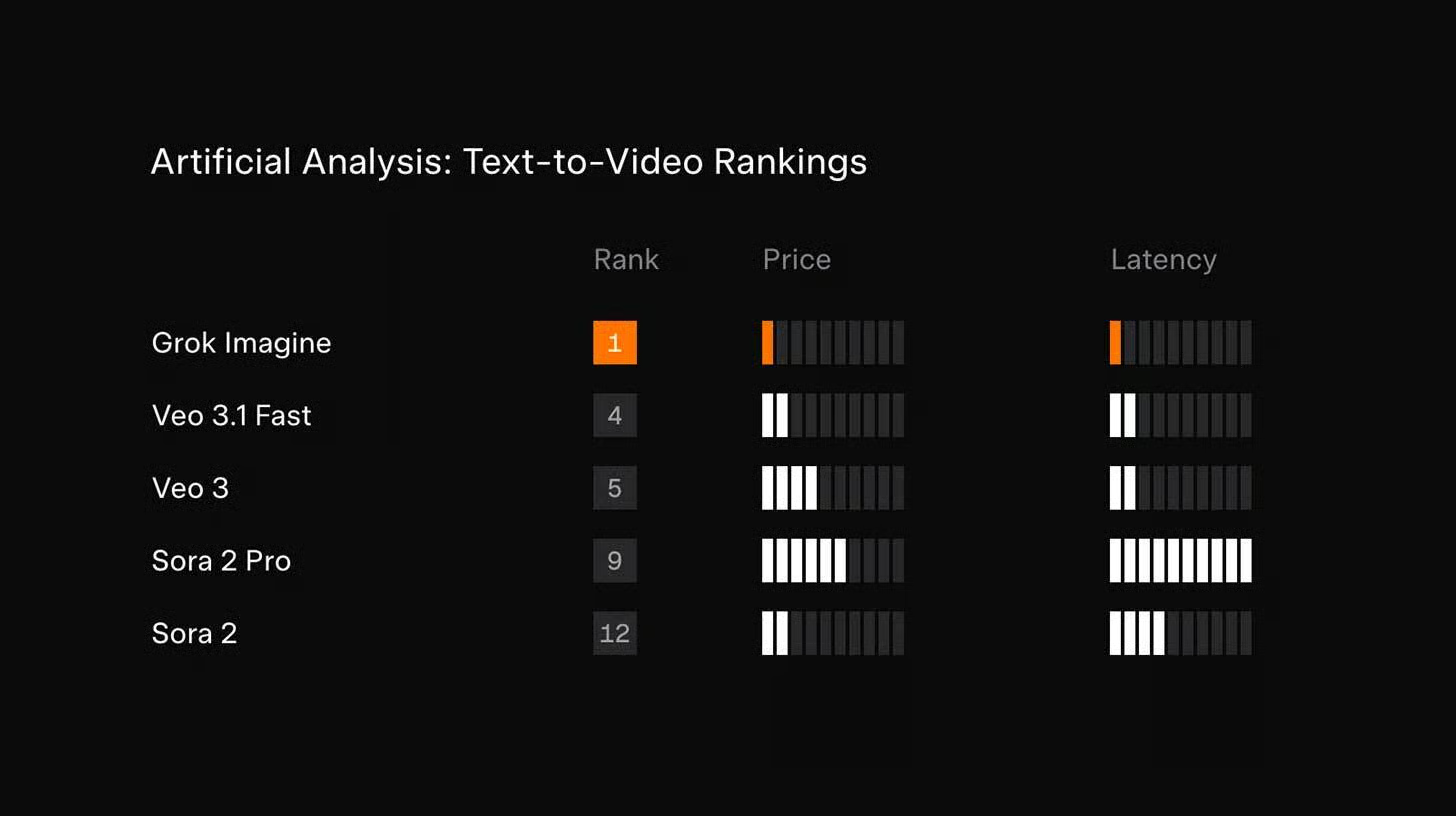
Elon Musk is price-warring the AI video market. xAI has officially released the Grok Imagine API, and it is shaking up the generative media landscape with a combination of high quality and shockingly low prices.
Here is the breakdown of xAI’s new contender:
- Top Performance: Imagine debuted at #1 on the Artificial Analysis leaderboard for both text-to-video and image-to-video, beating out early versions of competitors in blind tests.
- Aggressive Pricing: xAI is charging just **$4.20 per minute** of generated video (including audio). For context, Google’s Veo 3.1 costs ~$12/min and OpenAI’s Sora 2 Pro is estimated around $30/min.
- Features: The API supports clips up to 15 seconds, native sound generation, and advanced editing tools like object swap and style transfer.
- Developer Focus: By releasing this as an API immediately, xAI is encouraging developers to build apps on top of Grok Imagine before OpenAI fully opens the floodgates for Sora.
Why it matters: xAI is using its compute advantage (the massive Memphis cluster) to commoditize AI video. By offering top-tier quality at 1/3rd to 1/7th the price of rivals, Musk is trying to capture the developer market early. If high-quality AI video becomes cheap enough, we will see an explosion of generated content in apps, ads, and games.
UrviumAI Take: The $4.20 price point is a strategic meme, but also a ruthless business move. If you are a developer, now is the time to experiment with video apps. At this price, building a “personalized birthday video generator” or “dynamic ad creator” is finally economically viable for mass users.
Last AI News: Google Adds Agentic AI to Chrome, China Approves Nvidia Chips & New AI Labs Raise Billions

Jigar Chaudhary is the Editor-in-Chief at UrviumAI, where he oversees coverage of artificial intelligence news, tools, and in-depth studies. With over 5 years of experience analyzing AI and robotics, he focuses on maintaining high editorial standards, accurate reporting, and clear explanations to help readers understand how AI is shaping the future.

Pingback: SpaceX Buys xAI for $1.25T, AI Agents Form a Religion, Claude Drives on Mars