Can AI help the environment? This is the question most people are afraid to ask directly, because the answer is more complicated than either side wants to admit.
Here’s what the research actually says. A latest study by LSE and Systemiq found that AI applications in just three sectors, power, food, and mobility, could reduce global emissions by 3.2 to 5.4 billion tonnes of CO₂ equivalent every single year by 2035. According to a peer-reviewed study by LSE and Systemiq published in the journal npj Climate Action.
So, to put that in perspective, that figure outweighs the total projected emissions from every AI data center on the planet combined.
And that’s not a small number. That’s a genuinely significant number right?
But, and this is a real but, that potential only exists under specific conditions. Conditions that, right now, don’t reliably exist at scale anywhere in the world.
In this article, we are gonna talk about both those truths at once. The hope and the honest truth.
What Is Green AI, and Is It Different From Regular AI?
When we hear “green AI” we picture solar panels on a data center. That’s part of it, but only just a part.
Green AI actually means two separate things, and almost nobody explains this clearly.
The first meaning of AI is green models built to use less energy, run on renewable power sources, and produce fewer emissions per computation.
The second meaning of AI is used for green purposes, climate modeling, wildfire detection, precision farming, and methane leak tracking. These are genuinely different ideas, and a model can be one without being the other.
A massive language model running on coal-powered servers, used to monitor deforestation in the Amazon, is that green AI? Technically, yes on purpose, absolutely not on design.
That distinction matters because it shapes how we measure progress. Sustainable AI isn’t just about what the technology does. It’s about how it was built, what powers it, and whether the two sides of that equation actually line up.
Here’s a simple way to think about it:
| Dimension | Traditional AI | Green AI |
|---|---|---|
| Design goal | Maximum performance | Performance + minimum energy |
| Energy source | Whatever’s available | Renewable where possible |
| Model size | Bigger tends to be better | Efficient architecture prioritised |
| Transparency | Rarely disclosed | Sustainability reporting encouraged |
AI for sustainability means both columns moving in the right direction at the same time. But, right now, most of the industry is still somewhere in between.
Where AI Climate Solutions Are Actually Working

Search “AI and climate change” and you’ll find no shortage of listicles. Ten ways AI is saving the planet. Eight examples of AI fighting climate change. Fifteen breakthroughs you need to know about.
Most of them read the same way, one sentence per use case, a stock image of a wind turbine, and a vague conclusion about AI’s “incredible potential.”
You know what’s missing here? Depth. Specifics. Named companies, real numbers, and an honest look at what’s actually happened versus what’s been announced in a press release.
So instead of covering twelve things shallowly, this section covers fewer, but with actual detail. Because one example you can verify and remember is worth more than ten you’ll forget by tomorrow.
So, the Problem With Generic AI Climate Lists Every “AI for climate change” article covers the same three use cases in the same order. Renewable energy. Agriculture. Wildfires. They’re not wrong; those are important.
But the coverage almost always stops at the surface level, which leaves readers with a vague sense that AI is doing something useful without any real understanding of what, where, or how much. That’s the gap this article fills. And let’s get specific.
How AI Is Being Used in Renewable Energy
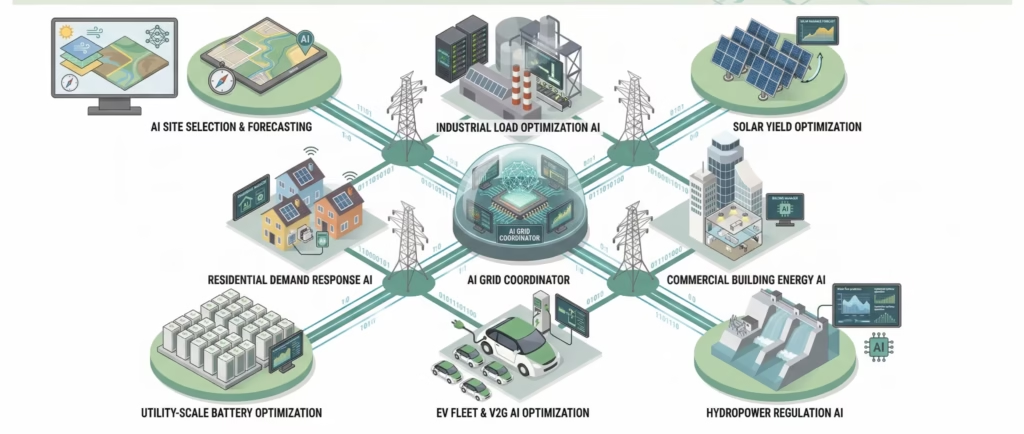
Here’s something that doesn’t get nearly enough attention: one of the biggest problems with renewable energy isn’t generating it. It’s managing it.
Solar and wind are unpredictable by nature. The sun doesn’t always shine when demand peaks. The wind doesn’t blow on cue. And traditional energy grids built for steady, controllable fossil fuel output struggle to handle that variability.
The result? Enormous amounts of renewable energy get wasted because the grid can’t absorb it fast enough. This is called curtailment, and it’s a bigger problem than most people realise.
AI changes this equation. By predicting renewable supply and demand in real time, AI-powered grid management systems can balance the load far more effectively than human operators.
Studies suggest AI-driven grid optimisation can reduce renewable energy curtailment by up to 30% in some systems, meaning significantly more clean energy actually reaches homes and businesses instead of being discarded.
Google’s DeepMind is the most cited example, and for good reason.
DeepMind’s AI reduced the energy used for cooling Google’s own data centers by 40%, and the same principles are now being applied to broader grid management.
In the UK, National Grid is using AI forecasting to better predict renewable generation and reduce reliance on gas-powered backup plants that kick in when clean supply dips.
None of this is science fiction. It’s running right now.
AI for Climate Modeling: Can It Actually Predict the Future?
Climate modeling is one of those areas where AI has delivered something genuinely surprising, results that are not just incrementally better, but categorically different.
Traditional climate models run on supercomputers and can take days or weeks to produce a forecast. Google DeepMind’s GraphCast, an AI weather model released in 2023, can produce a full 10-day global weather forecast in under 60 seconds.
Sixty seconds. And it outperformed the European Centre for Medium-Range Weather Forecasts, widely considered the gold standard in meteorology, on 90% of test targets. Google DeepMind published the full GraphCast research alongside open-sourced model code, meaning forecasters worldwide can use and build on it.
Better forecasts mean better early warnings for floods, droughts, and extreme heat events. That matters everywhere but it matters most in places that are both most exposed to climate risk and least equipped to respond.
The MyAnga app in Kenya is a good example of this playing out in practice. Using AI-powered drought forecasts drawn from global meteorological data, the app delivers actionable predictions to pastoralists on their mobile phones, so herders can plan livestock movement before a drought hits, not after. It’s a small thing by global standards. For the families depending on it, it’s not small at all.
As Demis Hassabis, CEO of Google DeepMind, said that “AI will be one of the most transformative tools humanity has ever developed, and one of the most important applications is accelerating our understanding of the natural world.”
That’s exactly what better climate modeling represents. Not just faster forecasts, but a faster path to decisions that keep people safer.
AI for Wildfire Detection, Methane, and Smarter Farming
Renewable energy and climate modeling get most of the headlines. But some of the most compelling AI climate work is happening in quieter, few places, and it deserves more attention than it gets.
AI for Wildfire Detection and Disaster Early Warning
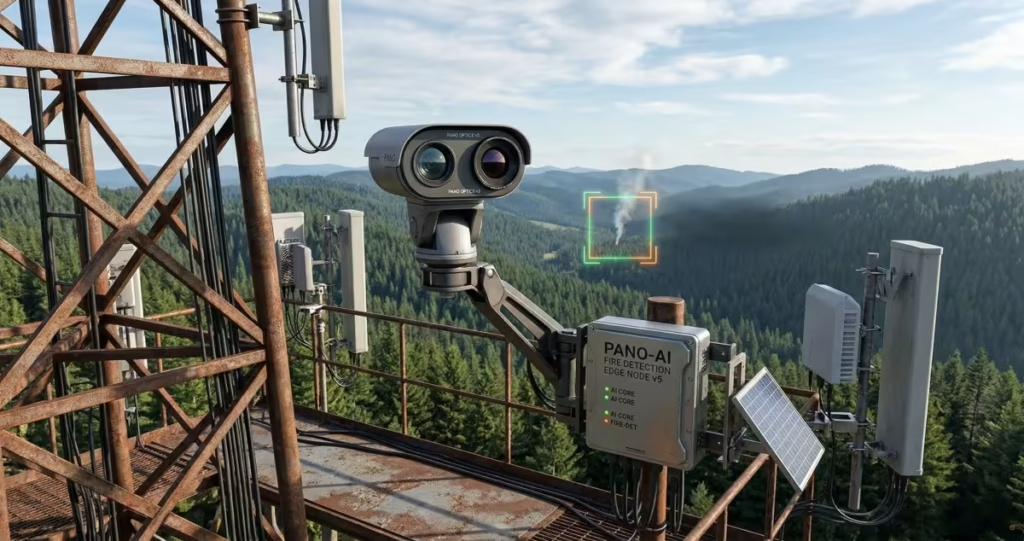
Wildfires don’t really announce themselves. By the time smoke is visible to a human observer, a fire may already have spread beyond containment range. Early detection, measured in minutes, sometimes seconds, is the difference between a manageable incident and a catastrophe.
ALERTCalifornia is doing exactly this. The system runs AI-powered cameras across more than 1,000 sites across California, using computer vision trained on thousands of historical fire images to detect smoke within seconds of ignition before human operators would spot it on a monitor.
The AI distinguishes smoke from fog, clouds, and dust with enough reliability to trigger automated alerts rather than waiting for human confirmation.
In 2023, early AI detection helped contain several California fires that would have spread significantly before traditional methods triggered a response.
Similar systems are now being piloted in Australia, Portugal, and parts of southern Europe, regions where wildfire seasons are extending and intensifying year on year.
AI Methane Detection: The Invisible Emissions Problem
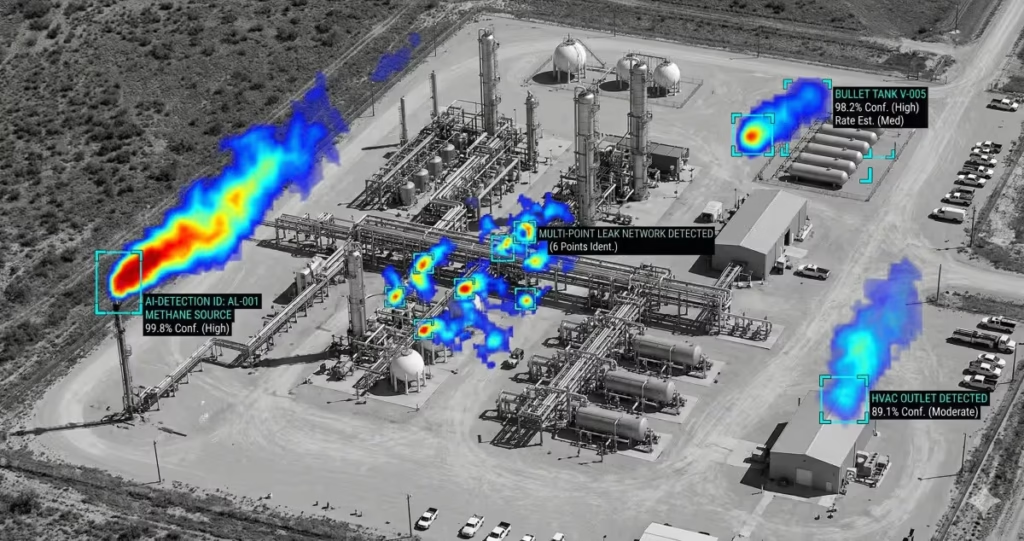
Methane is roughly 80 times more potent than CO₂ as a greenhouse gas over 20 years. And for decades, a significant portion of global methane emissions from oil and gas infrastructure went largely undetected because there was simply no way to monitor it at scale.
And AI changed that. Kayrros, a Paris-based climate analytics firm, uses AI to analyse satellite imagery and detect methane leaks from oil and gas infrastructure globally. Before tools like this existed, only a handful of major methane events were known about at any given time.
After Kayrros began operating, thousands of leak events were detected per year, and its data are now used by the United Nations Environment Programme to verify companies’ emissions reports.
This partnership, officially called the Methane Alert and Response System, was launched at COP27 and is now used to hold energy companies accountable at a global scale.
Just think about what that means practically. Companies that were quietly leaking methane either through negligence or deliberate underreporting now have satellite-level scrutiny applied to their infrastructure. That’s accountability that didn’t exist five years ago, made possible entirely by AI.
It’s one of those cases where AI provides something physically impossible before real-time global monitoring at a scale no human team could replicate.
AI and Precision Agriculture: Farming Smarter, Not Harder
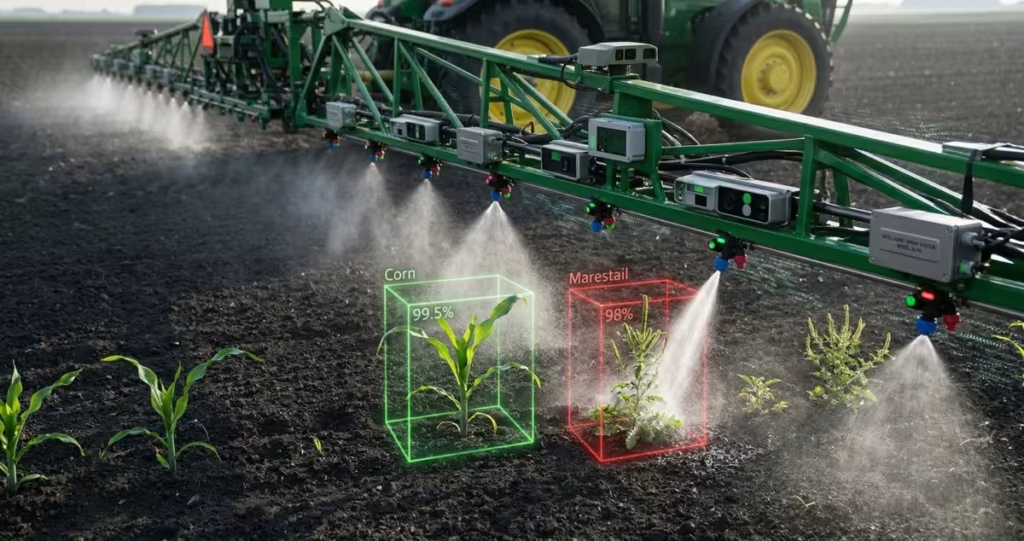
Agriculture accounts for roughly 10 to 12% of global greenhouse gas emissions. A significant chunk of that comes from overuse of fertiliser and water, inputs that are applied broadly because, without better data, farmers can’t tell where they’re needed and where they’re not.
AI in precision agriculture changes this. John Deere’s See & Spray technology uses computer vision to identify individual weeds in a crop field and spray herbicide only on those weeds, leaving the surrounding crop untreated.
The result: usage of herbicide reduced by up to 77% per application. Less chemical runoff. Lower emissions from the production and transport of those chemicals. And lower costs for the farmer.
In India, where water stress is one of the most urgent agricultural challenges, precision agriculture AI is being piloted in Andhra Pradesh and Maharashtra.
They use soil sensors and AI-driven irrigation systems to reduce water use per crop yield, which matters most in regions where groundwater depletion is already at crisis levels. It’s not yet at scale. But the direction is right, and the need is urgent.
London-based startup Greyparrot is tackling the waste side of the equation using AI to analyse processing facilities and track recyclable material.
In 2022 alone, their system tracked 32 billion waste items across 67 categories, identifying on average 86 tonnes of recyclable material per facility that was being incorrectly sent to landfill.
The Rebound Effect: Why AI Efficiency Can Backfire
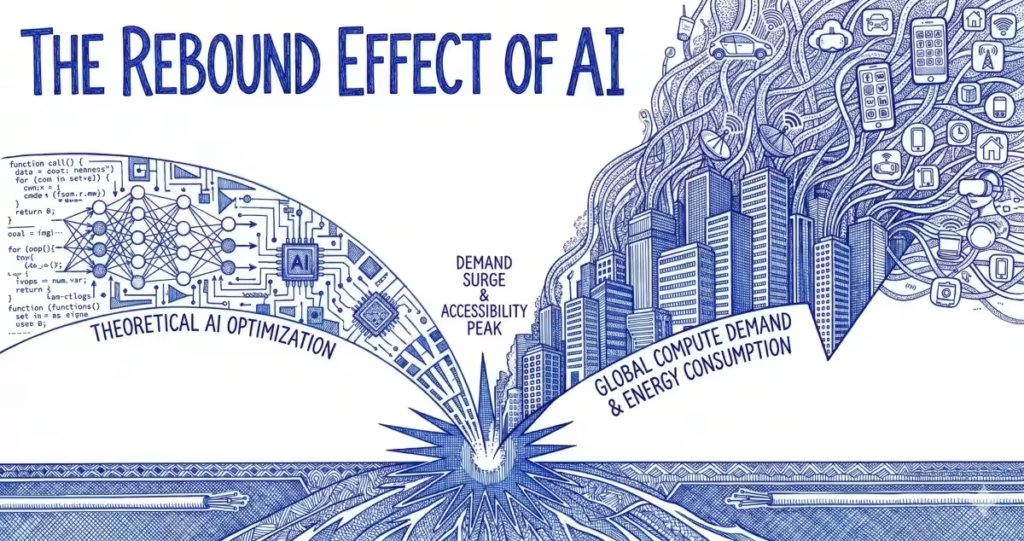
The rebound effect, this is actually more important than the use cases above.
So let me explain what it is. When a technology makes something more efficient, cheaper to run, faster to produce, and easier to access, people tend to use more of it. Not less.
So the efficiency gain is absorbed by increased demand, and sometimes total consumption ends up higher than before the improvement.
This isn’t a new phenomenon. It’s been observed since the 19th century, when more efficient steam engines led to more coal being burned, not less, because suddenly coal-powered production became so affordable that demand exploded.
And AI is also highly vulnerable to the same dynamic.
A meta-analysis across 150 studies found that AI-driven efficiency improvements frequently lead to higher overall consumption, because now it’s cheaper, and faster processes attract greater use.
The savings don’t disappear. They get reinvested into doing more of the thing that was just made cheaper.
The autonomous vehicle example makes this concrete. AI makes cars more fuel-efficient per mile. That’s genuinely good. But cheaper, easier, more comfortable travel may also cause people to travel significantly more, taking trips they wouldn’t have before, moving further from cities, and choosing driving over public transport.
Some projections suggest total transport energy use could double in an AI-optimised vehicle world, not less.
The same logic applies to AI-optimised industrial manufacturing. If AI cuts the cost of production, manufacturers produce more.
If AI reduces the energy needed per unit of steel, steelmakers may increase output. Total emissions can rise even as efficiency per unit falls.
Google is the most visible example of this tension in action. Their data centers are now nearly 30 times more energy-efficient per computation than Google’s first Cloud TPU in 2018.
Thirty times. That’s an really impressive engineering achievement. And yet Google’s total emissions are 51% higher than 2019 levels, driven directly by AI’s growing energy demands.
The International Energy Agency has been direct about this. They’ve warned that AI’s climate benefits are not automatic: “There is currently no momentum that could ensure widespread adoption of these applications, and their aggregate impact could be marginal if enabling conditions aren’t created.”
This comes directly from the IEA’s Energy and AI report, the most comprehensive data-driven analysis of the AI-energy relationship published to date.
The rebound effect doesn’t mean AI can’t help with climate change. It means the benefit requires deliberate structure around it. Like carbon pricing and energy caps.
Regulation that prevents efficiency gains from simply enabling more consumption. Without that structural layer, green AI risks being green in name only, a technology that does the right thing locally while making the broader problem quietly worse.
Can AI Help Reduce Carbon Emissions or Make Them Worse?
The hope is real. AI applications in power, food, and mobility alone could reduce global emissions by 3.2 to 5.4 billion tonnes of CO₂ equivalent annually by 2035.
Total global AI data center emissions are projected at roughly 1 billion tonnes by the same year. On paper, that’s a net positive of 2 to 4 billion tonnes annually, meaning AI could remove more carbon than it creates, by a wide margin.
But, that 5.4 billion tonne potential only materialises if AI is widely deployed for climate applications, not just for productivity, entertainment, and commerce.
It only works if those applications run on clean energy, not coal-heavy grids. And it only holds if the rebound effect is actively constrained by policy rather than left to compound quietly in the background.
Right now, none of these conditions is reliably met at scale.
The IEA has said: there is currently no momentum ensuring widespread adoption of AI for climate purposes.
Not because the technology isn’t ready, it is. But because the incentive structures, the regulatory frameworks, and the infrastructure to deploy it properly don’t exist yet where they’re needed.
AI and carbon emissions have a complicated relationship, not because the science is unclear, but because the gap between what AI could do and what it’s actually being used for is enormous.
Sasha Luccioni, an AI climate researcher at Hugging Face and one of TIME Magazine’s 100 most influential people in AI, said that: “There’s no free lunch. Every digital process carries an environmental cost.”
She’s right. But the flip side is also true: every digital process, pointed in the right direction, carries potential that most industries haven’t come close to tapping yet.
So, the gap is not a technology problem. It’s a policy and infrastructure problem, which means it’s solvable, but not by engineers alone.
What Is Holding Green AI Back?
If the potential is this large, billions of tonnes of emissions reduced, wildfires caught earlier, crops farmed smarter, methane leaks spotted from orbit, why isn’t it happening faster?
Four reasons. And none of them are about technology.
1. Energy source dependency. AI’s climate benefit is only as clean as the electricity powering it.
A wildfire detection system running on a coal-heavy grid still carries a carbon cost. A climate modeling tool powered by Indian thermal plants is doing good work through a dirty pipeline.
The application can be genuinely valuable while the infrastructure behind it quietly undermines the gain. Until clean energy reaches the grids where AI infrastructure actually sits, not just where press releases are written.
2. No policy incentives to deploy AI for climate. There is currently no regulatory requirement anywhere for AI companies to direct their tools toward climate applications. No mandate to report whether their sustainability commitments include Scope 3 emissions.
No carbon pricing mechanism that would make deploying AI for emissions reduction more financially attractive than deploying it for ad targeting or content generation.
So,right now, the incentives don’t strongly reward climate work.
3. Data gaps in the Global South. The regions most exposed to climate risk, sub-Saharan Africa, South Asia, and Southeast Asia, have the least data infrastructure for AI to work with. AI climate tools are disproportionately designed, trained, and deployed for rich-country contexts.
The MyAnga app in Kenya and India’s precision agriculture pilots are important precisely because they’re exceptions.
The UN is supporting AI-driven climate projects in Burundi, Chad, and Sudan but these remain isolated initiatives rather than systematic deployments. The communities that need these tools most are the last to receive them.
4. The rebound effect, without policy, efficiency backfires. We covered this in detail in the previous section. But it belongs here too, as a structural barrier rather than just a concept.
AI cannot constrain its own rebound effect. No amount of engineering solves it. Only regulation does carbon pricing, energy caps, and consumption limits that prevent efficiency gains from simply enabling more of the same. Without that layer, green AI remains a ceiling with no floor underneath it.
We have Technology ready. The obstacles are political, economic, and infrastructural which means they require a different kind of solution than building a better model.
Conclusion – The Tension Worth Taking Seriously

Green AI isn’t a product you buy or a label a company earns by publishing a sustainability report. It’s a set of conditions the right model, the right energy source, the right application, held together by policy that actually enforces the relationship between efficiency and outcome.
Right now, those conditions exist in patches. Kayrros tracking methane from orbit. DeepMind forecasts the weather in seconds. Farmers in Maharashtra are getting smarter irrigation data. ALERTCalifornia catching fires before they spread. These aren’t small things, they’re proof that the potential is real and the technology is ready.
But patches aren’t a climate strategy.
The LSE research says AI could deliver a net reduction of 2 to 4 billion tonnes of emissions annually by 2035 after accounting for its own energy costs.
But the IEA says there’s currently no momentum ensuring it actually happens. That’s the most sobering number, and it barely gets quoted either. The full analysis, covering all sectors and scenarios, is in the IEA’s Energy and AI executive summary, which is freely available
Both deserve more attention than they’re getting.
If you want to understand the full picture of water consumption, land use, hardware manufacturing, and how AI’s environmental cost fits together as a system, we covered all of it in our guide to the environmental impact of AI.
And for a model-by-model breakdown of exactly how much CO₂ AI actually produces, including ChatGPT, Gemini, and reasoning models, that’s covered in our AI carbon footprint guide.
The technology is ready. The conditions aren’t yet. That gap is solvable but not by AI alone.
FAQs
How is AI being used to fight climate change?
AI is fighting climate change through several real applications: optimising renewable energy grids to reduce wasted clean power, detecting methane leaks from satellites, improving wildfire early warning systems, building faster climate models, and making agriculture more resource-efficient. These aren’t theoretical; companies like Kayrros, ALERTCalifornia, and Google DeepMind are doing this work right now.
How does green AI work?
Green AI works by designing algorithms and models that require less computation to run, through techniques like model pruning, quantisation, and distillation, which reduce the number of calculations needed without sacrificing much accuracy. On the application side, it works by directing AI specifically at problems where efficiency gains translate into real-world emissions reductions: smarter grids, better forecasts, less wasted fertiliser and water.
How is artificial intelligence helping improve climate models?
AI dramatically speeds up climate modeling. Google DeepMind’s GraphCast can produce a 10-day global weather forecast in under 60 seconds, a process that previously took supercomputers days. It outperformed the European Centre for Medium-Range Weather Forecasts on 90% of test targets. Better, faster climate models mean better early warnings for floods, droughts, and extreme heat events, which directly save lives.
What is the green use of AI?
The green use of AI means directing its capabilities at environmental problems: optimising clean energy grids, detecting methane leaks from satellites, forecasting extreme weather, monitoring deforestation, reducing water and fertiliser use in farming, and tracking recyclable waste. The key distinction is that AI being used for green purposes isn’t automatically green in how it’s built or powered; both sides of that equation matter.
How harmful is AI to the environment?
AI’s environmental harm comes primarily from the electricity consumed by data centers, much of which still comes from coal and natural gas, and the water used to cool those facilities. Google’s total emissions are 51% higher than 2019 levels despite significant efficiency improvements, driven directly by AI’s energy demands. The harm is real but not fixed; it depends heavily on where data centers are located and what energy powers them. For a full breakdown, see our environmental impact of AI guide.

Jigar Chaudhary is the Editor-in-Chief at UrviumAI, where he oversees coverage of artificial intelligence news, tools, and in-depth studies. With over 5 years of experience analyzing AI and robotics, he focuses on maintaining high editorial standards, accurate reporting, and clear explanations to help readers understand how AI is shaping the future.