Lund University Develops AI Blood Test for Brain Diseases 🩸
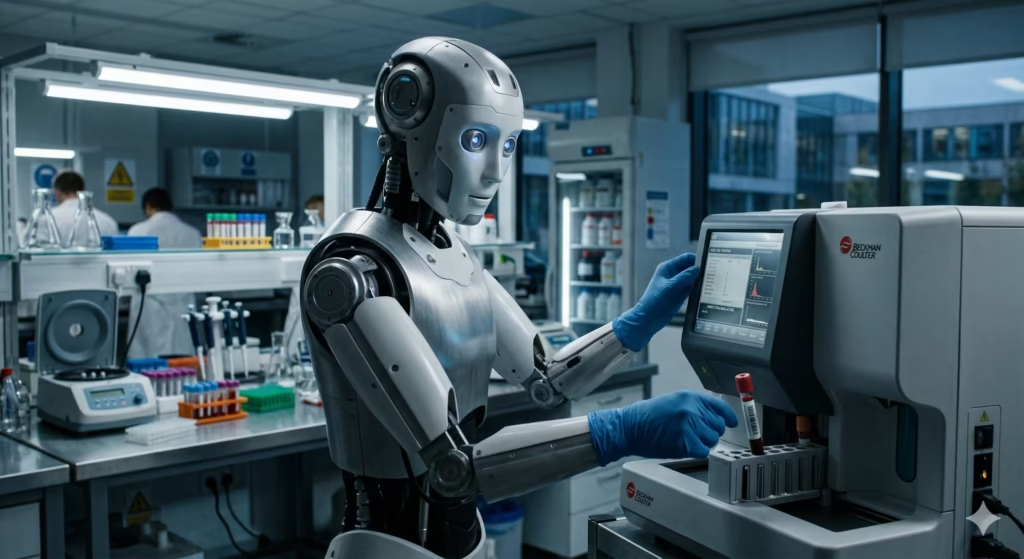
Artificial intelligence is rapidly advancing non-invasive medical diagnostics. Researchers at Lund University have developed a powerful new AI model capable of identifying patterns linked to multiple neurodegenerative diseases using just a single blood sample.
Here is how the new diagnostic AI operates:
- Massive Data Training: The system was trained on protein data from over 17,000 individuals via the GNPC, an international consortium hosting one of the world’s largest proteomics databases for brain diseases.
- Pattern Recognition: The AI analyzes complex protein patterns in the blood to differentiate between conditions with overlapping symptoms, even when a patient may suffer from more than one disease simultaneously.
- Broad Detection: The model successfully detected biological signals associated with several severe conditions, including Alzheimer’s, Parkinson’s, ALS, and frontotemporal dementia.
- Current Status: While the breakthrough is significant, researchers caution that the model requires further clinical validation before it is ready for standalone use in hospitals.
Why it matters: Diagnosing age-related cognitive decline currently involves expensive, invasive, and time-consuming procedures like spinal taps or PET scans. By training AI to spot the exact protein signatures of complex brain diseases in a simple blood draw, researchers are paving the way for faster, cheaper, and highly scalable early-detection screenings that could revolutionize global neurology.
UrviumAI Take: Healthcare AI is shifting from image analysis to molecular pattern recognition. If you operate in the health tech or biotech space, look beyond radiology and computer vision. The next massive wave of medical AI investment will focus on proteomics and genomics. Start exploring how machine learning can be applied to massive biological datasets to find the invisible, overlapping patterns that human doctors cannot spot with the naked eye.
Anthropic Issues Takedowns After Claude Code Leak 🕵️♂️

One of the world’s most valuable AI startups is currently in damage control following a massive intellectual property breach. Anthropic accidentally leaked parts of the proprietary source code behind its highly popular Claude Code AI tool onto the public internet.
Here are the details behind the accidental exposure:
- The Blunder: The leak was entirely due to human error during a routine software update, which mistakenly made internal instructions and code visible on GitHub rather than a malicious hack.
- The Exposure: While no confidential customer data or core AI model weights were compromised, the leak revealed Anthropic’s proprietary agent instructions, including how Claude coordinates tasks, manages memory, and uses external tools.
- The Takedowns: Attempting to contain the spread, Anthropic rapidly issued copyright takedown requests (DMCA notices), leading to the removal of over 8,000 GitHub repositories that had cloned or adapted the code.
- The Risk: Security experts warn that exposing this internal logic gives competitors a free roadmap to replicate Claude’s features and provides hackers with deep insights into potential vulnerabilities within the agent’s architecture.
Why it matters: AI companies guard their internal system prompts and agent orchestration loops as closely as Coca-Cola guards its recipe. While the core “brain” of Claude remains secure, leaking the actual instructions that tell the AI how to act as a coding assistant completely erodes Anthropic’s competitive advantage, handing open-source developers and rival tech giants a masterclass in AI software engineering for free.
UrviumAI Take: Your orchestration layer is your true intellectual property. As base AI models become increasingly commoditized and similar in performance, the real value of your AI product lies in how you string the tools, prompts, and memory systems together. Treat your agent workflows and internal system prompts as highly classified trade secrets. A single deployment error, like Anthropic’s, can instantly surrender years of expensive R&D to your competitors.
Jack Dorsey Replaces Block’s Middle Management with AI 🏢

The corporate hierarchy is being flattened by artificial intelligence. Twitter founder and Block CEO Jack Dorsey has co-authored a controversial new post outlining a radical corporate restructuring: replacing the entire middle management layer with AI.
Here is the strategy behind Block’s aggressive organizational pivot:
- The Cuts: In February, Block laid off over 4,000 employees roughly 40% of its workforce. Dorsey framed this not as a sign of financial weakness, but as a deliberate restructuring for the AI era.
- The AI Manager: Dorsey argues that managers traditionally exist simply to route information up and down a chain of command. He believes AI can now handle this by maintaining a continuously updated, live “world model” of the entire business.
- The New Hierarchy: With middle management eliminated, everyone at Block now falls into one of three distinct roles: individual builders, “problem-owners” responsible for specific outcomes, and “player-coaches” who develop talent.
- The Data Source: Because Block operates as a remote-first company, every decision, plan, and piece of code already exists as a digital record, providing the perfect raw data for an AI agent to analyze and manage.
Why it matters: This is the most aggressive real-world implementation of an AI-first corporate structure to date. If Dorsey successfully runs a multi-billion-dollar financial technology company using AI agents to coordinate workflows instead of human managers, it will trigger a tectonic shift in the labor market. Bloated legacy firms will be forced to adopt this ultra-lean, AI-driven model just to compete on speed and margins.
UrviumAI Take: AI is shifting from a productivity tool to an organizational structure. Evaluate your daily tasks. If your primary value to your company is collecting status updates from your team and summarizing them for executives above you, you are highly vulnerable to automation. You must pivot your career focus toward strategic decision-making, specialized execution (building), or high-level human mentorship, as the purely administrative routing of information is officially a job for algorithms.
Last AI News: Oracle’s AI Layoffs, OpenAI’s $122B Superapp & Stagecraft Project
Other AI News Today:
- Chinese students are renting AI-powered smart glasses to secretly scan exam questions and generate instant answers, creating a highly profitable cheating epidemic.
- SpaceX has filed for what could be the largest IPO in history, targeting a $1.75T valuation and up to a $75B raise after absorbing Elon Musk’s xAI.
- Roughly 2,400 mental health professionals at Kaiser Permanente in Northern California went on strike over concerns that AI could eventually replace therapists.
- Publishing giant Penguin Random House filed a lawsuit against OpenAI in Munich, claiming ChatGPT unlawfully reproduced its “Coconut the Little Dragon” books.
- Z.ai launched GLM-5V-Turbo, a powerful native multimodal vision coding model capable of reading screenshots and design drafts to generate runnable code.

Jigar Chaudhary is the Editor-in-Chief at UrviumAI, where he oversees coverage of artificial intelligence news, tools, and in-depth studies. With over 5 years of experience analyzing AI and robotics, he focuses on maintaining high editorial standards, accurate reporting, and clear explanations to help readers understand how AI is shaping the future.