
ChatGPT Starts Connecting to Your Money 💰
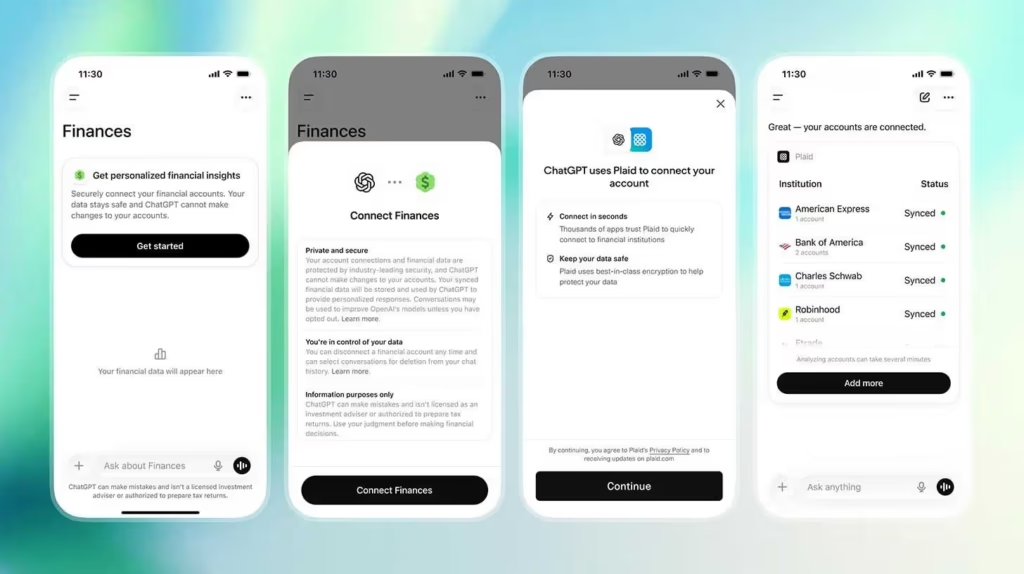
The application layer of generative AI is moving directly into personal asset management. OpenAI has officially launched a personal finance vertical inside ChatGPT, partnering with financial aggregator Plaid to grant the chatbot secure, real-time context over users’ spending, portfolios, and outstanding liabilities.
Key features of OpenAI’s financial orchestration:
- Hyperscale Aggregation: Through Plaid, users can link credentials across Chase, Charles Schwab, Robinhood, and over 12,000 global financial institutions into a unified, interactive dashboard.
- The Interface: The feature is being rolled out as a preview for U.S.-based Pro accounts, accessible via a dedicated “Finance” sidebar panel or by directly calling the
@financeagent in standard chat threads. - Intuit Partnership: OpenAI has explicitly outlined a looming integration with Intuit, designed to handle proactive tax optimization modeling, algorithmic credit-card approval metrics, and on-demand routing to human financial advisors.
- Security Restrictions: To protect consumer trust, the model operates purely on a read-only context architecture; it cannot execute monetary transfers, pay bills, make stock trades, or file legal tax paperwork autonomously.
Why it matters: For the last decade, retail wealth management has been trapped behind expensive human advisors or static, non-reasoning budgeting apps. By feeding a comprehensive, live financial ledger directly into an LLM context window, OpenAI transforms ChatGPT into a highly tailored, proactive wealth advisor. The security framework handled by Plaid acts as the critical trust layer, paving the way for AI to manage everyday personal microeconomics.
UrviumAI Suggestion: Contextual data aggregation is the real moat in the agentic era. If you operate a fintech app, transactional bank, or neo-broker, you must accept that the front-end user experience is migrating to conversation. Consumers will soon stop opening separate banking apps to audit their cash flow; they will simply ask their personal AI agent. You must immediately expose secure, standardized read-only APIs to platforms like Plaid, ensuring your financial products are seamlessly discoverable and parsable by frontier models.
Artist Shines Mirror on AI Anger with Viral Monet Post 🎨
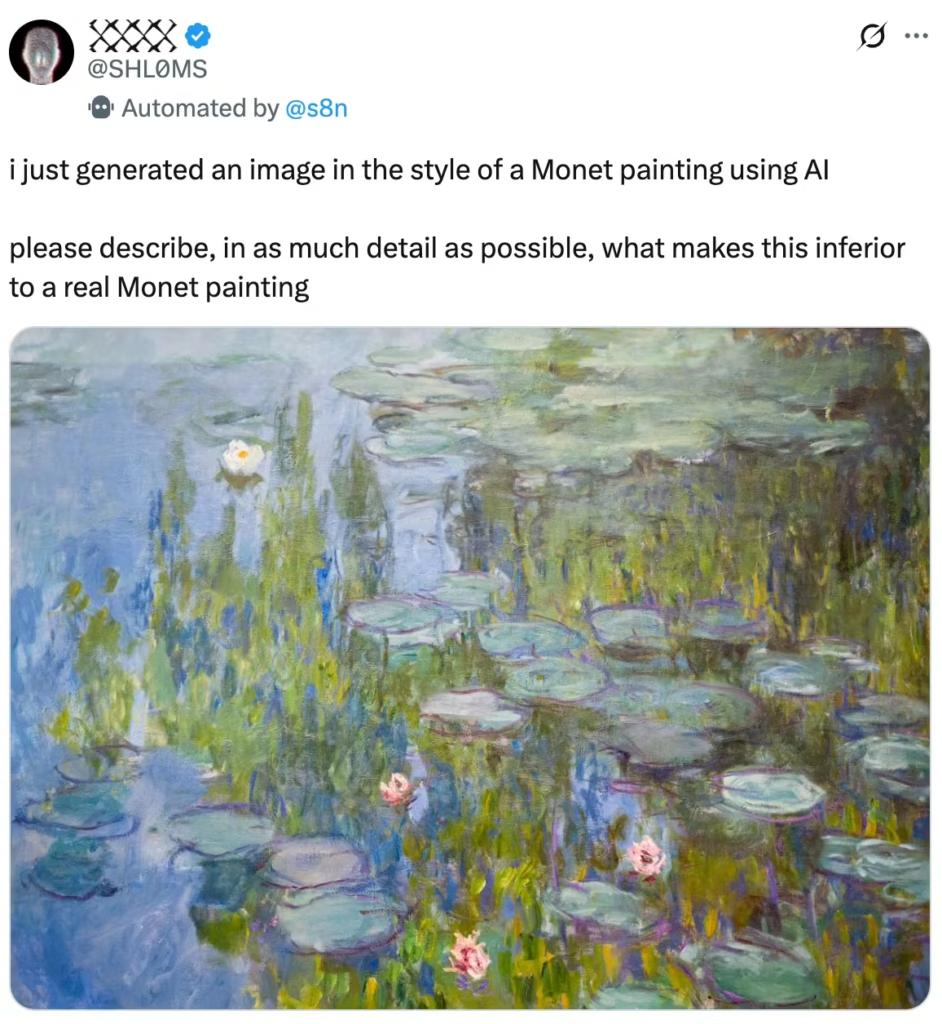
The baseline artistic critique of generative media has been exposed as a psychological reflex. Conceptual artist SHL0MS sparked a massive viral frenzy on X by posting an authentic, historical painting from impressionist master Claude Monet while claiming it was a newly generated AI image, eliciting thousands of intensely critical responses.
- The Hoax: SHL0MS uploaded an image of a real painting from Monet’s Water Lilies collection (circa 1915), telling his followers he generated it “in the style of Monet” and asking for specific breakdowns of why the “AI slop” was inherently inferior.
- The Backlash: The post instantly drew thousands of detailed critiques from anti-AI art communities, with commentators labeling the brushwork “soulless,” “emotionless,” and slamming the composition and lighting as clear signs of machine algorithmic failure.
- The Research Baseline: The social experiment mirrors academic research published in late 2024, where Scandinavian researchers noted that while blind audiences frequently prefer the visual aesthetics of AI art, labeling an asset as “AI-generated” immediately triggers a harsh negative bias.
Why it matters: “Monet-gate” proves that much of the contemporary philosophical outrage directed at generative art is untethered from the actual visual properties of the work. The word “AI” has become a profound cognitive trigger within the creative ecosystem. This knee-jerk hostility means that as generative tools integrate deeper into commercial graphic design, advertising, and film production, creators will face heavy ideological resistance from audiences based purely on attribution rather than quality.
UrviumAI Suggestion: Aesthetic evaluation is dominated by confirmation bias. If you are a digital marketer, brand strategist, or creative director deploying generative image models (like Krea 2 or Images 2.0), protect your brand from ideological internet dogpiling. Do not explicitly announce that your marketing collateral or visual backdrops are AI-generated unless legally mandated. Audiences can no longer visually differentiate between human mastery and algorithmic rendering; their backlash is entirely driven by the label, not the pixels.
Brockman Takes Charge of OpenAI Product Strategy 🛠️
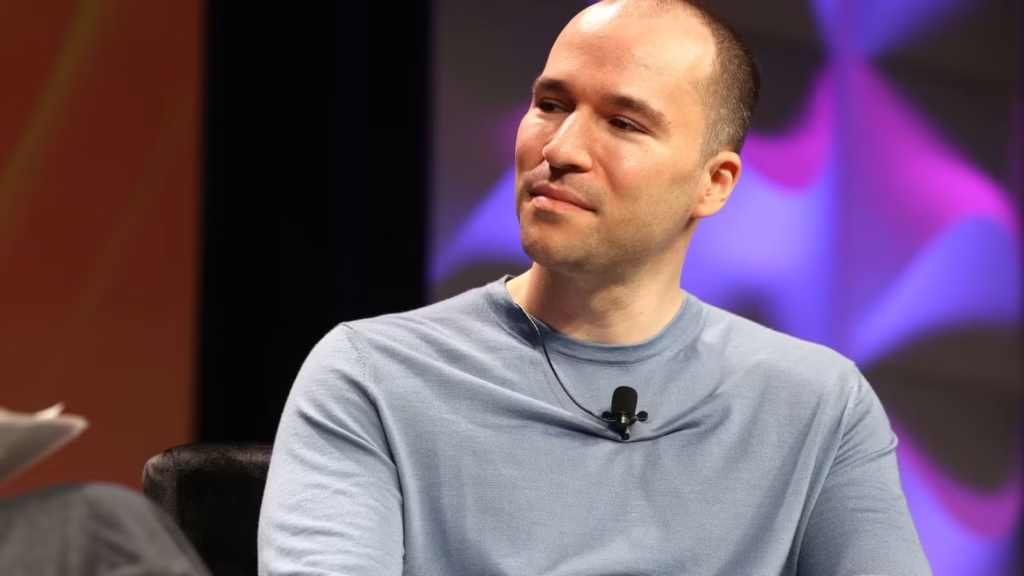
OpenAI is undergoing a major internal consolidation to prepare for highly autonomous, multi-step agent deployments. Co-founder and President Greg Brockman has officially taken direct control of the company’s product strategy division, filling the operational void left as AGI Deployment CEO Fidji Simo takes an extended medical leave.
Behind OpenAI’s internal product realignment:
- The Restructuring: Brockman is actively unifying OpenAI’s disparate engineering teams into a single, cohesive unit. Thibault Sottiaux has been tapped to lead core product and platform, while Nick Turley shifts to enterprise products.
- The Unified Engine: According to internal memos leaked to Wired, Brockman’s primary mandate is to completely merge the consumer ChatGPT interface with the technical capabilities of Codex into a singular, unified workspace experience.
- Ending Side Quests: This reorg cements the “code red” directive issued by CEO Sam Altman, which effectively halted speculative “side quests” including the Sora video branch and specialized science units to refocus capital entirely on core conversational utility.
- The Agentic Focus: Brockman stated the consolidation is explicitly designed to maximize focus toward the “agentic future,” creating an streamlined infrastructure to win over both retail consumers and Fortune 500 enterprise accounts.
Why it matters: OpenAI spent the last two years operating like a decentralized research playground, spinning out separate models for video, text, code, and robotics. This restructuring proves that the era is over. Facing a brutal enterprise market share challenge from Anthropic, OpenAI is consolidating its brightest minds under Brockman to build a single, hyper-focused ecosystem where ChatGPT can seamlessly manipulate the code-executing power of Codex natively.
UrviumAI Suggestion: Platform consolidation is a massive signal for enterprise software buyers. Stop viewing ChatGPT and Codex as separate software pipelines. OpenAI’s internal merging of these products means that the next major update to your ChatGPT subscription will feature native, highly autonomous code execution and system manipulation capabilities out of the box. Ensure your developer teams are building internal tooling that can interface w ith a unified OpenAI platform rather than maintaining disjointed API integrations.
Last AI News: Anthropic’s Credit Split, Codex Mobile & OpenAI vs. Apple
Other AI News Today:
- A new Gallup survey reveals that 71% of Americans oppose building AI data centers in their local area, citing resource strain and electricity costs.
- A Texas family has filed a wrongful death lawsuit against OpenAI, alleging that ChatGPT provided dangerous drug-use advice that led to the death of their 19-year-old son.
- OpenAI has quietly acquired Weights.gg, an AI startup famous for creating a voice-cloning social network, distributing its staff across internal teams.
- AI startup Poetiq released research showing its Meta-System achieved new State-of-the-Art (SOTA) coding performance through recursive self-improvement.
- Anthropic has partnered with the Gates Foundation, committing $200 million to deploy Claude in global health, education, and economic mobility programs.

Jigar Chaudhary is the Editor-in-Chief at UrviumAI, where he oversees coverage of artificial intelligence news, tools, and in-depth studies. With over 5 years of experience analyzing AI and robotics, he focuses on maintaining high editorial standards, accurate reporting, and clear explanations to help readers understand how AI is shaping the future.

Pingback: Musk Loses OpenAI Lawsuit, Alexa Podcasts & Anthropic Acquires Stainless