You asked ChatGPT to rewrite an email that wasn’t quite landing right. Maybe Google summarised an answer at the top of your search results before you even clicked a link. Maybe a friend showed you an image they made in Midjourney in about thirty seconds, something that would’ve taken a professional designer hours.
All of that is generative AI. It’s already woven into the tools millions of people use every single day, often without realising it.
But here’s the question most people ask: what actually is it? Not the marketing version. Not the sci-fi version. Just what is generative AI, really, and how does it do what it does?
That’s exactly what this guide explains. Just a clear, honest breakdown of one of the most talked-about technologies of our time and what it actually means for you.
What Is Generative AI? A Simple Definition
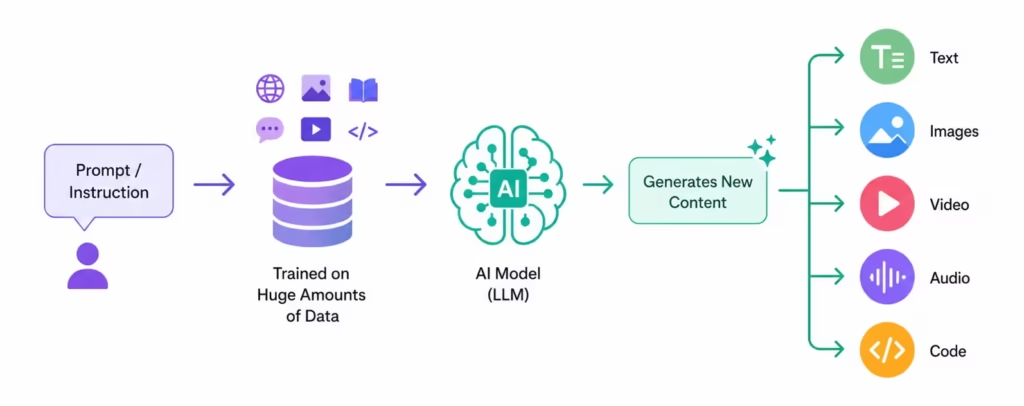
Generative AI, sometimes called gen AI for short, is technology that creates new content in response to a prompt or instruction. That content can be text, images, video, audio, or code. You ask, it creates. That’s it.
Generative artificial intelligence works by learning patterns from enormous amounts of existing data, like content, billions of web pages, images, books, conversations, and lines of code, and then using those patterns to produce something new.
Here’s the analogy that actually makes this click: think about the autocomplete feature on your phone keyboard. It guesses the next word based on everything you’ve typed before, your habits, your phrasing, and your usual word choices.
Generative AI does exactly the same thing, except it’s been trained on an almost incomprehensible amount of data, and instead of predicting one word at a time, it can produce entire essays, photorealistic images, working software code, and voices that sound genuinely human.
The technology behind text-based gen AI is called a large language model, or LLM. ChatGPT, Google Gemini, and Claude are all built on LLMs. When you type a question and get a coherent, detailed response back within seconds, that’s an LLM doing what it was trained to do, predicting, word by word, what a useful answer looks like.
Sam Altman, CEO of OpenAI, described it simply: “ChatGPT is a tool, not a creature. It doesn’t understand. It predicts.” That single sentence is more useful than most 2,000-word technical explanations.
Generative AI vs AI: What’s Actually Different?
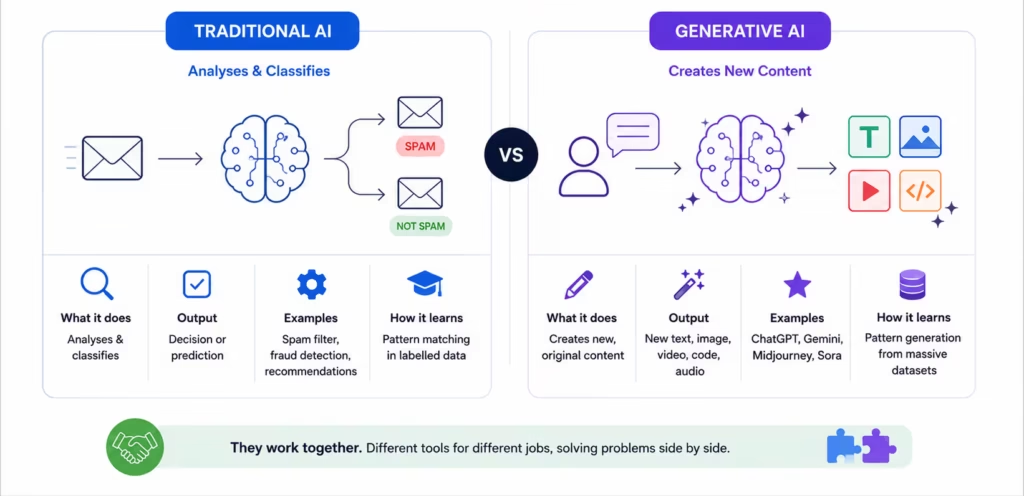
AI isn’t new. It’s been part of everyday life for years: spam filters, Netflix recommendations, fraud detection on your credit card, the algorithm that decides what shows up in your Instagram feed. All of that is AI.
So what makes generative AI different? The simplest way to think about it: traditional AI is like a judge. It looks at something and makes a decision, spam or not spam, fraud or not fraud, this movie or that movie. It analyses existing content and classifies it.
Generative AI is like an author. It doesn’t just evaluate, it creates. It produces something that didn’t exist before you asked for it. A paragraph, an image, a melody, a block of code. That fundamental shift from analysing to creating is what makes generative AI feel so different from everything that came before it.
| Traditional AI | Generative AI | |
|---|---|---|
| What it does | Analyses and classifies existing content | Creates new, original content |
| Example task | “Is this email spam?” | “Write me an email about this topic” |
| Output | A decision or prediction | New text, image, video, code, audio |
| Real tools | Spam filters, Google Search ranking, fraud detection | ChatGPT, Gemini, Midjourney, Sora |
| How it learns | Pattern matching in labelled data | Pattern generation from massive datasets |
Traditional AI and generative AI aren’t competitors. They coexist. Your email app uses traditional AI to filter spam and generative AI to suggest replies. They’re solving different problems, with different tools, at the same time.
How Does Generative AI Work?
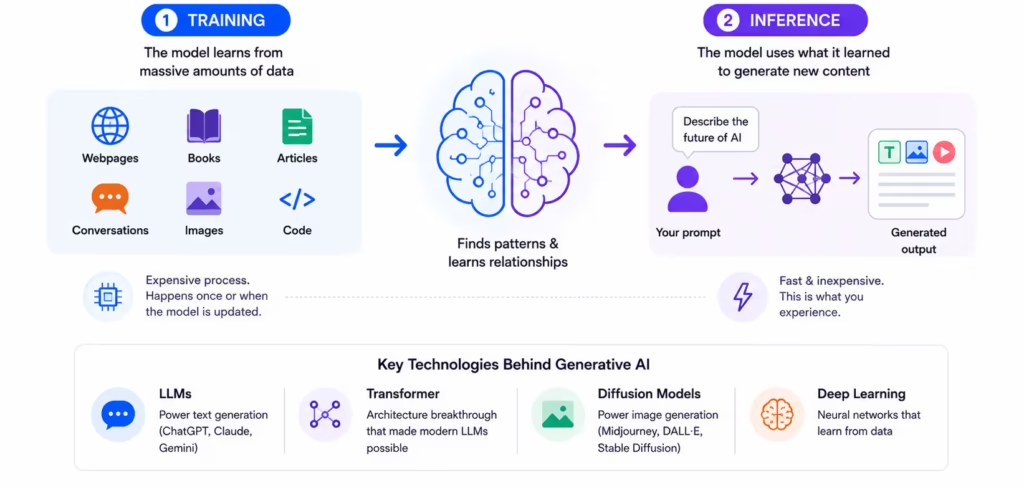
Generative AI works in two phases. That’s it. Two phases, and once you understand both, the whole thing makes a lot more sense.
Phase 1: Training
Before a generative AI model can create anything, it has to learn. And it learns by consuming enormous amounts of existing data. We’re talking billions of web pages, books, articles, images, conversations, lines of code, more data than any human could read in thousands of lifetimes.
During training, the model doesn’t memorise this content. It identifies patterns. It learns that certain words tend to follow certain other words. That certain visual elements appear together in certain contexts.
That certain code structures solve certain problems. It’s not understanding in the way humans understand things. It’s deep, sophisticated pattern recognition at a scale that’s genuinely hard to picture.
This phase is expensive. Training a large model like GPT-4 costs tens of millions of dollars in computing power and takes weeks of continuous processing across thousands of specialised chips. It happens once or periodically when the model is updated.
According to research published by the IEA, AI-specific servers consumed between 53 and 76 terawatt-hours of electricity globally — a figure that continues to rise as larger models are trained and deployed at scale.
That energy demand has real environmental consequences, something we explore in detail in our guide to green AI and how it’s being used to fight climate change.
Phase 2: Inference (what you actually experience)
Once training is done, the model is deployed. This is the phase you interact with every time you type a prompt into ChatGPT, ask Gemini a question, or generate an image in Midjourney.
When you send a prompt, the model doesn’t “think” about it the way you do. It uses everything it learned during training to predict the most appropriate response word by word for text, pixel by pixel for images.
Each output is generated in sequence, each step informed by everything that came before it in that conversation.
There’s no database of answers being searched. No copy-paste from the internet. It’s generating something new, in real time, based entirely on learned patterns.
Here’s the technical vocabulary, quickly:
- Large Language Models (LLMs): the specific architecture behind text-based generative AI. ChatGPT, Claude, and Gemini are all LLMs.
- Transformer architecture: the technical breakthrough from a Google research paper titled ‘Attention Is All You Need’ that made modern LLMs possible. Every major AI model today, ChatGPT, Claude, and Gemini, is built on this foundation. When people say AI “transformed” in the last few years, this is literally part of the reason.
- Diffusion models: the technology behind most AI image generation tools like Midjourney, DALL-E, and Stable Diffusion. They work differently from LLMs but follow the same two-phase logic.
Deep learning and neural networks sit underneath all of these mathematical systems, loosely modelled on how the human brain processes information.
Types of Generative AI: Text, Image, Video, Audio, and Code
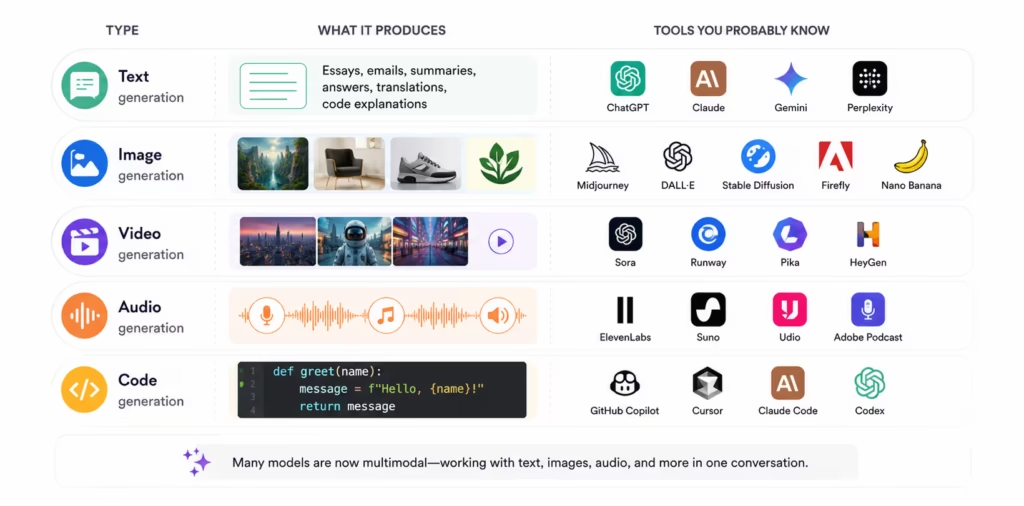
Generative AI isn’t one thing. It’s a family of technologies, each trained on different kinds of data, each producing different kinds of output.
The category that gets the most attention is text, largely because ChatGPT made it famous, but text is only one piece of a much bigger picture.
Here’s the full breakdown:
| Type | What It Produces | Tools You Probably Know |
|---|---|---|
| Text generation | Essays, emails, summaries, answers, translations, code explanations | ChatGPT, Claude, Google Gemini, Perplexity |
| Image generation | Realistic photos, illustrations, concept art, product mockups, logos | Midjourney, DALL-E, Stable Diffusion, Adobe Firefly, Nano Banana |
| Video generation | Short video clips from text or image prompts | Realistic voices, music, sound effects, and podcast narration |
| Audio generation | Realistic voices, music, sound effects, podcast narration | ElevenLabs, Suno, Udio, Adobe Podcast |
| Code generation | Working software code in any programming language | GitHub Copilot, Cursor, Claude Code, Codex |
Each of these categories uses a somewhat different underlying approach: LLMs for text, diffusion models for images, and increasingly hybrid architectures for video and audio.
But the core idea is the same across all of them: learn from existing examples, then generate something new.
Models like GPT-4o and Google Gemini are now multimodal, meaning they handle text, images, audio, and sometimes video within a single conversation. You can show Gemini a photo of a broken appliance and ask it to explain what’s wrong.
You can have a spoken conversation with ChatGPT’s voice mode and ask it to describe what it “sees” in an image you’ve shared. The neat boxes we used to put these tools in are getting harder to maintain because the tools themselves keep expanding beyond them.
Generative AI Examples You Already Use Every Day
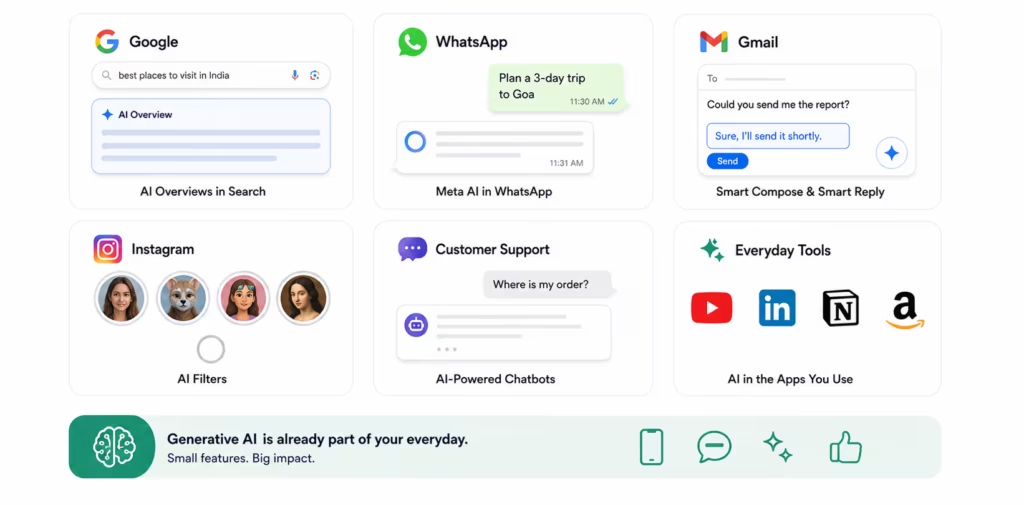
Let’s talk about the generative AI examples you’ve probably already bumped into, whether you knew it or not.
Google Search AI Overviews
When you search something on Google, and an AI-generated summary appears at the very top before any links, that’s generative AI producing original text from multiple sources in real time. It’s not pulling a cached answer. It’s writing one, specifically for your query, right now.
WhatsApp Meta AI
Meta AI is now built directly into WhatsApp the app that a significant portion of the country uses as a primary communication tool. Ask it to plan a trip to Goa, explain a news story, or help draft a message, and you’re using generative AI inside an app you probably open dozens of times a day.
Gmail Smart Compose and Smart Reply
Those greyed-out word suggestions that appear as you type an email in Gmail? Generative AI. The short reply suggests “Sounds great!”, “I’ll look into it,” that pops up when you receive a message? Also, generative AI. It’s so seamlessly built in that most people don’t register it as AI at all.
Instagram and Snapchat AI Filters
When a filter dramatically changes your appearance, transforms a selfie into a cartoon, or reimagines your photo in the style of a Renaissance painting, that’s generative image AI working in real time on your phone. These aren’t just adjustments to brightness and contrast. The model is generating new visual information that wasn’t in the original photo.
Customer Service Chatbots
The chat assistant that pops up on Amazon, Flipkart, Zomato, your bank’s app, or any major e-commerce platform, the one that gives contextual, conversational responses rather than rigid menu options, is increasingly powered by generative AI. It’s not searching a FAQ database anymore. It’s generating a response based on what you asked.
Honestly, the list goes on. AI-written product descriptions on Amazon. Auto-generated captions on YouTube. The suggested replies in LinkedIn messages. The “continue writing” button in Notion.
Generative AI isn’t coming. It’s already here quietly doing a lot of small jobs that used to require human time and attention.
Generative AI Tools: The Big Names Worth Knowing
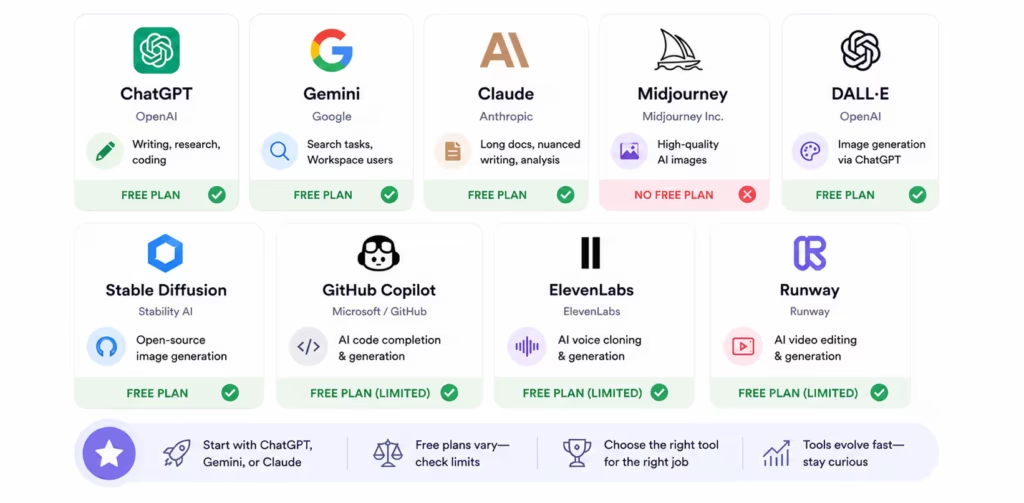
What’s actually useful is knowing the major players, what each one is best at, and whether you can try it without paying anything upfront. Here’s a clean breakdown:
| Tool | Made By | Best For | Free Plan? |
|---|---|---|---|
| ChatGPT | OpenAI | Writing, research, coding, general-purpose use | Yes (limited) |
| Gemini | Search-integrated tasks, Google Workspace users | Yes | |
| Claude | Anthropic | Long documents, nuanced writing, deep analysis | Yes (limited) |
| Midjourney | Midjourney Inc. | High-quality AI image generation | No |
| DALL-E | OpenAI | Image generation via ChatGPT interface | Yes (via ChatGPT) |
| Stable Diffusion | Stability AI | Open-source image generation, self-hostable | Yes |
| GitHub Copilot | Microsoft / GitHub | AI code completion and generation | Yes (limited) |
| ElevenLabs | ElevenLabs | Realistic AI voice cloning and generation | Yes (limited) |
| Runway | Runway | AI video editing and generation | Yes (limited) |
A few things worth knowing about this list. First, “free plan” doesn’t always mean the same thing; some tools give you a generous free tier, others give you a handful of uses before the paywall appears. Second, the tools at the top of this table (ChatGPT, Gemini, Claude) are the ones most worth starting with if you’re new to all of this.
Claude tends to handle long, complex documents better than ChatGPT. Gemini has a natural advantage if you’re already deep in Google’s ecosystem. Midjourney consistently produces more aesthetically refined images than most competitors, which is why creative professionals gravitate toward it despite the lack of a free plan.
As Sundar Pichai, CEO of Google, said: “AI is probably the most important thing humanity has worked on. More profound than electricity or fire.” Whether or not you agree with the scale of that claim, the pace of development in these tools over the last two years suggests he’s not wrong.
Generative AI Use Cases: What Industries Are Actually Doing With It
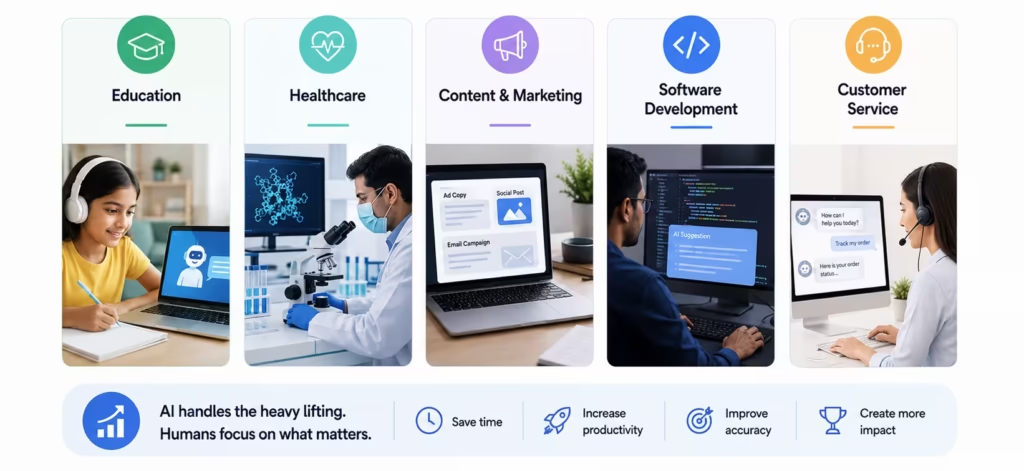
Knowing what generative AI is and knowing what it’s doing across real industries are two different things. The technology sounds impressive in theory. What makes it genuinely significant is where it’s landing in practice.
Education
AI tutors are starting to personalise learning in ways that one teacher in a classroom of forty students simply can’t. Adapts explanations to the pace and level of individual students, asking questions rather than just giving answers, nudging students to think rather than handing them solutions.
The scale of this potential is hard to overstate. Platforms are integrating generative AI to create customised study materials, practice questions, and explanations tailored to different learning levels and regional curricula.
For a country with a million school-going children and a chronic shortage of quality teachers in rural areas, AI-assisted education isn’t a luxury; it’s a genuine lever.
Healthcare
Google DeepMind’s AlphaFold, an AI model that predicts protein structures, has been described as one of the most significant scientific breakthroughs in decades. It solved a 50-year-old problem in biology, and its database of over 200 million protein structure predictions is now freely available to researchers in 190 countries.
It compressed what might have taken researchers years of lab work into something that can run in hours. In drug discovery, vaccine design, and understanding diseases at a molecular level, generative AI is accelerating all of it.
Content and Marketing
This is probably the most visible generative AI use case for most people. Marketing teams are using AI to generate social media captions, ad copy, product descriptions, email campaigns, and first drafts of everything, at a scale that would require ten times the headcount to produce manually.
The quality still requires human editing and judgment, but the starting point has changed completely.
Software Development
GitHub Copilot, Microsoft’s AI coding assistant, Anthropic Claude Code, and OpenAI’s Codex help developers write code up to 55% faster in their tasks.
It suggests completions, writes entire functions, explains legacy code, and catches errors. For a developer staring at an unfamiliar codebase at 11 pm, that’s not a small thing.
Customer Service
AI-powered customer service agents are handling queries, summarising support tickets, routing complaints, and generating personalised responses across banking, e-commerce, and telecom at a scale no human team could match.
The common thread across all of these isn’t that AI is replacing human judgment. It’s that it’s handling the volume, the repetitive, time-consuming, first-pass work, so human attention can go where it actually matters.
Generative AI Benefits: What It Actually Does Well
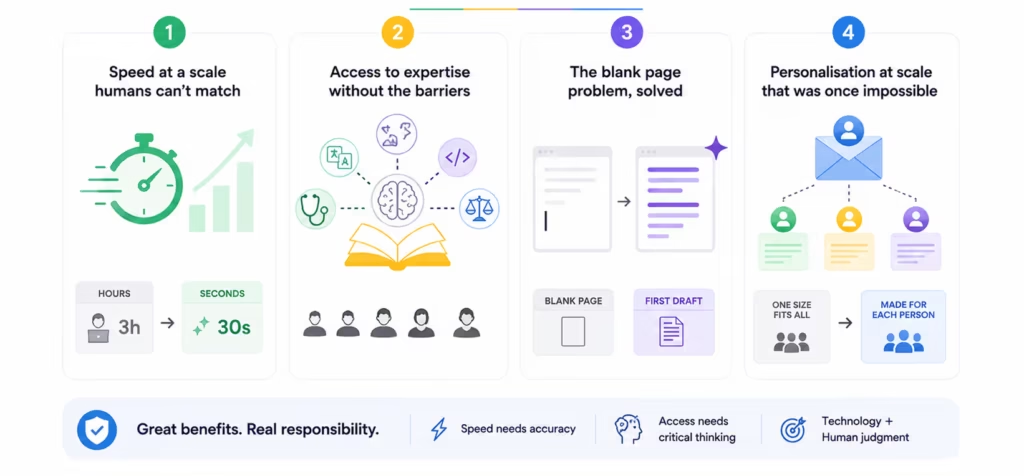
Speed at a scale humans can’t match
A task that would take a skilled copywriter three hours takes generative AI thirty seconds. Not always better, the human version usually has more nuance, more originality, more personality.
But thirty seconds versus three hours is a real difference that compounds across an entire working week. For anyone who produces content, code, or communication at volume, that compression changes what’s possible.
According to a controlled study by GitHub and MIT involving 95 professional developers, GitHub Copilot helped developers complete tasks 55% faster — reducing average completion time from 2 hours 41 minutes to 1 hour 11 minutes.
Access to expertise that used to require years of training
This is the benefit that doesn’t get talked about enough. Generative AI can explain complex medical information in plain language, translate between dozens of languages in real time, debug software code for someone who has never programmed before, and draft a legal letter for someone who can’t afford a lawyer.
It doesn’t replace professionals, but it lowers the barrier to capability in ways that are genuinely meaningful, especially for people without access to expensive expertise.
The blank page problem, solved
Ask any writer, designer, or developer what the hardest part of their job is, and a significant number will say starting. The blank page, the empty canvas, the blinking cursor.
Generative AI eliminates that specific obstacle, not by doing the whole job, but by giving you something to react to. A first draft, a rough concept, a skeleton structure. Even when the output is mediocre, having something to improve is faster and less draining than building from nothing.
Personalisation at a scale that was previously impossible
Sending the same email to 10,000 people and calling it personalised because you swapped in their first name, that’s what marketing looked like for most of the last decade.
Generative AI can produce genuinely different versions of content for different audiences, contexts, and stages of a customer journey, at volume, without a proportionally larger team. That’s not a small upgrade.
Here’s the thing, though. Every one of these benefits comes with a corresponding responsibility. Speed without accuracy is just fast mistakes. Access to expertise without critical thinking is just confident misinformation. Which is a natural bridge into what generative AI doesn’t do well, so let’s understand this.
Generative AI Limitations and Risks
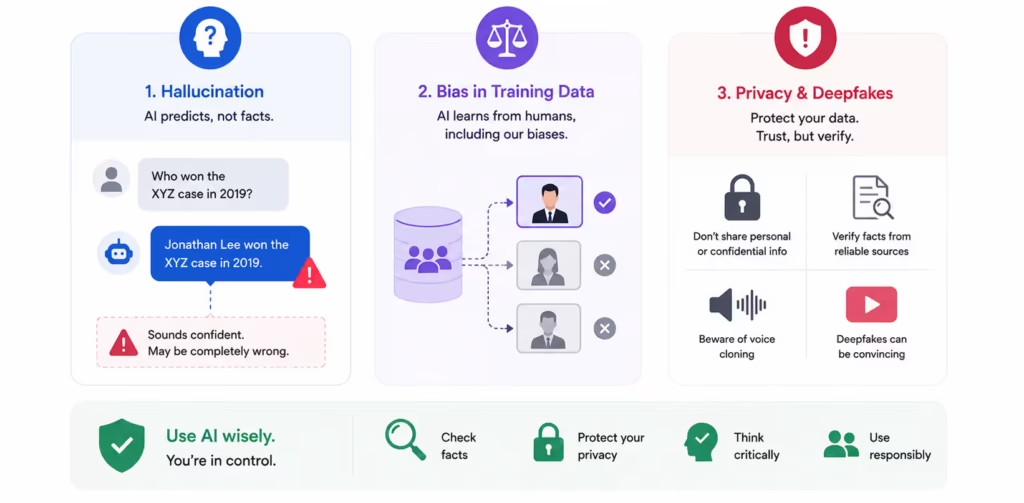
Generative AI has real limitations. Not theoretical ones, actual, present-day problems that affect how you should use these tools right now. Understanding them doesn’t make you a pessimist. It makes you a smarter user.
Hallucination and why it happens
Generative AI doesn’t know facts. It predicts text. When you ask ChatGPT a question, it isn’t searching a database of verified information and returning the correct answer.
It’s generating a response that looks like what a correct answer would look like, based on patterns in its training data. It has no internal fact-checking mechanism. No awareness that it’s made a mistake.
So when a model confidently tells you that a lawyer named Jonathan Lee won a landmark case in 2019, and that lawyer doesn’t exist, and that case never happened.
It’s pattern-matching. The pattern of text that follows “a landmark case was won by” suggested a name that fit the context. The model produced it. That’s all that happened.
This is called hallucination, and the newer models, GPT-4o, Claude 3.5, Gemini 1.5, hallucinate less than earlier versions. But they still hallucinate. Which means you should never use AI-generated text about health, legal, financial, or any high-stakes topic without verifying it through a reliable, primary source.
Bias, inherited from human data
Every generative AI model is trained on human-generated content. And human-generated content, decades of it, across the internet, carries biases, stereotypes, cultural blind spots, and historical inequalities embedded in the language itself.
Image generators prompted with words like “CEO,” “engineer,” or “professor” have been observed to disproportionately produce images of white male figures, because that’s the pattern that dominated their training data.
Language models can produce culturally skewed responses, underrepresent non-Western perspectives, and perform worse in languages that were less represented in their training sets.
Is generative AI safe to use?
For most everyday tasks, writing, research, brainstorming, image creation – yes, with some sensible caveats.
Don’t put personal, sensitive, or confidential information into a public AI tool. Most free-tier tools use your conversations to improve their models, meaning what you type may be reviewed or used as training data.
Major providers like OpenAI, Google, and Anthropic have privacy policies that govern this, but reading them isn’t the same as never having sent the data.
Don’t trust AI-generated factual claims without checking. This applies especially to statistics, dates, citations, and anything where being wrong has real consequences.
And be aware of deepfakes, AI-generated audio and video that can convincingly impersonate real people. This is one of the more serious societal risks attached to generative AI, and it’s not hypothetical.
Voice cloning tools that can replicate someone’s voice from a few seconds of audio are already publicly available. The technology for generating realistic fake videos of real people exists and is accessible. This isn’t a reason to panic, but it is a reason to be more sceptical of what you see and hear online.
As Mustafa Suleyman, CEO of Microsoft AI, said: “AI is the most powerful tool humanity has ever built. And like every powerful tool, it reflects the intentions of the people using it.” The limitations of generative AI are mostly manageable if you go in with accurate expectations rather than misplaced blind trust.
What Is the Main Goal of Generative AI?
The main goal of generative AI is to create new, original content, text, images, video, audio, or code that is useful, coherent, and contextually appropriate based on what a user asks for.
Unlike traditional AI, which analyses existing data to make predictions or decisions, generative AI produces something that didn’t exist before the prompt was sent. That’s it. That’s the core goal.
In practical terms, this means helping people complete tasks faster, access expertise more easily, express ideas they couldn’t easily express before, and create things they couldn’t create alone.
It’s a tool for augmentation, not replacement, not automation for its own sake, but genuine expansion of what individuals and organisations can do with the time and skills they already have.
Conclusion – What Is Generative AI, Really?
It’s not magic. It’s not a thinking machine. IFt’s not going to replace everything humans do, at least not any time soon, and not in the ways most headlines suggest.
Generative AI is a very powerful pattern-matching system, trained on an extraordinary amount of human-created content, that can produce new text, images, video, audio, and code on demand. It does some things remarkably well.
If you want to understand the environmental cost of running all this AI infrastructure, the energy, the water, the carbon, we covered that in full in our guide to the environmental impact of AI. And for a specific breakdown of how much CO₂ ChatGPT, Gemini, and other models actually produce per query, see our AI carbon footprint guide.
Generative AI is here, it’s growing, and it’s worth understanding properly. This was the starting point.
FAQs
1. What does GPT stand for in ChatGPT?
GPT stands for Generative Pre-trained Transformer. Breaking that down: Generative means it creates new content rather than retrieving existing answers. Pre-trained means the model was trained on a vast amount of internet data before you interact with it — it already “knows” a lot before you ask it anything. Transformer refers to the underlying neural network architecture introduced in Google’s 2017 “Attention Is All You Need” research paper, which is the technical foundation every major AI model today is built on.
2. What is the difference between GenAI and AGI?
GenAI (short for Generative AI) is a real, existing technology you can use today — ChatGPT, Midjourney, Gemini. It creates new content based on patterns learned from training data, but it’s narrow: it does specific things well and nothing outside its training. AGI (Artificial General Intelligence) is a theoretical concept — a hypothetical AI that could learn and reason across any field at human level or beyond. AGI doesn’t exist yet. Every AI tool available today, no matter how impressive, is still narrow AI.
3. Is generative AI the same as machine learning?
Not exactly — machine learning is the broader field, and generative AI is a specific application within it. Machine learning covers any system that learns from data to make predictions or decisions — spam filters, recommendation engines, fraud detection. Generative AI is a subset of machine learning that specifically focuses on creating new content. All generative AI uses machine learning. But most machine learning isn’t generative — it’s analytical or predictive rather than creative. Think of machine learning as the field, deep learning as the technical approach within it, and generative AI as one powerful category of what you can build using deep learning.
4. What are the main types of generative AI models?
There are three core model architectures behind most generative AI tools. Large Language Models (LLMs) — like ChatGPT, Claude, and Gemini — are trained on text and generate text. They use transformer architecture and work by predicting the most likely next word based on context. Diffusion models — used by Midjourney, DALL-E, and Stable Diffusion — generate images by learning to remove noise from random data until a coherent image emerges. Generative Adversarial Networks (GANs) use two competing neural networks — one generates content, the other evaluates it — to produce increasingly realistic outputs.

Jigar Chaudhary is the Editor-in-Chief at UrviumAI, where he oversees coverage of artificial intelligence news, tools, and in-depth studies. With over 5 years of experience analyzing AI and robotics, he focuses on maintaining high editorial standards, accurate reporting, and clear explanations to help readers understand how AI is shaping the future.