
AI Turns Solo Founder Into a $1.8B Operator 🚀
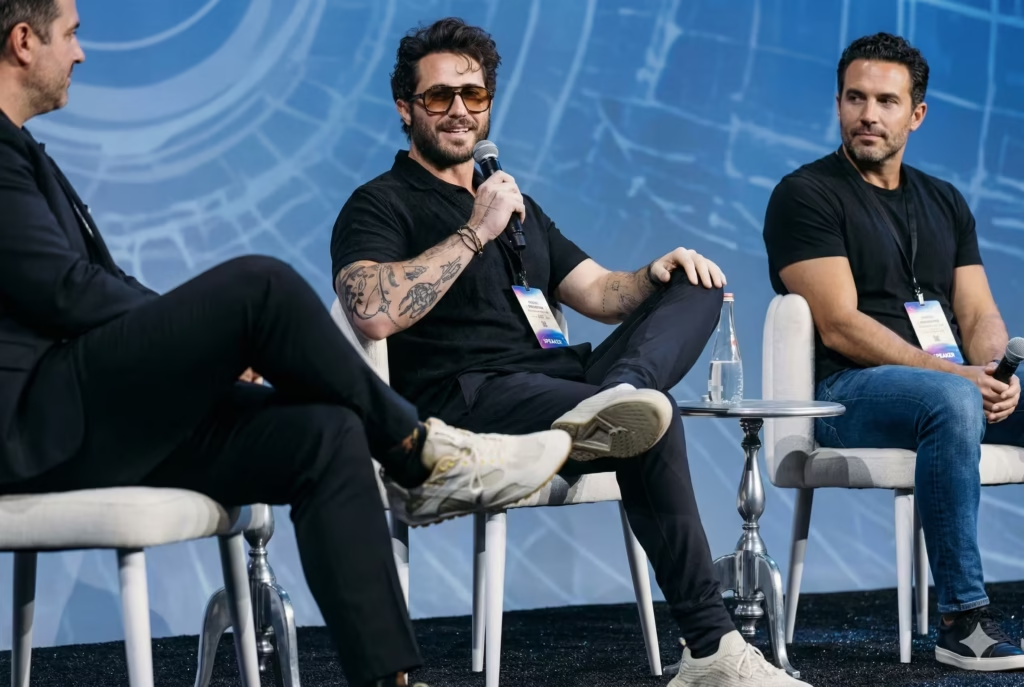
The era of the solo billion-dollar founder has officially arrived. Matthew Gallagher recently scaled his telehealth startup, Medvi, from a $20,000 AI experiment into a massive business projected to hit $1.8 billion in annual sales, becoming the first real-world proof of Sam Altman’s famous “solo unicorn” prediction.
Here is how Gallagher built a massive healthcare operation from his living room:
- The Business Model: Medvi sells GLP-1 weight-loss drugs online, entirely outsourcing the heavy lifting, including doctors, prescriptions, and physical shipping to existing telehealth infrastructure platforms like CareValidate and OpenLoop.
- The AI Workforce: To avoid hiring a massive corporate team, Gallagher used ChatGPT, Claude, and Grok to write the platform’s code. He used Midjourney and Runway to generate all ad creatives, and ElevenLabs, alongside custom AI agents to handle customer service.
- The Scale: The entire operation took just two months and $20,000 to launch, bringing in a staggering $401 million in revenue during its first year.
- The Team: Today, the team consists only of Matthew, his brother (the only full-time hire), and a handful of contract engineers and account managers orchestrating the AI tools.
Why it matters: Two years ago, OpenAI CEO Sam Altman predicted that AI would eventually allow a single person to build a billion-dollar company. The realization of that prediction isn’t a team of savant engineers inventing a new algorithm; it’s a savvy operator using off-the-shelf AI tools to completely automate the marketing, coding, and customer service of a traditional e-commerce business. This permanently shatters the idea that you need heavy venture capital and hundreds of employees to achieve massive enterprise scale.
UrviumAI Take: Execution is the only moat left. Stop waiting for a technical co-founder or a massive seed round to launch your business idea. Gallagher built a billion-dollar company by acting as an orchestrator, plugging existing AI tools into existing healthcare fulfillment APIs. If you have an idea, use AI to write the code, generate the ads, and handle the support today. The barrier to entry has dropped to zero; the only thing separating you from scale is your willingness to build it.
Apple Corners the Mobile DRAM Market 🍏

Apple has decided to weaponize its massive cash reserves to crush its hardware rivals. The tech giant is reportedly executing a highly aggressive supply-chain maneuver, buying up massive amounts of mobile DRAM memory at premium prices to starve out competitors deliberately.
Here is the strategy behind Apple’s ruthless market squeeze:
- The Premium Buyout: According to supply chain analysts, Apple is currently purchasing all available mobile DRAM on the market, immediately accepting near 100% price hikes from suppliers like Samsung and SK Hynix without negotiation.
- Absorbing the Cost: Rather than passing these massive component costs onto the consumer, Apple is sacrificing its own operating margins to keep its device prices stable and highly competitive.
- The Market Squeeze: The global memory market is already facing a historic shortage because manufacturers have shifted capacity to high-margin AI chips (HBM). Apple’s hoarding is exacerbating this deficit for everyone else.
- The Fallout: The strategy is already impacting the broader ecosystem. Rivals like MediaTek and Qualcomm are reportedly being forced to slash production of their own 4nm mobile chips because they cannot secure enough memory to pair with them.
Why it matters: Apple is leveraging its unparalleled $160+ billion cash pile not just to secure its own supply lines, but to actively sabotage the Android ecosystem. By willfully absorbing short-term profit losses to corner a constrained component market, Apple is ensuring that its competitors simply cannot physically manufacture enough smartphones and laptops to compete, setting the stage for massive market share expansion.
UrviumAI Take: Supply chain control is a weapon of mass disruption. Apple’s ruthless move highlights a harsh business reality: whoever controls the physical hardware bottleneck controls the entire market. If your business relies on constrained components or computing power, you cannot assume the free market will provide for you equitably. Massive, cash-rich competitors will happily overpay for inventory just to put you out of business. Diversify your vendor relationships aggressively.
Anthropic Acquires Stealth Biotech Startup for $400M 🧬
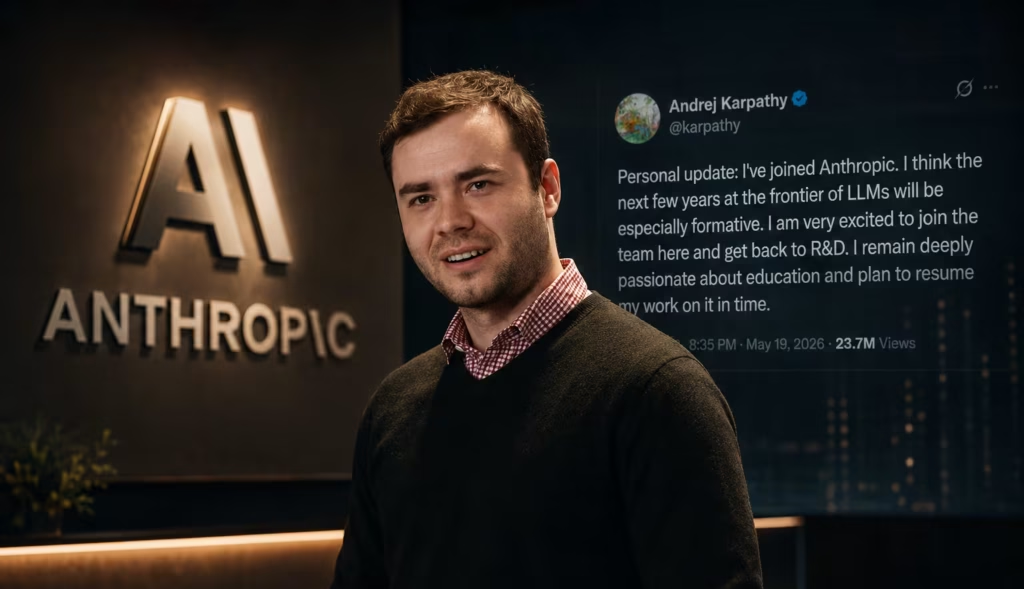
Anthropic is placing a massive financial bet on the intersection of artificial intelligence and biological science. The maker of the Claude AI assistant has acquired Coefficient Bio, an ultra-stealth biotech startup, in an all-stock deal worth over $400 million.
Here is the breakdown of Anthropic’s massive foray into the life sciences:
- The Acquisition: Anthropic paid over $400 million for a company that is barely eight months old, has under ten employees, and possesses no publicly disclosed revenue or conventional traction metrics.
- The Pedigree: Coefficient Bio’s founders are former computational biology researchers from Genentech. The team specializes in building biological foundation models and novel machine learning approaches for biomolecule design.
- The Integration: The newly acquired team will immediately join Anthropic’s healthcare and life sciences division, integrating their platform directly into Claude to draft drug research plans and manage clinical regulatory strategies.
- The Divergence: This massive acquisition highlights a stark strategic divergence among frontier labs. While OpenAI is heavily focused on consumer media, agentic workflows, and Hollywood partnerships, Anthropic is aggressively positioning its models as deep scientific research partners.
Why it matters: Paying $400 million for a tiny team of ten researchers proves just how fiercely competitive the market for elite computational biologists has become. Anthropic realizes that the true, multi-trillion-dollar value of Artificial Superintelligence won’t come from writing better marketing emails, but from fundamentally accelerating global drug discovery, curing diseases, and synthesizing novel biomolecules.
UrviumAI Take: The AI talent war is shifting from computer science to computational biology. Notice the massive divergence in corporate strategy. While ChatGPT is learning how to edit videos and run talk shows, Claude is learning how to synthesize proteins and manage FDA clinical trials. If your enterprise operates in the hard sciences, healthcare, or heavy R&D, Anthropic is clearly signaling that they want to be your foundational AI partner.
Last AI News: Lund’s AI Blood Test, Anthropic Code Leak & Block Replaces Managers
Other AI News Today:
- OpenAI has announced its first-ever media acquisition, purchasing the popular daily live tech talk show TBPN for the low hundreds of millions.
- Google DeepMind rolled out the Gemma 4 family of AI models, shifting to an Apache 2.0 license to remove legal friction and aggressively court enterprise developers.
- Cursor unveiled “Cursor 3,” an entirely rebuilt interface designed to help developers manage fleets of autonomous coding agents across multiple repositories simultaneously.
- ByteDance’s new Seedance 2.0 AI video generator has launched broadly across platforms and immediately claimed the top spot on major industry leaderboards.
- Japanese AI startup Sakana AI launched beta testing for Marlin, an autonomous AI research assistant capable of working for 8 hours straight on complex business tasks.

Jigar Chaudhary is the Editor-in-Chief at UrviumAI, where he oversees coverage of artificial intelligence news, tools, and in-depth studies. With over 5 years of experience analyzing AI and robotics, he focuses on maintaining high editorial standards, accurate reporting, and clear explanations to help readers understand how AI is shaping the future.
Pingback: Anthropic's Claude Mythos, AI Anti-Distillation Alliance & more