
Google Circles SpaceX for Orbital AI Compute 🚀

The race for AI supremacy is officially leaving the atmosphere. Google is currently exploring a massive launch deal with SpaceX to deploy orbital data centers, bringing two already intertwined tech giants together to pioneer space-based AI infrastructure.
Here is a look at the emerging orbital compute landscape:
- The Investment Tie: Google already holds a 6.1% stake in SpaceX from a $900 million investment made in 2015, and Google VP Don Harrison occupies a board seat, smoothing the path for collaboration.
- Project Suncatcher: Google’s internal moonshot is aiming to launch prototype AI satellites by 2027. They are partnering with Planet Labs to build the initial solar-powered hardware equipped with custom TPUs.
- SpaceX’s Ambitions: SpaceX has filed for approval to launch up to 1 million satellites, positioning orbital compute as a massive pre-IPO pitch to investors. Furthermore, Anthropic recently expressed interest in securing “multiple GW” of orbital AI compute capacity alongside their new SpaceX deal.
- The Skeptics: Not everyone is sold. OpenAI CEO Sam Altman called the concept of orbital compute “ridiculous” during a recent event in New Delhi, stating it won’t matter at scale this decade.
Why it matters: As terrestrial data centers completely drain local power grids, tech giants are looking to space for unlimited solar energy and zero cooling costs. If Google and SpaceX successfully deploy TPU-equipped satellites, it won’t just solve the power bottleneck it will create an entirely new, unregulated frontier for AI infrastructure that completely bypasses the physical limitations of Earth-bound data centers.
UrviumAI Suggestion: Space is the final frontier for sovereign computing. Ignore the skeptics. When companies with the capital of Google and the launch capacity of SpaceX align on an infrastructure bet, it usually becomes a reality. If you operate an enterprise heavily reliant on global, low-latency AI models, begin monitoring the development of orbital cloud networks. The ability to run continuous, heavy AI workloads via solar-powered satellites could fundamentally disrupt the pricing models of traditional terrestrial cloud providers within the next five years.
New Googlebooks, Gemini Intelligence for Android 💻
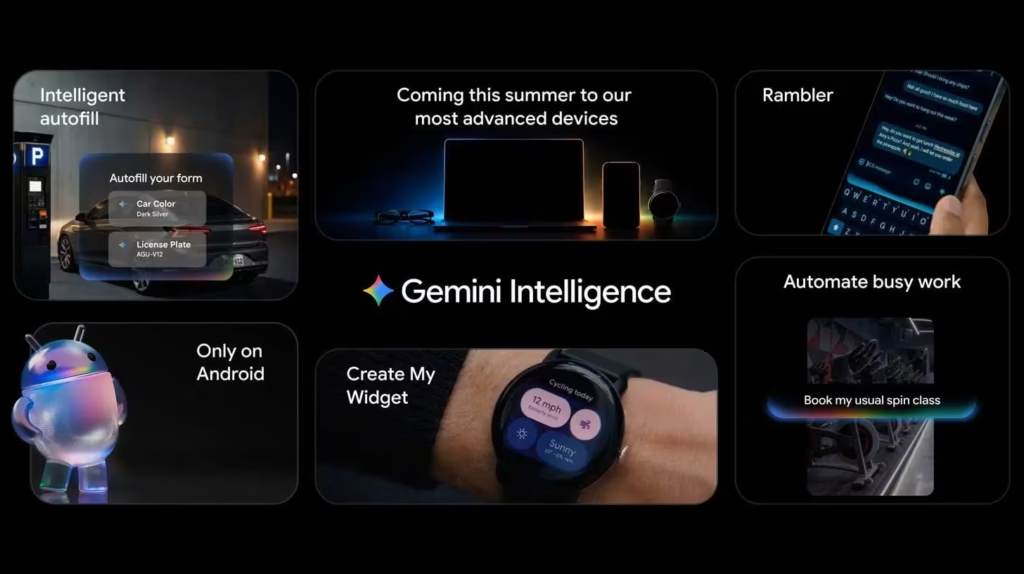
Google is blurring the line between hardware and artificial intelligence. During its recent Android Show event, the tech giant unveiled a massive ecosystem upgrade, heavily integrating Gemini directly into its hardware stack rather than treating it as a bolted-on application.
Here are the major announcements from Google’s hardware showcase:
- AI-Native Googlebooks: Shipping this fall, Googlebooks are premium, Gemini-first laptops built in partnership with Dell, HP, Lenovo, Acer, and Asus. They seamlessly run Android phone apps and files natively on the desktop.
- The Magic Pointer: A major UI shift, the laptops feature an AI-infused cursor. Hovering over a date, flight number, or image instantly triggers contextual Gemini actions and suggestions without needing to copy-paste into a chat window.
- Gemini Intelligence: Serving as Android’s cross-device AI platform, this system acts as a proactive agent capable of executing multi-step tasks across different apps using live on-screen context.
- New Productivity Tools: Google also debuted “Rambler” (a dictation tool that automatically strips out filler words), a “Create My Widget” generator, and Gemini auto-browse functionality directly within Chrome on Android.
Why it matters: The traditional desktop interface, clicking icons and opening separate apps, is effectively dead. By integrating Gemini directly into the mouse cursor and allowing it to act autonomously across the operating system, Google is establishing the first true “intent-driven” computer. You don’t open an app to book a flight; you just point your mouse at a flyer on your screen and tell the AI to handle it. This gives Google a massive head start as the world anxiously awaits Apple’s response with Siri’s revival.
UrviumAI Suggestion: The operating system is the new AI agent. If you are a software developer or UX designer, the introduction of the “Magic Pointer” fundamentally changes how you must design applications. Users will no longer navigate through your carefully designed menus; they will simply point their AI cursor at an element and expect the agent to execute the action via an API. You must ensure that your software is entirely discoverable and interoperable with cross-device AI intelligence systems, or your application will be bypassed completely.
Amazon’s AI Scoreboard Warps Work Incentives 📉

The corporate mandate to adopt artificial intelligence has accidentally spawned a bizarre new subculture of metric gaming. At Amazon, employees have resorted to a practice dubbed “tokenmaxxing” to artificially inflate their AI usage scores on internal company leaderboards.
Here is the breakdown of the corporate metrics scandal:
- The Incentive: Amazon established an aggressive internal target aiming for over 80% of developers to use AI on a weekly basis, implementing leaderboards to actively track employee model and token consumption.
- The Tool: Employees primarily use MeshClaw, an in-house agentic tool that allows staff to create AI agents capable of deploying code, sorting emails, and interacting with workplace software like Slack.
- The Exploit: Driven by the pressure of the scoreboard, employees admitted to the Financial Times that they are intentionally burning tokens by using MeshClaw to automate trivial, entirely unnecessary tasks just to artificially raise their numbers.
- The Fallout: While Amazon stated that token statistics are not tied to formal performance reviews, the company recently restricted the visibility of the leaderboards to mitigate the competitive, perverse incentives it created.
Why it matters: This incident is a textbook example of Goodhart’s Law: when a measure becomes a target, it ceases to be a good measure. Companies are pouring billions into AI infrastructure and desperately want to prove a return on investment (ROI). However, by treating raw “token consumption” as a proxy for productivity, Amazon accidentally encouraged its highly paid engineers to waste time and computing power gaming a scoreboard instead of actually doing valuable work.
UrviumAI Suggestion: Measure outcomes, not compute usage. If you are an enterprise leader rolling out generative AI, do not build adoption scoreboards. Your employees will inevitably game the system to look busy. You must focus your KPIs strictly on business outcomes: did the AI reduce customer ticket resolution times by 20%? Did it cut the software QA cycle by two days? If an employee uses zero tokens but hits their performance targets, their workflow is already optimized; forcing them to use an AI agent just for the sake of adoption destroys actual productivity.
Last AI News: TML’s Real-Time AI, OpenAI Daybreak & Anthropic Fixes Claude
Other AI News Today:
- A hacker deployed the ‘Mini Shai-Hulud’ malware across 42 TanStack npm packages, executing a massive supply-chain attack targeting AI developer tools.
- Meta employees in U.S. offices are protesting the installation of mouse-tracking software being used to harvest data to train the company’s autonomous AI agents.
- Google’s Isomorphic Labs has secured $2.1 billion in Series B funding to scale its AI-driven drug design engine and move candidates toward the clinic.
- Krea has launched Krea 2, its first proprietary image model built for aesthetic range, featuring style references and moodboard tools for creative professionals.
- Rivian has launched the Rivian Assistant, a proactive AI voice assistant built directly into vehicle hardware to control car systems and manage agentic tasks.

Jigar Chaudhary is the Editor-in-Chief at UrviumAI, where he oversees coverage of artificial intelligence news, tools, and in-depth studies. With over 5 years of experience analyzing AI and robotics, he focuses on maintaining high editorial standards, accurate reporting, and clear explanations to help readers understand how AI is shaping the future.

Pingback: Anthropic's Enterprise Lead, OpenAI's Global Watchdog & Claude Recovers Bitcoin