
OpenAI Breaks New Ground with Images 2.0 🎨

The text-to-image landscape has been completely upended by reasoning capabilities. OpenAI has officially rolled out ChatGPT Images 2.0, an upgraded visual model that the company is touting as the “smartest image generation model ever built.”
Here is how OpenAI’s new model is changing the creative workflow:
- Agentic Reasoning: Images 2.0 “thinks” before generating. It plans the composition, searches the web for accurate visual references, and self-corrects outputs for errors before delivering the final image.
- Benchmark Dominance: The model immediately claimed the No. 1 spot on Arena AI’s text-to-image leaderboard by a massive margin, sweeping every category and dethroning competitors like Nano Banana 2.
- Technical Upgrades: Features include stunning 2K resolution, the ability to generate up to 8 images simultaneously, custom aspect ratios ranging from 3:1 to 1:3, and flawless multilingual text rendering inside the images.
- The Rollout: Available across ChatGPT, Codex, and the API, CEO Sam Altman described the sheer leap in visual capability as being “like going from GPT-3 to GPT-5 all at once.”
Why it matters: OpenAI has successfully applied the “Chain of Thought” reasoning breakthroughs from its text models directly into visual generation. By forcing the AI to plan its layout and search for reference materials before rendering pixels, OpenAI has solved the most frustrating aspects of AI art, like mangled text, anatomical errors, and historical inaccuracies. This completely changes the workflow for commercial artists, shifting image generation from a slot-machine guessing game to a precise, highly controllable design engine.
UrviumAI Take: Reasoning is the new baseline for all generative media. If you are a graphic designer or digital marketer, you must adapt your prompting strategy for Images 2.0 immediately. Because the model actually “thinks” and researches, your prompts should no longer just be a list of visual keywords. You can now write complex, multi-step creative briefs like “analyze Apple’s 1990s marketing aesthetic and generate a 3:1 ad for a new smart shoe,” and the AI will autonomously do the historical research to get it right.
SpaceX Secures $60B Acquisition Deal for Cursor 🚀
The consolidation of the most powerful tech companies on Earth is accelerating. SpaceX has signed a historic, high-stakes agreement with the AI coding startup Cursor, tightly integrating the software unicorn into Elon Musk’s hardware empire.
Here is the breakdown of the massive M&A structure:
- The Financials: SpaceX has secured the exclusive right to acquire Cursor for a staggering $60 billion. If the acquisition does not ultimately occur, SpaceX must pay the startup a massive $10 billion breakup fee.
- The Compute Lock-In: As part of the partnership, Cursor gains immediate access to SpaceX’s vast computing infrastructure, including the gigawatt-class Colossus supercomputer powered by Nvidia GPUs.
- Cursor’s Trajectory: Founded in 2022, Cursor has experienced explosive growth, rapidly hitting $1 billion in annual recurring revenue (ARR) by dominating the agentic coding tool market.
- The Musk Ecosystem: The deal deeply integrates Cursor into the broader Musk ecosystem, strengthening both SpaceX and xAI’s strategic position against rivals like Anthropic and OpenAI ahead of SpaceX’s looming mega-IPO.
Why it matters: This deal proves that frontier AI startups are hitting an infrastructural ceiling. Cursor generates $1 billion a year in revenue, but even that isn’t enough to secure the massive, physical supercomputing clusters required to train the next generation of autonomous coding agents. By agreeing to a $60 billion buyout, Cursor gets the unlimited raw compute power of Colossus, while Elon Musk gets the crown jewel of the developer ecosystem to supercharge his AI empire.
UrviumAI Take: Compute capital is the only capital that matters. Notice how cash is no longer the primary driver in AI acquisitions; physical hardware is. Cursor didn’t partner with SpaceX just for money; they partnered for access to the Colossus supercomputer. If you are building an AI enterprise, you must secure long-term infrastructure partnerships. A brilliant software roadmap is entirely useless if you cannot secure the physical Nvidia GPUs required to run it.
Meta Logs Employee Keystrokes to Train AI 🕵️♂️
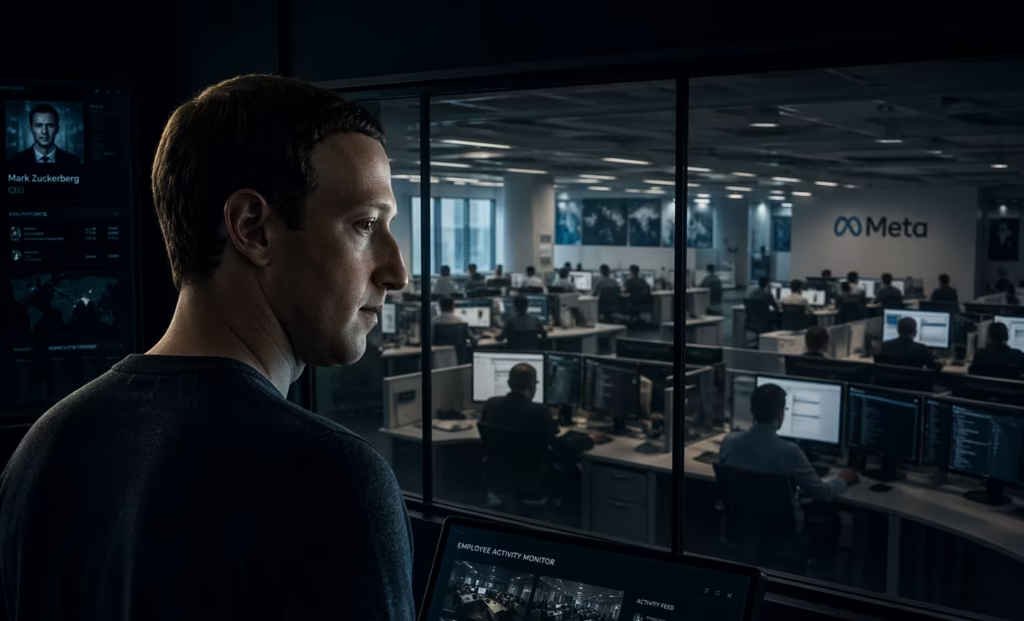
The quest for autonomous AI agents has taken a highly controversial, dystopian turn inside Mark Zuckerberg’s tech empire. Meta is currently facing fierce internal backlash over a new program that actively records the screens and keystrokes of its own US employees to train artificial intelligence.
Here is the breakdown of Meta’s invasive new training protocol:
- The Program: Internally dubbed the Model Capability Initiative (MCI), the system records screenshots, keystrokes, and mouse activity on company laptops to capture real-world workflow data.
- The Target: The logging heavily skews toward developers, tracking complex activities inside applications like VSCode, Google Chat, Gmail, and Meta’s internal assistant, Metamate.
- No Opt-Out: A leaked internal memo published by Business Insider revealed that CTO Andrew Bosworth dismissed employee privacy concerns, reportedly stating there is “no option to opt out” of the surveillance.
- The Layoff Backdrop: Making matters significantly worse, MCI began heavily logging the daily workflows of roughly 8,000 Meta staffers just a month before they are scheduled to be officially laid off on May 20.
Why it matters: Robotics labs have spent years recording humans washing dishes or picking up boxes to teach physical robots how to move. Meta is simply applying that exact same “imitation learning” playbook to corporate software. However, forcing 8,000 employees to literally generate the training data that will be used by an AI to replace their own jobs, all without the ability to opt out, crosses a massive ethical boundary and completely destroys internal corporate trust.
UrviumAI Take: Corporate surveillance is fueling the agentic era. You must assume that every action you take on corporate hardware is being used as training data. If your company issues you a laptop, the workflow data belongs to them. The age of building models from public internet data is ending; the next wave of highly capable enterprise agents will be trained directly on the recorded keystrokes and mouse clicks of human employees. Adapt your career by focusing on soft skills and strategic leadership that a screen-recording algorithm cannot easily clone.
Last AI News: DeepMind’s Strike Team, Adobe CX Enterprise & Kimi K2.6
Other AI News Today:
- Google released Deep Research and Deep Research Max via Gemini 3.1 Pro, enabling users to generate massive, data-rich reports with deep MCP integrations.
- Meta systematically poached five founding members from Mira Murati’s startup, Thinking Machines Lab, reportedly offering a $1.5 billion package to secure a top engineer.
- Google has open-sourced its DESIGN.md format, creating a universal standard that helps AI agents understand project branding, colors, and accessibility rules.
- Google revealed at its Cloud Next 2026 event that 75% of its new code is now generated by AI, signaling a massive internal shift toward agentic workflows.
- Jeff Bezos is reportedly closing a massive $10 billion funding round for his physical-AI startup, Project Prometheus, securing a $38 billion valuation.

Jigar Chaudhary is the Editor-in-Chief at UrviumAI, where he oversees coverage of artificial intelligence news, tools, and in-depth studies. With over 5 years of experience analyzing AI and robotics, he focuses on maintaining high editorial standards, accurate reporting, and clear explanations to help readers understand how AI is shaping the future.
Pingback: Anthropic's Mythos Leaks, UAE's AI Government & OpenAI Workspace Agents