
Anthropic’s Locked-Down Mythos Leaked 🔓

The illusion of perfect control over frontier AI models has been shattered. Access to Anthropic’s highly restricted Claude Mythos model has reportedly leaked into a private Discord group within days of its highly publicized launch.
Here is the breakdown of the unauthorized model access:
- The Leak: According to Bloomberg, a private Discord group dedicated to tracking unreleased AI models successfully accessed Mythos on the day of its release and has been using it regularly.
- The Method: The group did not hack Anthropic’s servers. Instead, one member possessed vendor credentials through contract work. The group then used naming patterns exposed in a recent data breach at AI startup Mercor to guess the exact deployment URL.
- The Model: Mythos is Anthropic’s top-tier cybersecurity model, originally released on April 10 strictly to select corporate partners under ‘Project Glasswing’ because the company deemed it too dangerous for public use.
- The Intent: The Discord group claimed they are not using Mythos for cyberattacks or malicious activities, and also alleged they have access to other unreleased frontier models.
Why it matters: This incident highlights a massive vulnerability in the AI supply chain. The first unauthorized use of a model so dangerous it triggered emergency meetings at the White House didn’t come from an advanced nation-state like China or Russia—it came from an internet forum using a shared contractor password. As AI models become increasingly capable of discovering zero-day vulnerabilities, this breach proves that the weakest link in AI safety isn’t the algorithm; it’s the human vendors managing the deployment endpoints.
UrviumAI Take: Human error is the ultimate cybersecurity vulnerability. Stop assuming your proprietary data and tools are safe just because you use a secure cloud provider. As the Mythos leak demonstrates, devastating breaches often happen through third-party contractors and shared credentials. You must immediately audit your vendor access logs, enforce strict multi-factor authentication (MFA) across your entire supply chain, and ensure that no single contractor holds the keys to your most sensitive enterprise assets.
UAE Plans 50% AI Government Rollout 🇦🇪

The global benchmark for public sector technology adoption has just been completely redefined. The United Arab Emirates has announced a remarkably ambitious plan to transition 50% of its government operations to agentic artificial intelligence within the next two years.
Here is how the UAE is transforming its government infrastructure:
- Agentic Integration: The UAE plans to move beyond using AI as a simple chatbot tool. Instead, the government will deploy autonomous AI agents to act as “executive partners” across essential public services and daily operations.
- Aggressive Timeline: Achieving a 50% transition to autonomous systems within a two-year window makes this one of the most aggressive public sector AI rollouts in global history.
- Performance Metrics: To ensure compliance, the performance of individual government departments will be strictly evaluated based on their speed of AI adoption, the quality of implementation, and the overall impact on citizen services.
- Mandatory Upskilling: Recognizing the human element of this transition, the UAE has mandated that every single federal employee will undergo rigorous training to use and master these new AI systems.
Why it matters: While Western governments are currently tied up in endless regulatory debates and bureaucratic red tape regarding AI safety, the UAE is aggressively leaning into the technology to gain a massive geopolitical and economic advantage. By mandating that AI acts as an “executive partner” rather than just a software tool, the UAE is positioning itself to become the world’s first fully AI-native sovereign state, drastically reducing administrative bloat and radically increasing the speed of public services.
UrviumAI Take: Government adoption is the ultimate catalyst for enterprise scale. Do not underestimate the speed at which autonomous agents are becoming mandatory infrastructure. If a sovereign government is actively replacing 50% of its administrative operations with agentic AI in just 24 months, your business cannot afford to wait a decade to innovate. You must start training your employees to orchestrate AI workflows today, or you will be completely outpaced by international competitors who are operating with a fraction of your corporate overhead.
ChatGPT Launches Codex-Powered Workspace Agents 💼
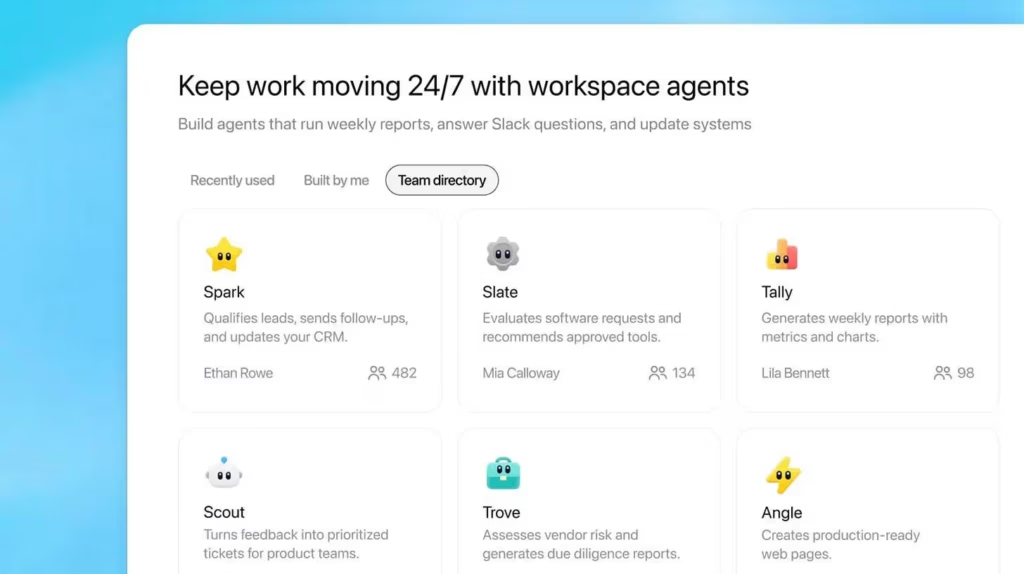
OpenAI is aggressively targeting the enterprise sector by transforming its consumer chatbot into a collaborative digital workforce. The company has officially introduced “Workspace Agents” within ChatGPT, shifting from isolated prompts to fully autonomous, team-wide orchestration.
Here is how OpenAI’s new agents are attempting to solve enterprise workflow fragmentation:
- The Evolution: Pitched as a massive architectural upgrade to the standalone custom GPTs of 2023, Workspace Agents are shared bots built to tackle complex, multi-step operations for entire departments.
- Asynchronous Execution: Backed by the powerful Codex model, these agents retain persistent memory, can autonomously call connected third-party apps, and can live inside Slack to trigger on a schedule even when human users are offline.
- Internal Validation: OpenAI is already heavily utilizing the feature internally. Sales teams use the agents for deep account research and automated follow-ups, while the accounting department runs them for journal entries and financial reconciliations.
- Enterprise Controls: Administrators can securely create and share agents across specific teams, applying strict governance restrictions on data usage, app permissions, and mandatory human-in-the-loop approvals.
Why it matters: The original GPT Store largely failed to gain traction because it offered isolated, single-user novelties rather than integrated enterprise workers. By embedding Workspace Agents directly into daily communication hubs like Slack and giving them the ability to operate asynchronously, OpenAI is solving the “last mile” problem of corporate AI. This allows businesses to finally unify the scattered prompts and half-built automation scripts their employees have accumulated into reliable, always-on digital employees.
UrviumAI Take: Asynchronous execution is the defining trait of an agent. If you are assessing whether to adopt OpenAI’s new Workspace Agents, focus entirely on their ability to run offline. A tool that waits for you to hit “enter” is just a chatbot. A tool that automatically scrapes account data at 3:00 AM and has a summary waiting in your Slack channel at 8:00 AM is an agent. Begin auditing your team’s workflows immediately to identify repetitive, multi-step processes that can be handed off to these asynchronous digital workers.
Last AI News: OpenAI Images 2.0, SpaceX’s $60B Cursor Deal & Meta Logs Keystrokes
Other AI News Today:
- Google has unveiled its 8th-generation TPUs, specifically bifurcating its architecture into the TPU 8t for training and TPU 8i for inference to handle massive agentic workloads.
- Anthropic faced severe backlash after a pricing test removed Claude Code from the $20/month Pro tier for some new signups, signaling a shift in enterprise API costs.
- The White House has formally accused China of executing an “industrial-scale” campaign of intellectual property theft against American AI labs.
- Ideogram has officially launched Custom Models, an API feature allowing users to fine-tune image generation using just 15 to 100 proprietary brand assets.
- Microsoft has appointed current COO Dan Shapero as the new CEO of LinkedIn, replacing Ryan Roslansky, who will assume broader responsibilities at Microsoft.

Jigar Chaudhary is the Editor-in-Chief at UrviumAI, where he oversees coverage of artificial intelligence news, tools, and in-depth studies. With over 5 years of experience analyzing AI and robotics, he focuses on maintaining high editorial standards, accurate reporting, and clear explanations to help readers understand how AI is shaping the future.

Pingback: OpenAI's AI Phone, Span's Home Data Centers & Anthropic Finance Agents