
Anthropic Simplifies the Agent-Building System 🛠️
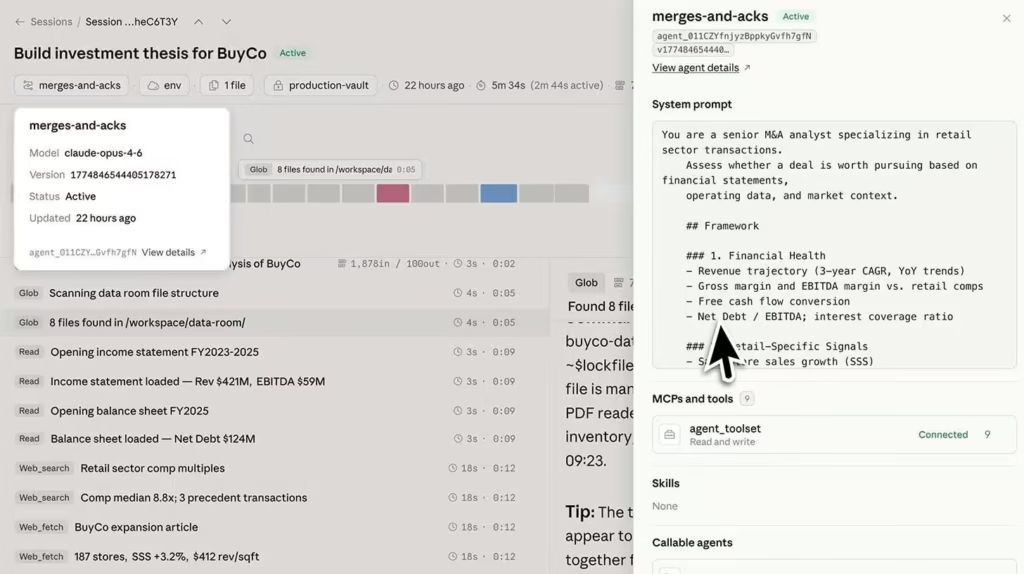
The grueling backend engineering required to build autonomous AI agents is being abstracted away. Anthropic has opened a public beta for Claude Managed Agents, a cloud-hosted infrastructure platform designed to let developers launch live agentic products in a matter of days rather than months.
Here is how Anthropic is eliminating the friction of agent orchestration:
- Managed Infrastructure: Instead of manually building secure environments, developers simply define the task, tools, and guardrails. Anthropic handles the backend execution, securing the sandbox, and managing error recovery.
- Persistent Sessions: Agents can operate autonomously for hours on complex tasks without losing state or dropping context if a connection stutters.
- Multi-Agent Coordination: Currently in preview, a coordination mode allows a primary agent to break down a complex problem and farm out subtasks to specialized secondary agents in parallel.
- The Economics: Instead of massive upfront platform fees, Anthropic charges based on consumption pricing for each agent session at $0.08 per hour on top of standard API usage fees.
- Early Adoption: Major enterprises like Notion, Asana, Sentry, and Rakuten are already using the platform, with Rakuten reportedly deploying specialist agents across five separate departments in just a week each.
Why it matters: Building a quick AI demo is easy; building a secure, long-running agent that doesn’t break production systems is incredibly hard. By handling the complex infrastructure (like secure sandboxing and credential management), Anthropic is dramatically lowering the barrier to entry. Managed Agents turns complex agentic orchestration into a scalable API service, accelerating the transition of enterprise AI from chatbots to autonomous digital workforces.
UrviumAI Take: Infrastructure as a Service is coming to AI agents. If you manage an engineering team, stop wasting weeks of expensive developer time trying to build custom, secure execution environments for your internal AI tools. Leverage platforms like Claude Managed Agents to handle the plumbing. Your engineers should be focused on defining business logic and unique workflows, not reinventing container security for LLMs.
Meta Superintelligence Labs Ships Its First Model 🧠
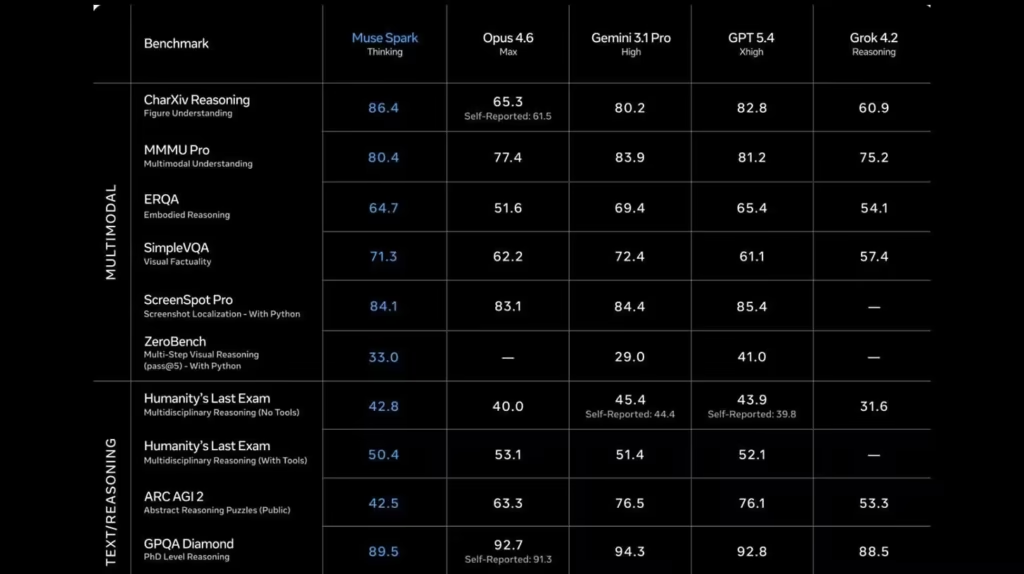
Mark Zuckerberg’s massive multibillion-dollar bet on specialized AI talent is finally bearing fruit. Meta Superintelligence Labs (MSL) has officially debuted its first product: a highly capable, multimodal reasoning model named Muse Spark.
Here are the technical and strategic highlights of Meta’s new frontier contender:
- The Debut: Muse Spark handles voice, text, and image inputs natively. It introduces a unique “contemplating mode” that pits multiple internal agents against each other to solve exceptionally hard problems.
- Performance: The model is competitive with frontier heavyweights like Claude Opus 4.6 and GPT-5.4 on core reasoning benchmarks, though it still lags slightly behind in coding and complex logic tests like ARC-AGI 2.
- Health Specialization: Driven by Meta’s goal of creating a “personal superintelligence,” Muse Spark is particularly strong in health and biological reasoning, trained in collaboration with over 1,000 physicians.
- The Strategy: Led by Alexandr Wang (who took over MSL 9 months ago following Meta’s $14.3B acquisition of Scale AI), the team rebuilt Meta’s AI stack from scratch. Notably, Muse Spark is proprietary, marking a temporary departure from the open-source ethos of the Llama family.
Why it matters: Meta is proving it can hang with the absolute bleeding edge of the AI industry. While Muse Spark might not completely dethrone OpenAI or Anthropic today, it represents a massive leap forward. With billions of daily active users across Instagram, WhatsApp, and Facebook, Meta possesses the ultimate distribution network. If they can seamlessly integrate a reasoning engine like Muse Spark into the daily lives of half the planet, they won’t need to have the absolute best model to win the consumer AI war.
UrviumAI Take: Distribution often beats pure capability. Don’t ignore Meta’s AI ecosystem just because they occasionally trail on a coding benchmark. Muse Spark’s deep integration into Meta’s massive social platforms means your customers will be interacting with this intelligence daily. If you are a digital marketer, content creator, or e-commerce brand, you must optimize your social presence to be “readable” and actionable for Meta’s emerging multimodal agents.
Power Shortages Delay US Data Center Projects 🔌
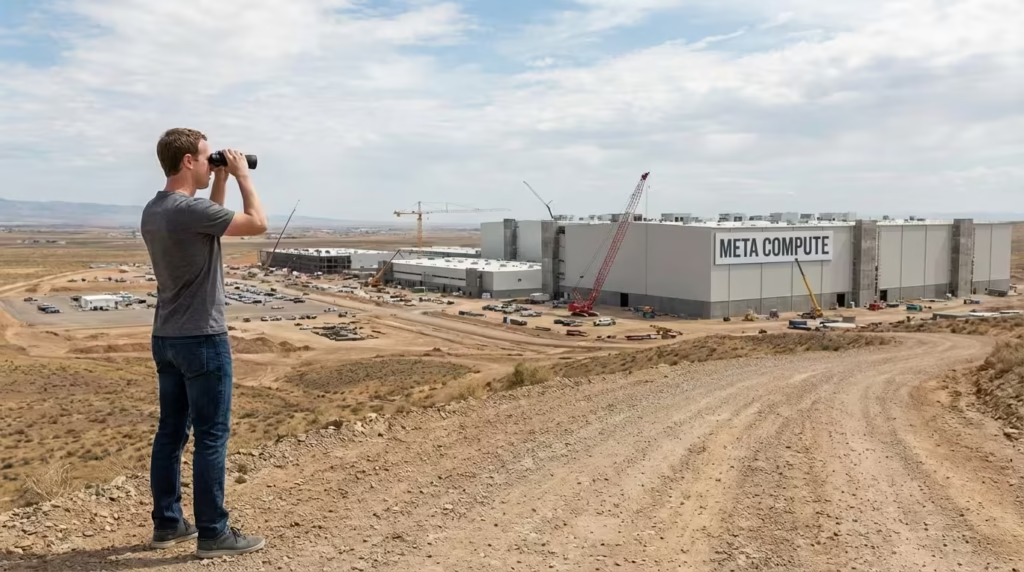
The physical reality of the artificial intelligence boom is colliding with a crippled supply chain. Despite massive capital investments from Big Tech, nearly half of the U.S. data center projects planned for 2026 are facing severe delays or outright cancellations.
Here is what is causing the massive bottleneck in American AI infrastructure:
- The Hardware Crisis: The delay has nothing to do with a lack of funding or advanced GPUs. The bottleneck is a critical, global shortage of the heavy electrical infrastructure required to power the facilities, specifically high-power transformers, switchgear, and backup batteries.
- Stretching Timelines: High-capacity transformers that historically took two to three years to deliver are now facing massive backlogs, with some companies waiting up to five years for fulfillment.
- The Execution Gap: While Big Tech has committed over $650 billion to expand AI capacity this year (projecting 12 gigawatts of new power), analysts estimate that only about one-third of that capacity is actually under active construction.
- Geopolitical Risk: U.S. manufacturers cannot keep up with the overlapping demand from data centers and the EV transition. This forces developers to rely heavily on imports, particularly from China, creating immense geopolitical and supply-chain vulnerabilities.
Why it matters: You can have all the money and AI chips in the world, but if you cannot plug them into the grid, they are useless. The AI arms race is currently constrained by the boring, heavy-industrial reality of the power grid. Until the U.S. radically scales its domestic production of industrial electrical equipment, the deployment of next-generation frontier AI models will be bottlenecked not by silicon, but by steel and copper.
UrviumAI Take: Infrastructure is the ultimate speed limit of innovation. Do not base your long-term enterprise AI strategy entirely on the assumption that massive, cheap cloud compute will be infinitely available. If data center construction continues to stall due to power constraints, cloud computing costs will inevitably surge as Big Tech tries to recoup its investments on limited hardware. Start exploring heavily compressed edge-AI models that can run locally on your own corporate hardware to hedge against future cloud inflation.
Last AI News: Anthropic’s Claude Mythos, AI Anti-Distillation Alliance, & HappyHorse-1.0
Other AI News Today:
- A hacker group claims to have breached China’s National Supercomputing Center, siphoning 10 petabytes of classified research and defense data over several months.
- Jeff Bezos’ secretive AI startup, Project Prometheus, has hired former xAI co-founder Kyle Kosic to lead its large-scale AI infrastructure for physical environments.
- Canva has acquired Simtheory and Ortto, bringing powerful agentic AI workspace tools and full-stack marketing automation natively to its design platform.
- Elon Musk revealed that xAI is currently training seven new models in parallel on its Colossus 2 supercomputer, including massive 6T and 10T parameter systems.
- Researchers invented a fake disease called “bixonimania,” successfully tricking major AI chatbots and academic journals into citing it as a real medical illness.

Jigar Chaudhary is the Editor-in-Chief at UrviumAI, where he oversees coverage of artificial intelligence news, tools, and in-depth studies. With over 5 years of experience analyzing AI and robotics, he focuses on maintaining high editorial standards, accurate reporting, and clear explanations to help readers understand how AI is shaping the future.



Pingback: Perplexity's Bank Agent, Anthropic Loses Appeal & OpenAI's Cyber Tool