
OpenAI Scraps ‘Side Quests’ to Chase Anthropic 🎯

OpenAI is undergoing a massive strategic overhaul to reclaim its grip on the enterprise market. During a recent company-wide meeting, CEO of Applications Fidji Simo delivered a stark message to employees, calling Anthropic’s dominance with business customers a “wake-up call” and signaling a major shift in focus.
Here is the breakdown of OpenAI’s strategic pivot:
- The Code Red: Simo told staff that OpenAI is treating the enterprise gap as a “code red,” emphasizing that the company must prioritize coding tools and business customers over scattered product launches.
- Cutting Distractions: Acknowledging that the company was “distracted by side quests,” leadership is actively reviewing which initiatives to scale back, including hardware, adult modes, and web browsers.
- The Competition: Anthropic’s Claude Code and Cowork releases have rapidly captured enterprise market share, exposing OpenAI’s vulnerability after a year of launching disparate consumer products like Sora and Atlas.
- The Rebound: Despite the internal alarm, OpenAI’s Codex has seen significant recovery, quadrupling its weekly users to over 2 million since January as the company readies new enterprise workflows.
Why it matters: The public may focus on consumer chatbots, but the real trillion-dollar war is being fought over enterprise integration. Simo publicly admitting to the entire company that Anthropic is winning the B2B space proves that OpenAI’s “do everything at once” strategy has failed, forcing a critical return to core developer infrastructure.
UrviumAI Take: Focus beats funding in the enterprise AI space. Stop getting distracted by shiny consumer AI toys like video generators and voice modes. If you are building a business or managing a team, double down on AI coding tools and workflow automation—because that is exactly where the biggest AI labs in the world are shifting all their resources.
OpenAI Launches GPT-5.4 Mini and Nano ⚡
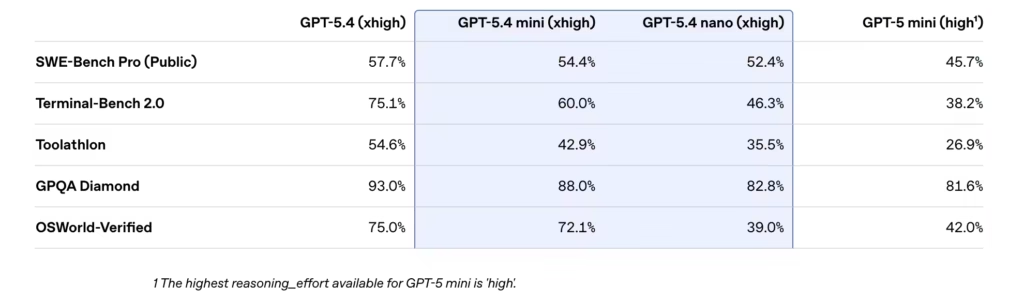
The trend in artificial intelligence is rapidly moving toward smaller, faster, and cheaper execution. OpenAI has officially launched GPT-5.4 mini and nano, two compact versions of its flagship model designed specifically for high-volume workloads and multi-agent systems.
Here is what these new lightweight models bring to the table:
- GPT-5.4 Mini: A massive upgrade over GPT-5 mini, this model runs more than 2x faster while approaching the performance of the full GPT-5.4 model in coding, reasoning, and multimodal understanding.
- GPT-5.4 Nano: The smallest and cheapest model in the lineup, specifically built for ultra-low latency tasks like data extraction, classification, and ranking.
- Subagent Optimization: Both models are engineered for “subagent” workflows, where a larger model handles high-level planning while delegating hundreds of smaller, repetitive tasks to the mini or nano models in the background.
- Computer Use: GPT-5.4 mini excels at quickly interpreting screenshots of dense user interfaces, making it ideal for software-interaction loops and real-time coding assistants.
Why it matters: Massive frontier models are incredible at reasoning, but their latency and cost kill real-time product experiences. By releasing highly capable, dirt-cheap small models, OpenAI is giving developers the infrastructure to build background AI agents that can execute thousands of micro-tasks a minute without bankrupting the company.
UrviumAI Take: The future of AI isn’t one giant brain; it’s a swarm of tiny workers. Stop trying to force a massive, expensive model to do every single task in your business. Architect your systems so that a smart model acts as the “manager,” while delegating high-volume data sorting and simple coding edits to ultra-cheap models like GPT-5.4 nano to reduce your API costs drastically.
Mistral Opens Its Model-Training Playbook with Forge 🛠️
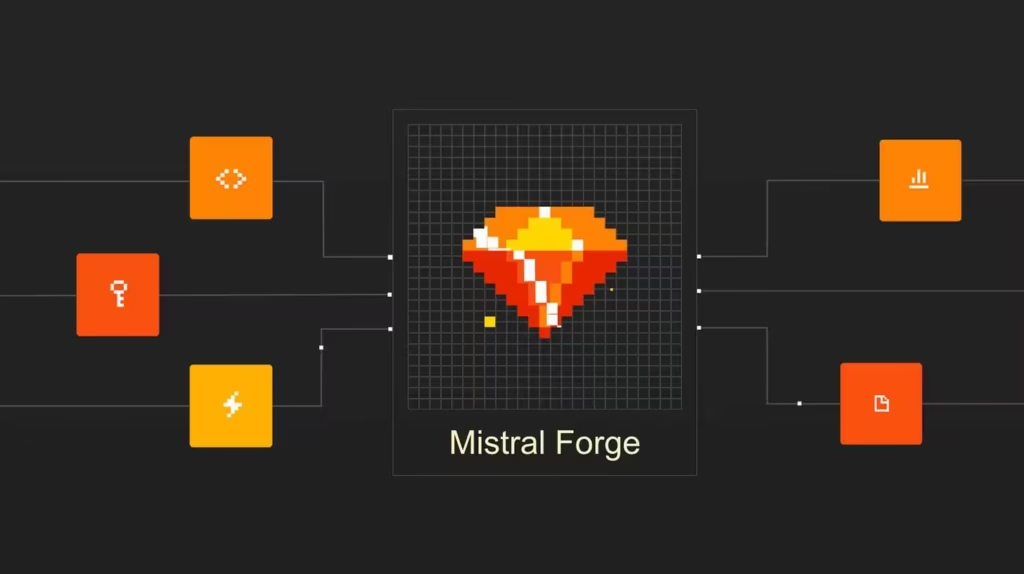
European AI champion Mistral is taking a radically different approach to enterprise artificial intelligence. The French lab has officially launched Forge, a comprehensive platform that hands enterprises the exact same training recipes and infrastructure Mistral uses internally to build its frontier models.
Here is how Forge is changing enterprise AI adoption:
- Beyond Fine-Tuning: Rather than just tweaking a generic model, Forge offers full pre-training, post-training, and reinforcement learning pipelines so companies can build AI from scratch using their own data.
- Zero Data Exposure: Training can run entirely on a company’s own secure servers or virtual private clouds, ensuring proprietary data is never exposed to Mistral—a hard requirement for defense and finance buyers.
- Synthetic Data: The platform includes complete tooling for synthetic data generation, allowing highly regulated industries to train models safely without risking customer privacy.
- Early Adopters: Major global players like ASML, Ericsson, and the European Space Agency are already using Forge to migrate legacy code and optimize internal workflows.
Why it matters: Most enterprise AI relies on prompting generic models with external data (RAG). Mistral is betting that the most valuable companies in the world—those sitting on decades of proprietary code, compliance rules, and institutional knowledge—need models that natively understand their business, not just models that read about it in a prompt.
UrviumAI Take: True enterprise AI is customized, not rented. If you operate in a highly regulated industry like healthcare, finance, or defense, generic API models are a massive security liability. You need to look into platforms like Mistral Forge that allow you to natively train smaller, highly intelligent models entirely within your own secure, air-gapped infrastructure.
Last AI News: Nvidia’s GTC Agent Push, Manus Desktop App & AI Band Goes Live
Other AI News Today:
- Anthropic launched Dispatch, a new feature allowing users to message their Claude Desktop assistant from their phone to run PC tasks autonomously.
- Microsoft has overhauled its AI org chart, merging Copilot teams and shifting Mustafa Suleyman’s focus entirely toward building in-house superintelligence.
- Sam Altman’s World launched AgentKit, a developer tool that uses World ID to verify that a real human is behind an AI shopping agent’s actions.
- Mistral launched Small 4, an open-source model that unifies its reasoning, coding, and multimodal capabilities into a single, highly efficient system.
- Google announced that its Personal Intelligence feature is now rolling out to free-tier users across AI Mode in Search, the Gemini app, and Chrome in the U.S.

Jigar Chaudhary is the Editor-in-Chief at UrviumAI, where he oversees coverage of artificial intelligence news, tools, and in-depth studies. With over 5 years of experience analyzing AI and robotics, he focuses on maintaining high editorial standards, accurate reporting, and clear explanations to help readers understand how AI is shaping the future.

Pingback: Google Vibe Design, Microsoft's OAI Lawsuit Threat & DoD vs. Anthropic